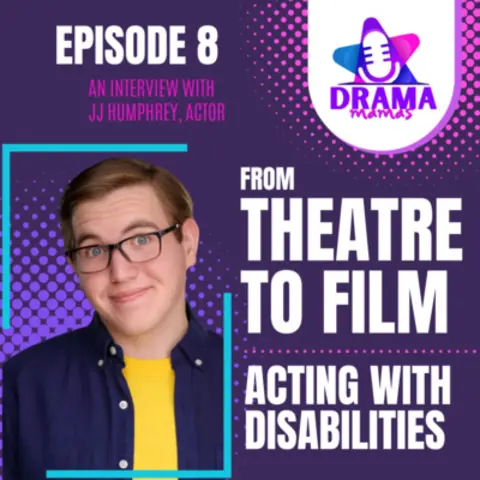
Acting with Disabilities
JJ Humphrey talks about working in theatre and television as an autistic actor. He also brings his experience speaking publicly about disability and the barriers performers encounter.
Audio could not load. Try Play again.
JJ Humphrey
Actor and disability-awareness speaker (when we recorded).
This transcript was made automatically and may contain mistakes; the audio is the record of the conversation.
Read the full transcript
I mean, he's right. Chitchatting. Yeah, yeah, yeah. It's like friend sitting around talking. Yeah. Okay, good. So we're good. We, you talk about our week first. Mm-hmm. , sorry. Recording. Yeah, it should be, should be good. We recording already? I feel like that Well mean that'll be in the podcast is it's recording.
I've been listening to the Out for Blood podcast about the making of Carry the Musical because I like to do research before I see things. Oh, nice, nice. Those are so nice. And they do the same thing we do . Oh, look at s Spoiling my gifts. I know. Yeah, you each, but they like kind chatter first before they start the episode.
I'm like, oh, they're just like us. Or actually we're probably like them, but it's very interesting. We can say they're just like us, . We're the og, we're the og. We're, we're, you know, five or four published episodes in two in the Can. So this is seven. We're we're professionals here. Og, anything. , og Noobs. Hey, well listen, we are seven episodes ahead of where we were.
That's true. Like every time we do this, learn just a little bit more. Yes, definitely. Yeah. Which is nice. Yeah, it is. Good stuff. Did you guys have a good week? What did we do this week? Yes. We went and saw Carrie last night. Yeah, we did at Florida Southern College. And it was really, really fun. I'm a huge Stephen King fan.
I grew. reading all of his books. I've read everything he's ever written. And to the point of when I would go to the library, we had a library about six blocks away from our house. So on the weekends I would go to the library mm-hmm. and I'd come home with a stack of books. And I had Nancy Drew and Beauty, uh, black Beauty on the top,
And then hiding underneath Nice was all my Stephen King books, cuz my mom did not want me reading those . And I'd sit all weekend and read them. And so I was really excited to go see that. And it was a lot of fun. Nice. Yeah. Yeah. Yeah. They thought, oh man, they were great. The, um, actress that played Margaret, I think that's the mom's name.
Mm-hmm. , right? Oh my gosh, that was goodness. The second she started singing, I was like, oh, oh, okay. I got this. I mean, just the sheer amount of talent in this area is always good, but then when you go to the colleges and you're seeing kids that aren't from here, that are here for school and what they're bringing into the area too is just Wow.
Yes. They really knock your socks off. Yes. Yeah, they do. I did get home though, and I was like, something didn't feel right to me. And then I realized it has been so long since I've been to a local. production where, I don't know, people in the cast. Ah, right. Where you're like, oh, I feel connected to them because I know their background.
I've seen them in other things, and that it took me a while to figure out what it was. I'm like, it's because I didn't know anybody. So that I noticed that made a difference. Yeah. I was definitely like scouring. Yeah. The play bill ahead of time, like doing any of these people. Yeah. Mm-hmm. . Yeah. The girl that played Sue Snell, she was amazing.
She's only a freshman. Oh, wow. Okay. Well, she's got a big career ahead of her there. Anyway, I can't wait to see her on, see Lots of weekends left to see Carrie at Florida Southern College. Yeah, absolutely. Yeah. I thought it was only one, but then I went and got our tickets and I was like, oh, nope. There's more.
It's in December. Mm-hmm. . Yep. Yeah. All right. Well, welcome to Drama Mamas. I'm Angela. Yeah. I'm Kristen. I'm Kathy. And I'm jj. Yay. . Welcome, jj. Welcome jj. We've known JJ for a while and JJ reached out to us because he has. So much beyond just community theater and has a lot to help us understand and can help parents know how to navigate moving from community to professional.
And so we are really excited to have you here. Yeah, I'm happy to be here. Thank you. You're welcome. Yeah. So you started out at L C T? Yes, I did. I originally started out with out of the Box, which for those of you who don't know, is a all inclusive special needs theater trou. And uh, I started off there as someone who needed to, I needed assistance and then now I'm someone who's giving assistance.
I'm one of the TKs there, which stands for Theater Kid. And, uh, we help the out of the boxers hit their mark, get to where they need to be. And uh, that was me about a decade ago. I was the one being helped up and down the stairs and, uh, that stuff. And, uh, it's nice to give back and, you know, it's. Nice to see that this is where I was and here's where I am now.
I can relate to all of these people because I was like that at some point in time, needing that assistance. And so you're 18 now, correct? Yes, I am. So you were like pretty young when you were there? Yes, I was eight years old then. Yeah. Oh, is the baby in the program? Yeah. . So were you pretty young at that point for the group?
I know that was a lot smaller. Um, I think so. I feel like I, I might've been the youngest. Mm-hmm. , but I'm not sure. Right. It, it was a lot ago. . Yeah. For your lifespan. It was a long time now. It was, it was a lot smaller in the beginning when it started out. Oh yeah. We only had like, uh, between 12 to 20 people.
In the beginning it was a really small group, but over the years it just kept growing and growing and growing because, you know, we got the word out about it. And, you know, the community that it's, uh, a part of is, we are a huge community. and uh, you know, acting is a great way to express yourself, especially for, uh, individuals with disabilities.
Yeah, yeah, it definitely is. I love what that program brings to the community and I love the shows that they put on because they are just so special. Mm-hmm. , uh, my favorite that I've seen and been a part of was, um, I wanna Go to Mars. That was, I just loved that production so much. That was our first being part of that was, yeah, that was our first, first one, which was probably why I feel so like, attached to it, you know?
Mm-hmm. . Yeah. But yeah. Yeah, and they're, Christmas shows are so great and it's just a great way to kick off the season and everybody comes together as a community and, you know, it's just a great, lovely, they just have theirs this past. , how was that? It was awesome. Yes. It was so much fun. Yeah. There's so much joy.
Oh yeah. With all of them. They just love what they're doing and it, you just can't help but feel super happy when you're in there. And they're double cast this show. Oh yeah. Mm-hmm. , how, how many PE people were in the program this time? Over a hundred. Oh yes. Definitely over a hundred. And it, it's nice to see that everyone got equal opportunity instead of just having one cast with all the roles and then, you know, a bunch of different extras in it or ensemble parts in it.
And it was nice to see an even, uh, distribution of the parts. Yeah, it was. So when did you make the transition from out of the box to like the Theater for Youth program? Um, not too long after. I took some drama classes after out at the box. And my first, uh, theater for youth program was Arista Kat's Kids.
And I was in the dog brigade . And that, that was a lot of fun. That sounds fun. . That was awesome. Everybody has to be in those little clumps of animals at some point in their career. You start off as animals and trees and you slowly get into the humans after. Although you were a snowman at one point. Yes.
Uh, Ola one of my top two favorite characters I've played. Yes. That's a great character. That was so much. You were fantastic. Oh, thank you. Phenomenal goodness. I know. Totally brought that character to life. Ola is a character I, I have loved since like Frozen released, and so being able to play him was a, a really good thing for me because I can relate to that character on so many different levels and I've just loved him ever since I was little.
He's amazing. That was such a fun role. That was a double cast one as well. Yes. That was right after, uh, COVID wasn't the first one when we came back after Covid. I think so. Yeah. Which was like so exciting for everyone. Oh yeah. Yeah. So now you are, do you still do community theater or have you moved pretty strictly to I still do community theater on occasion, not, um, as often as I used to.
Um, I'm focusing more on the film and television side of things and professional theater. Okay. So why don't you explain to us how that transition happened for you? Well, it started off, uh, my friends were doing professional theater and I was like, you know what, I'll give it a try and see how it works. And, uh, I had a little bit of, actually, I had a decent amount of training for professional theater and professional theater auditions cuz they are slightly different.
Mm-hmm. , but they're similar. And the first thing I auditioned for was, uh, gypsy at the Garden Theater. That was professional theater. But while I was there auditioning for that, They went up to me and said, Hey, we have this show called Christmas Story. I see you're not auditioning for it. Maybe you should go audition for it if you're available.
And so they went to my mom, who's over there, your momager. Momager. Yes. We love that. Love that, love that term. Yes. . And so they went to her and, uh, she saw that my schedule was clear and um, ended up auditioning for that as well. And what I had to do was I had to sing a song and I had to do a comedic monologue.
And then later on I got an email about a callback for it. And I went to the callback. And as far as I remember, I was the only person reading for Scott Farcus at that time. Wow. Or at least when I was there. And I ended up booking it. And it, it was a lot of fun. It was a great role. And it was a character role.
Like it was very character heavy and. I made him a bit funnier than maybe what he was supposed to be at . You know, he's, that's a character choice. Yeah. He's comedic relief. Mm-hmm. , I feel like he's comedic and, um, it was a lot of fun. It was a great project, great cast. And one of the main differences between community theater and, um, professional theater during the rehearsal process.
The first readthrough usually that for community theater, that's when you get your script the first time is during the readthrough. Okay. For professional theater, it's a little bit different. They either email it to you or you can go pick it up at a, at the theater, depending on, you know, if they paid for like book hard cover copies of the script or if they have a printed version, but you get in advance and so that way you are as close to as memorized to the first read through.
And that's one of the things that, uh, the Garden Theater did. And they're like, Hey, if you can be as close to memorize, we'll start blocking things right away. Wow. If we read through it quickly enough. Yeah. And we feel like we had at least two hours of rehearsal left when we finished the read through. And I think we blocked the first three scenes of the show.
Show. Oh my gosh. That's quick. That is really fast. That is quick. Oh, yeah, yeah. Now, was the audition process different from commun community to professional? It was a little different. Um, oh, apologies. . No problem. That's, that happens real life.
We're all human around here. Yeah. Okay. Sorry about that. No problem. . Totally fine. Um, where was I? rare. No. Audition process. Audition process. Yes. So in the past, before Covid Community Theaters didn't have the, Audition time slot thing. Yes. Uh, that's something I'm noticing now that they're doing more since Covid happened, which is wonderful.
Yes, it's, I love that. Really good. And, uh, that was a difference in the past. Professional theater mainly did that with audition times and slots and that was one of the differences. Another thing is, um, excuse me, another difference is that I, it's a bit more intimate and sometimes they have, they ask you a bit more questions.
They try and get you to know you better. It's a bit more personal. I, I think, and I, but I also think it depends on who's directing and who's there and that type of thing. Okay. Okay. Makes sense. Yeah, it does make sense. It's nice cuz you probably get to know them a little bit while they're asking questions, feel a little more comfortable.
In those time slots, do they kind of keep it character driven in the time slot or is it more just, here's your slot, you show up, doesn't matter what you're going for. Um, it's more, it's your slot. You show up and then you. Have your audition pieces ready and um, they're very specific with what they want.
They'll tell you if they want a comedic or dramatic monologue or if they want a upbeat song or a song that's a bit more, um, I guess down to earth or something like that. And they're very specific with what they want. So typically they ask for a monologue. Typically they'll ask for a monologue. Yeah. Um, if it's
imagine . Um, if it is a musical and it's just a musical, I think most times they'll have you just do a song and I feel like during the callback they'll have you do a scene, which they usually have you do that anyway during the callback. But I feel like it's a mixture and it depends where you're auditioning.
Cuz I know the Orlando rep. Usually has you sing and then do a monologue and then for the callback you dance Then for the musical, instead of like community theater, you dance. Dance. Okay. Yeah. Right. Got it. And no monologue and not of the time. Yeah. Most of the time. Yeah. Yeah. Right. Have you had a lot of dance and voice training?
Uh, I've had a lot of voice training. Not as much dance training. I haven't danced in Whew, quite a while. ? , um, probably since the pandemic. Okay. Um, um, but I take voice lessons with, uh, Patrick Flights. Oh yeah. He's wonderful. Yeah. And in the past it used to take with Ms. Frieda mm-hmm. and, uh, because of Ms.
Frieda, we actually found out I could sing cuz we, we had no clue. I had a singing ability before out of the box and she was the, uh, vocal, um, Music director for out of the box. And uh, she brought it to my mom's attention that I can sing and that I should take voice lessons. And so I did. And then at some point in time she moved outta state and then I started taking with Pat, who was Ms.
Frida's teacher. I didn't realize that. And um, I'm still with him today and we do Zoom lessons. Oh, perfect. Yeah. That's so nice that you can do the Zoom lesson. We were saying that I think it was last week, how that's opened up a whole new world for, it really has. Oh yeah. Lessons made it so much easier and accessible for people, especially for auditions and callbacks.
Cuz I've had I think two or three callbacks now with, uh, it being on Zoom or on the computer or virtual. And it is slightly different cuz you have to be more conscious of here's the framing of my computer or phone or whatever you're using for the Zoom. Uh, I, I recommend a computer cuz you can. see yourself a bit better.
Plus you can see them better versus when it's on the phone, it's really small. That makes sense. Yeah. It's hard to see and I feel like the audio's a bit better on a computer, or at least that's my opinion. Um, but it, you definitely have to be more conscious of your framing and you can't be as big as you would be.
I mean, you're on the stage, but you still have to show that, you know, you have that theater presence, you have that strong stage presence. Yeah, that makes perfect sense. That's intimidating though. I can imagine just being in that little computer screen to do it, show your stuff. It's a little, little nerveracking.
You have to make something, uh, you wanna do something bigger and it's like, ah, I can't do it that way. You have to do it a little bit smaller and it's like, ah, rake me out of the shell. . . Yeah. You gotta really show what you can do in that little tiny Oh yeah. Box. It's kind of like, I'm always amazed that they can.
make decisions based on 16 or 32 bars of a song. Like within that little tiny bit of music, they're able to kind of pick out what they're looking for. I'm that always, I'm very amazed by that because I have zero musical ability and . Well, that's not just about the singing, it's also about the acting. Yes.
As well. You, when you audition and you have a song, you have to put character behind it because that's one of the things they're looking for. They're looking for you to be comfortable with them and they're looking for you to have a character behind your song and to know what you're singing. Because if you're just singing the words and even if you sound great, you know, that's not as good as sounding great and having a character behind it.
Right. Do you do a lot of research behind roles you're going for to kind of understand where that character's coming from? Yes, I do. Um, it depends on how much is known about the character. Cuz with some auditions, it's a brand new character that was created, but that's more so for film and television. . Um, but with musical theater and, uh, theater in general, you can usually find out a lot about the character.
Like, uh, precarious incident I was in, there's a book. So I read the book that it was based off of, and I have this special thing I do that helps me develop a character. And it's basically ways it can relate, ways I can't relate. And then, you know, what of our, like, what our differences are. And then I kind of think about what is his thought process, because everybody has a different thought process and each character will think differently, have different opinions, have different love languages, and that type of thing.
And all that can come into play while developing a character. Oh wait, so slow down. Cause it sounds really cool. Yeah. So are you like writing this down or is this something you're just kind of in your head? Okay. So yeah, write it, explain it more. This is fascinating. Write. Yeah. Yeah. It really is. Mm-hmm. , I write it down to help me remember it.
Um, but you know, while you're there, you can't have a piece of paper and look at it. And so I write it down to help me memorize it and get familiar with it. So that way it's in my body like I know. And so then I kind of have to put a part of that to memory. And with the way I am I, with my disabilities, I have the ability to think in pictures.
Most people think in like, I don't know how to explain it, but I guess words in instead of having pictures and words. So I feel like that visual, that, uh, visualization. Mm-hmm. tough one. I know have my visual line in. So words are like, ah, , it's okay. . And, uh, having that where you can see it, see the scene playing out in your head, see what the character is thinking and know what the character is thinking for me is really helpful.
And having those small things of figuring out why the character is saying what they're saying. And oftentimes, uh, this is a tip for memorization of lines. If you're having trouble with the line. . Usually it's because you don't understand why the character is saying it. Because if you don't understand it, you're not gonna say it doesn't make any sense.
Why should I say it? Mm-hmm. . So you have to understand why the character is saying it, and it may be something that you would never think of, but this is the way your character thinks. So. Mm-hmm. , this justifies it through this way. So your checklist is, I wanna make sure I remember this because this is awesome.
How am I like the character? How am I different from the character? Yes. Mm-hmm. . And what was the next part? You said something else? Um, a little bit about love languages, which is more of like, like body posture and that type of stuff. And like if they're okay with being touched, if they're not okay with being touched.
Right. That type of thing. Okay. And like opinions, I think you had mentioned Yes. Opinions. Mm-hmm. . And that comes into play because it, you're playing an entirely different person and an entirely different human being with different thoughts. And so you have to try and think. How would this character think differently from me in this situation?
How has their life experiences changed them? And with some characters you have to make up your own, their own life experiences with the character based off of what you have in the script. Now isn't that isn't necessarily necessary. That's just something I do for myself. And if you wanna do it, that's great.
Um, but whatever works for you and that's what works for me. Do you find that it's easier the more you practice it with each different character? Um, I feel like with that in particular way of doing it, it is helpful to do it more times cuz then you're like, okay, I know what I'm doing. Know it need, I know it questions I need to ask.
And I've had multiple different teachers teach me different things and I've kind of incorporated it into one. , uh, like what works for you? Yes. Methodology. All right, excellent. So you mentioned Curious Incident. Tell us more about that. Cause that was fantastic and how that all happened. Yeah. Oh, okay. So it's gonna start off with a story about the Family Cafe and if you don't know, the Family Cafe is America's largest cross disability conference and I'm a member of the Florida Youth Council, which is a youth advocacy group.
And we host panels there at the Family Cafe. And we also do like, we do the showroom and that stuff, hall monitoring, cuz we're also volunteering there at the same time as we're demonstrating. And, um, during that, the keynote speaker was Mickey Rowe. He is the first autistic actor to play Christopher Boone in the Curious Incident of the dog in the nighttime.
And my youth advisor at the time introduced me to him and we started talking to each other. We exchanged Instagrams and that type of stuff and we stayed in contact with each other over time. And at some point in time, the Tampa rep reached out to him and said, Hey, would you know anybody that would be interested in auditioning for Christopher?
Um, we have auditions coming up. And he thought of me. And so he said, Hey, jj, you know, there's this kid I, I met him. He's great actor. You should really consider him for an audition. And so they sent me an audition, but I hadn't, I did not know they did, cuz it went to my spam folder. Oh no. Oh no. So I only found out after Dread spam.
Yeah. I only found out after Mickey wrote, texted me on Instagram and I was like, Hey, have you checked your emails recently? And I'm like, yeah, no. And like, have you seen an audition for a curious incident? I'm like, no, I haven't. Oh gosh. , it was like, check your spam. And so I checked my spam and there it was.
Oh no. And um, of course I accepted it because Christopher is one of my dream roles. I, I had an audition for it a long time ago. And I didn't get it at that time. And, um, it was a character that I got emotionally attached to and I think he still is, I still am emotionally attached to that character. And, uh, you know, it is the dream role of mine.
And so of course I accepted the audition, but since I didn't have a lot of time to prepare, I only had two days to prepare two different monologues. Oh god. Goodness. And the monologues I had at the time were extremely outdated, like they were for when I was way younger. And so I was like, okay, I gotta find two different contrasting monologues.
Oh, goodness. Gosh. And, um, oh, thanks. Two days, Jeremy Henry Dixon. Um, my mom reached out to him and said, Hey, do you have any monologues? We need two contrasting monologues. And he sent us an entire list of monologues while he was at a callback himself. Oh, wow. . Oh my gosh. Wow. That's great. Yeah. And uh, then.
And I was on the internet scouring for some and we found two really good monologues. Um, I believe the one is called Equis and the other one is called Treat Me Different. And both were along the lines of the show cuz I tried to get something similar to the show, but also not exactly like it. Mm-hmm. . So there were certain things that each character did in the monologue that was similar to Christopher, but not exactly the same.
Okay. So I had two days to memorize it and prepare it, and I had a coaching session with Angela Angel, who was actually my first, um, acting coach, uh, that I ever had. And, uh, she had these great classes and she had master classes as well. And it was masterclass about different things, how to master the art of auditioning, uh, dance auditioning, cold reading, all that type of stuff.
Mm-hmm. . And she had, uh, like, uh, guest, uh, teachers come in and. Like from Orlando Shakes and that type of stuff. So it was really, it was really cool to be there. And I, I was actually the youngest in that class at the time, other than my friend who is three years older than me. He popped in on occasion. Okay.
Um, but kind of got off track. We do it all the, that's what this is all about. Yeah. Yeah. Leave it where it takes you. Take your go. No, that didn't sound good. . Go where it leads you. Yeah, that's what I was, right. Better, better. My microphone keeps like d drifting down place. This little sad movement trying to keep my face over here.
I mean, you can try. I tried to cinch it down, but, so you had two days to prepare two Monolog. Yes. I had two days and so thanks to Angela I had coaching and that gave me a huge boost of. And, uh, the day came for the audition and in the car I was going over 'em a lot cuz I'm like, okay, gotta make sure I get the words right and everything like that.
So how long are these monologues? Um, I believe they needed to be, I think I had either two minutes or minute to do the monologues. Okay. And it was for both of the monologues all and I think I kept it, I think each one was around under maybe 30 seconds. I'm not exactly. Oh, that's quick. Yeah. It's still stuff to remember.
Right, right. Yeah, because they'll, um, in the email it said you have this much time to do two monologues and I don't remember the exact time. Yeah. So I'm just gonna say it was two minutes. And so maybe I had, each monologue was a minute long or one was 30 seconds long, one was a minute long, you know, that type of thing.
Yeah. So that way I stayed in the two minute timeframe that they asked for. . But during the audition I got there and I did a thing which is called Dressing the Essence, and I dressed the essence of the character. And Christopher, he often wears a hoodie and a t-shirt and jeans. So that's what I wore. So I wore something similar to the character, but not like exactly how the character would.
Okay. That's an interesting point. Cause I've always wondered that. So you're saying it's okay to kind of not go full on like I'm this person, but to kind of get the feeling of the character and what they would be like. I always wonder if that was zone maybe, right? Oh yeah. I personally think it, it is helpful for the actor and also helpful for casting to see that, oh, this is how they would look kind of in like the costume.
That's helpful. It gives them a little bit of an idea and. . It also says, you know, like I, I know the character a little bit, I feel like, but you don't want to go too far out, like say it's um, Shrek and you paint your face green, you have the ear, you're wearing little all sound with a prosthetic nose . Yeah.
Like ola, right nose? No, just a little bit too much. Yeah. But all white totally on the table. . Yeah. Wearing the white t-shirt and jeans. Yeah. Yeah. For all. That'd be fine. And so that happened, and then I went into the audition room. They called me in. I had my two different monologues. I did 'em both. Um, and then I finished.
And you know, usually you're finish and like, okay, thank you. And you know, but they had me do the second monologue again, three different ways. Oh, okay. Interesting. Okay. Yeah. And so they wanted to see if I could change on the fly. Wow. With the way I had the character and the way I said lines. And so, , they had me do it three different ways.
One of the ways was like you're in a library. One of the ways it's like you wanna keep this a secret and the other way is you're telling your best friend and you're being very sincere. And, you know, they had me do it those three different ways. Mm-hmm. . And they're like, wow, that was great. Thank you. And, um, we hope to be hearing back from you soon.
And then I got a call back for that and it was on Zoom and I think that was my very first Zoom callback. And they had me prepare three different, um, scenes. I think one of them was a monologue and two of them were just regular scenes. And since the play is taken place in, um, London, uh, I had to learn a British accent.
Oh wow. And I haven't done a Bri at that time, I haven't done a British accent since Peter Pan, which was years ago. And so my friend Mickey Roe, I contacted him and said, Hey, , could you give me some advice with, you know, the accent? And he was like, yeah, sure. Hey, would you like to do a FaceTime? So we ended up doing a FaceTime and he was like, when I was on tour, this is how they taught us to do it.
And so I had that advice from him and a little bit of training beforehand. So that way I had the accent during the callback and the callback happened and I did the scene. Now they had me do the scenes a different way a few times. And uh, they gave me a little bit of directions during the callback because it was just me and them.
So it was a bit more personal since it was on Zoom. And then when I did the scenes, they asked me some questions and I gave them some really out there answers. And they liked it. They were impressed with it. And they're like, so how do you take directions if I tell you to raise your right hand? What does that mean to you?
And so I went into this like my own little monologue of what raising your right hand could mean . And I went into like extreme detail of, you know, what emotion it could mean. And they're like that. That's not exactly what we asked, but that was a great answer. , nice because they, they just wanted to know, do you want to be told to do something or do you want to, you know, feel free.
And I went into this like development of the character type of thing, which they really like that answer. Um, and that was actually the first time and the only time during a callback that they said, Hey, this isn't an official offer, but we are offering you the role of Christopher Boone, the Curious incident.
And it was during the day of the. That's Wow. Wow. Like right there, right there during the zoom and it was right there. And were you like, what? And it was like, wow. Did you raise your right hand? Were you like, I was like, yes. , please. Yes, please. And of course I accepted it right away. I was like, yes, yes. And I was really excited.
Um, and Christopher was, being in that show was a huge and great experience for me, cuz it was my first time being like the lead, lead in a professional show. And Christopher never left the stage. He was on there the entire time. There was only one time in the entire show where he left the stage and in the script it said Christopher leaves the stage for the first time.
Wow. So, and also with quick changes for that, They happened on the stage. Oh my gosh. Tell us about one of those. Okay. The most difficult one you had to do. So there's a scene where Christopher reads a letter and finds out, spoiler alert, his mom is still alive. Oh wow. And isn't dead. And cuz he was told his mom was dead.
And that makes him like very stressed, very panicked. He's like, why did my mom leave? Why did this happen? This happened in the and all that. And he gets so overwhelmed and so panicked that he ends up throwing up and he throws up on himself, it curls up in the ball. The dad finds him in the middle of the floor with this letter from his mom and he is like, oh crap.
My lie that I've been telling has been found out. This is not good. And so since he has yuck all over him, Uh, his dad ends up changing the shirt because he can't move. He's so petrified, so startled that Yeah, he's like paralyzed. There's no reaction. He's like paralyzed. Yeah. In shock. Yeah, he's in shock and there's no reaction from him.
And so the dad ends up changing him, but because of that, it happened on the stage. So we had a thing where I would be turning my back to the audience, which that was really the only time where, you know, it was okay and turn your back to the audience. Cause you never want to do that normally. But for a quick change, which wasn't really quick because it was emotional and it was slow and emotional.
It was like, you know, I'm there for you son. And, um, but that was one of, I think that was really the only quick change that I had on the stage. Otherwise it was just like changing a jacket or something like that. But that was the only time like when my shirt came off or anything like that. Gotcha. Got it.
That sounds like an amazing experience. Yeah, it was. Especially with all the lift. And, uh, the stunts we did. Oh, really? Oh, yeah. When the play takes place in Christopher's mind. And so to him, things to us that would seem small to him are big, like going to a bus station or going to a train station and having all this sound and people is extremely overwhelming for him.
And to show that they had little jumps and lifts and that type of stuff. And so there was an entire rehearsal dedicated to lifts and training and, you know, learning to trust each other. And, uh, a lot of it was also on viewpoints as well. And the viewpoints helped with the lifts and make it look like Christopher was actually falling or Christopher was actually getting thrown across the stage.
And, um, during the training process for that, , uh, you know, I had to put all my trust in them because they were lifting me like three or four feet off the ground. Oh. And wow. It was, at first it was scary, but, you know, you did it again and again and again and, you know, you got more confident and you got a rhythm going.
And, and we had, uh, I think it was a fight choreographer and, uh, he, you know, had us do it slowly. Like, do it 30%, 50%. All right. Now do it a hundred percent. And so we warmed up before every show and we practiced each individual stunt that we did and lift and, uh, it was a lot of fun. We did almost every one they did in the show, except for walking on the walls.
Okay. Which, um, we didn't end up doing. I forget the reasoning why, but. , basically that would be where someone is holding onto my shoulder here. Mm-hmm. and holding onto my waist here and I'm walking on the walls. If we did that, that's what it would've been. I saw like, okay, cool. So I stage managed the stage read at L C T for, uh, curious Incident.
And, uh, it was a, it was like a stage read plus, right. A little extra. And so they did a little bit of that, but in order to kind of be prepared for it, um, I didn't have enough time to kind of dive in and read the book. I read the script and then I watched. Um, like a, a recording that I had found online and I saw that and I was like, oh, wow, this is really cool.
And then when the director decided to try and incorporate some of that into the stage read, I was really excited for it. Yeah. Um, because I, I was like, oh, okay, cool. So we're gonna like do this, you know? Yeah. We had the sound effects and we had, you know, the lighting that helps you kind of get the feeling of what it means to be in his head and Yeah.
Be overwhelmed by all of the sensations in a train station, for example, or, yeah. And, but when I saw the recording of that, I was like, oh gosh, I really wanna see this live. Like Yeah. Not a stage read, you know? Yeah. When was the play? When did you guys do this? Uh, we did this a year ago now, which is, that's hard to believe it was a year ago.
It, and, uh, it was during this timeframe of November, December, I believe is when we had it and, um, at the Tampa rep. At the Tampa rep, yes. Okay. But we performed. , uh, with On Stage Works theater, but we also had another theater company working with us called Think Tank. And we had like a little partnership going on where half the cast from Curious Incident was also in the Giver.
Oh, nice. And nice. So we shared a cast and we also shared a runtime. So instead of it all being Curious Incident, it was Carrie's incident, the Giver Carrie's incident, the Giver and so on. Oh, that's cool. And we, that's super cool. And I got to see The Giver and it was a great show. I really enjoyed it. Hmm.
And it was nice to see, you know, my castmates also in that show and like, oh, so this is what they've been doing. While, you know, we haven't had rehearsal for this show, they were working on this. Yeah. Now some members in the cast weren't in that show. I was not in the Giver. Um, but most of the cast kind of shared each other.
That's a really neat concept. I've never heard that before. We've never been to the Tampa. Have you ever been there? No. No. We're gonna have to spread our wings. Yeah, they, they have a show today at three 3:00 PM At three. What are they doing? A Doll's House, part two. Okay. Wow. Um, the show is about, uh, a woman who is searching for her independence and finds it through, uh, her own way.
I, I, without spoiling the show, cause anyone has part of the show, right? Yeah. Right. No, I gotcha. Are you able to go see a lot of shows or you're, sounds like you're pretty busy doing your own shows. Um, usually I'm pretty busy, but I did get to see a Doll's House and it was great. I enjoyed it. And, um, my director for a Curious in Incident is actually leading in it.
She's playing Laura. Oh, that's nice. Yeah. That's super cool. Yeah. So it was great to see her acting. Yeah. Yeah. What was the rehearsal process for Curious incident? Was that um, like an everyday thing or was it more sporadic like at a community theater rehearsal we had How intense is that? I believe we had, um, rehearsals almost every day, except for the times when the other half of the cast was working on the Giver.
Okay. Um, but, you know, they had a lot more rehearsals per that mm-hmm. and, uh, it, it was not necessarily intense, but it was, it, it was a bit of a difficult process cuz it's a big show and, you know, with all the stunts and the movement, it's really, uh, tiring. Mm-hmm. and, um, but it, it is a super fun show and I enjoyed every minute.
But one of the differences that they had us do versus community theater, we would have to acknowledge an email and kind of like check in before each rehearsal. Oh, that's nice. And also, this was like right after like Covid was, you know, starting to get better and all that. Okay. And um, we had this like little covid waiver.
We would sign in every time saying, we don't feel any symptoms, we haven't been exposed to anybody recently, this, this, this, and so on. And, you know, you couldn't really start the rehearsal until everyone kind of, you know, initiated that. Um, did their sign in. Yeah. Okay. Did their acknowledgement. And also with the tamper rep, we had to take breaks at certain times because with community theater you could keep going for the 12 hours and only take a five minute break.
Um, but with professional theater, we actually got like a longer 15, 20 minute break and we had to get it on every certain. amount of time. I forget the exact time, but it was whatever the equity standards are. Mm-hmm. , I believe is what we did. Okay. Well let's talk about that a little bit. Yeah. If that's okay.
I don't know if I'm going off track, but, um, when it comes to equity and I, so was this a paid performance for you? Yes, this was professional theater and it was paid. Okay. And, um, they didn't have to do equity standards because I don't believe we had any equity actors. I don't think, maybe I'm wrong. Okay.
um, can you explain what that is? Equity versus non-equity for equity versus non-equity? So with equity they have to give you certain things, like they have to give you a mandatory break. You have to, and if you're a kid, you have to have a tutor or something like that. And, um, basically there's more rules for equity and then basically it gives you not more priority, but.
they have to give you certain specialties. So sounds It's like a union. Yeah. It's more like protection. My question. Ok. Right. Check the answer. So like you can, you can be equity and then in actor's world you could be sag, right? Yeah. They're kind of the same thing. Mm-hmm. ? Yes. Okay. Uh, they're very similar, I think.
So equity is theater and SAG is TB and film, I think. Yes. Is that true? Yes. Okay. Okay. Perfect. All right. And then, so in order to be an equity actor in the theater, I'm assuming there's a process for that, correct? There's probably dues and applications. Yes. Yes. I have not done that personally myself, so I don't know an awful lot about that.
But I have a lot of friends who are equity actors and are a part of that. I am not a part of that myself. Okay. At the moment. Well, it doesn't sound like you have to be. No. You don't necessarily have to be. And sometimes it's. I Sometimes it's a good thing, sometimes it's a bad thing. Gotcha. It depends on what the theater can and can't provide on.
Gotcha. Depending on the thing, like community theater, if you're an equity actor or that you can't do community theater because you know, they would have to give you those breaks at a certain time, which you can't really do in community theater. And so, you know, legally they, it can't be done where you can do community theater because, you know, they, I think they have to pay you.
I think. So that's the way I've understood it. Um, okay. I've had a couple of conversations with people who were equity and are no longer Okay. Um, and yeah, they talk about it kind of like that, like, oh, well I couldn't do community theater for years while I was equity because I had to have this and this and this.
Like, you know, the unions exist to help give you those protections and make sure that there's. You know, you're fairly compensated for your time that you get tutors if you're underage, like that kind of thing. Right, right. Um, and yeah, you're right. Like I don't think community theater really has the ability to do that, you know?
Right, exactly. Most of the time, kind of the difference between like an amateur and a professional, but you can still get paid and not be an equity actor, it sounds like. Yes, yes. Mm-hmm. . Okay. Well, perfect. Well, awesome. When did you first start getting into professional theater? Like guess was this your first time with Garden Theater was my first time and it, that Christmas story was my very first professional theater job.
Okay. And and how long ago was that? 2018. Okay, so before Covid? Yeah, pre Covid. Before Covid, yeah. And things changed drastically before and after Covid, like everything changed. Like example, the film industry. Uh, you in the past you had a little bit more in-person auditions. You did have self-tapes then as well.
But since the pandemic, pretty much everything is self-taped or self submissions and that type of stuff. Okay, wow. Yeah. So you now have transitioned to doing TV and film? Yes, I have. Let's talk about that. Let's exciting. I've been doing that for a while and the way I got into that was someone, uh, from the theater reached out to me and said, Hey, this person is doing a movie and they need some extras.
Would you be interested in doing that? And I said, yes. And I loved the experience so much. I loved being on set so much that in that moment I decided this is what I wanna do. I want to go towards professional film and television and professional theater. And, um, so I ended up going and taking some trainings on camera classes and some, because on camera acting and stage acting are two completely different ballgames.
With theater, you're big, you're huge, and you're this giant energy, and you're louder, you project more, right? But when you have a boom mic above your head and you have a camera and it's like, say it's only on your face, all they see is your face or your face in your, um, chest area. And, um, you know, you can't be that moving around as big because then you'll go out of frame and well, it's about like the point of your audience, right?
Yeah. You know, in, in, in theater, like the set doesn't have to be perfect. It can, it just has to pass the 10 foot rule. a 20 foot rule, right? Mm-hmm. . And so your acting's kind of in the same vein, whereas if you're on TV minute, things are picked up, right? Oh, yeah. Like, even like small little character choices, like if you do an eye twitch or raise an eyebrow, like in, like something like this that can be big and like really like show an emotion of a character depending on the scene.
And, um, . Let's see, I, I had a point where I was going, , that happens when that happens, it's probably really good. Some changes. Station eyebrows, my God, even be noticed. Yeah. Because you're off on the stage and it's like mm-hmm. if you don't do it, like really is the truth. Yeah. Yeah, yeah. Um, and one of the other things with uh, getting into film is I started looking for an agency and I ended up signing with 22 Talent and uh, I got a recommendation, um, through Amy Fox cuz that's the agent she agency she is with.
And so I got a recommendation and I had a little audition for the agency and uh, I've been with 22 Talent for years now. They are a great agency. And I'm also represented by Kmr, which is a newer development that's happened recently. And I also had a recommendation from Mickey Roe. Um, And so that's kind of how that happened.
And I had an audition with that and I had a Zoom audition, uh, for them. And, uh, I'm on their diversity department, which means they're sending me out for more roles that are for actually autistic characters for film and television. Awesome. Yeah. Oh, that's great. So yeah, you'll be able to relate and put your personal experience in with that.
Oh, yeah. And also it's a, it's a great thing for. Uh, my community to have someone who actually has the disability playing the role. Yeah. Because it's like, oh, I can actually look up to this person. Mm-hmm. because they actually have the disabilities and they did this thing that most people would say that, you know, someone with our disabilities can't do.
Mm-hmm. . Mm-hmm. . So I'm picking up on two things with you. One is networking. So it sounds like yes, networking is huge. Yeah. Network, network, network. Right. And we've heard that from another guest that you really have to like go up and introduce yourself and Oh, yeah. Exchange contact information. You have those.
You're scared to do that. Yeah. Yeah. And the other thing is, I'm so impressed is you clearly have a natural talent, but you're not just resting on your natural talent. You're researching, you're taking classes, you're doing everything you can. Oh man. Sorry, . Go ahead. One thing that I can say is never stop training.
Um, one thing that I was told by a coach one time is no matter how good you think you are, things in the industry are always changing, always evolving. . So not only in like the acting style, but also in the technical things. Like years ago, headshot used to be in black and white and now they're not. And um, and even though there was, you know, um, and some people still do the black and white, but it's not necessarily the more accepted thing.
And also background in the headshot, you don't want anything distracting. You don't want a rainbow unicorn in the background. . There's gonna be like, why is there unicorn there? Because like, you know, you want them to look at you. And also your eyes in the headshot are very important. And, um, things change constantly.
And so it's good to stay in the loop. It's also good to keep your acting bones sharp. Yeah. Well I'm, I'm very impressed by that. Cause you were saying all these things, like, I know, I think our children are still pretty young. Although you did this when you were super young too. I don't think they recognize the importance of putting in the work before.
The audition and to really nail the audition, to understand the character and to then, if you get the part, be able to act the character well. Yeah. So I'm, I'm very impressed with all the things you're saying. You'd be taking notes. I know. We'll be having a meeting with Pinky before the next . Okay. So we're gonna sit down and we're gonna think, explore the characters as we can.
Have JJ come back and actually, that's what I'm just thinking. You should be teaching classes. Yeah, yeah. In all your spare time. , I would gladly teach or, you know, workshops. And you, you're doing workshops with, um, oh gosh. Tell me the name again. Family. The disability Workshop. Family Cafe. Employee Family Cafe.
Cafe. Yes. Workshops or panels or what do you doing with them? Um, they are panels. Okay. And, uh, example of a few of the sessions last year I hosted the disability history session. And that entire session is devoted to talking about disability history and. figures in the past who you might not have thought, have a dis, you might not have thought, have a disability and they end up having it.
Uh, like example, some people don't know that Franklin d Roosevelt had a disability and that's why he had his podiums reinforced because he needed that extra support to stand up because um, I believe he had a polio. Mm-hmm. , I believe. Mm-hmm. . And, um, that was one of the things that I did. And I also had to do a lot of research for the session cuz I had to come up with the script, not only for what I was saying, but for what everyone else was saying.
And I had to make sure nothing was plagiarized cuz you know, it's, it is history. But you, you can't copy exactly what someone else said where it's like, this is how it happened. How do you say it in a different way? . Yeah. Yeah. Right. It's true. It's amazing to know how many actors, um, are dyslexic. Yeah. Yes.
That's huge. We learned about that cuz our son. Um, max, he's 12 and he has dyslexia. And so that's something that we've, you know, in supporting him and helping him have said, Hey, listen buddy, look at all these people that are out there that are doing all these wonderful successful things in the public eye, being on stage and, you know, they do have these disabilities and it's just a wonderful thing to be able to show.
So I think it's great that you're out there, you know, representing, um, you know, your own disability and being able to show, Hey, listen guys, I can do it. You can do it too. Yeah, it's great. You know, and not only do it, but do it magnificently well. So thank you. Yeah. I think if you wanna do something, you can do it.
If you put in the work, the time and the effort, that is what I think. And as long as you truly love what you're doing and you have a passion for it, nothing's gonna stop. . Um, and one other thing, uh, just I hate it when things pop in your head. Yeah. Write down real quick. Something else. And it goes out. , we have so much going on.
I know you have so much to tell, you're so inspirational. I'm like, you know, goodness gracious. My kid needs to hear this. Do you ever get nervous? You seem like so. Okay. Because you seem so, like even keeled and oddly enough, during a show, I usually don't get too nervous. It's only like the, like the very first scene that it's like, okay, how is the audience gonna react to my character, first of all?
And like, and then like you can feed off the energy of the character Now you should never change anything in the show. Yes. Important. In fact, never that I have seen that happen and I have seen technical things go wrong because of actors and other people changing things. Um, so don't change things when you haven't been told to do that during the rehearsal process.
Mm-hmm. , that's the time to do it. There's a phrase I learned from, um, miss Debbie, ask for forgiveness, not permission. Do that during the rehearsal process. Not during the show, right? Yeah. Cuz once you get to that dress rehearsal, it should be all solid rehearsal. Everything's set in stone by then. Yes. Now during, like if you have, um, ooh, I forget the name of it, but it's like you rehearse the show in between, but you do a speed through of the show there, you get the opportunity to goof around a little bit.
I have no idea what a speed through is. Oh, it's basically, uh, say you had a week break or something like that and you just go through the script and the blocking really fast. , um, like a refresh type thing. Like a refresh two x speed. Right. , but it's at speed. So you're saying everything really fast like this and you're trying to go and you're like, okay, let's go home so we can all finish
Let's all finish so we can go home. There we go. You did it too. That's what I did. I did that one time. I was part of that process one time. Oh, yeah. Yeah. I, I had no idea. And then all of a sudden, um, the director of curious incident decided he was gonna do that. Wow. Because we needed to. We needed it. Mm-hmm.
like everybody kind of needed it, right? Yeah. It was kind of neat. Yeah. I didn't know that was like, I thought it was just a thing that happened that time. Cause I don't never seen it. I've never heard of that . It's happened two times for me, once for Cinderella when I, at L C T and once for a Christmas story, that is where it happened.
But for a Christmas story, uh, it was really my first time like having like, you know, a lot of things to do in lines and a bit more blocking and so, It was like, oh, so I have to be really fast with this. Cause they're like, okay, let's go, let's go, let's go . Um, but it was, uh, speed throughs are a lot of fun because you get to goof around a little bit, but it's also, it's like really fast.
And so it's like, gotta be on your feet. Yeah. You gotta be on your feet. You get that adrenaline going. Oh yeah. Yeah. I bet. And um, one other thing, and I, I wanted to mention this earlier, but it slipped my mind is cold reads. Um, that for me is still something that's difficult because I do have dyslexia and I also have dys.
Dysgraphia. Okay. I have both those. And so when I was younger and starting in community theater, um, there's this thing you can ask for, it's called a perusal script. And you can get it usually like a, a day before the callback or, you know, that type of thing. And since I have dyslexia, I need that accommodation.
to help me with it, because if I go up there and it's actually time, I'm gonna be like reading every word slowly. Mm-hmm. . But I've gotten better at it. I have, yeah. I've gotten better at cold breeds. Um, but that's something I do and have done in the past. And, uh, so, and I, I, I think that's a reasonable accommodation to ask for.
Absolutely. And sometimes you, that can't be provided, and I completely understand that. Um, for film and television, you can't really ask for, you know, that type of stuff in advance because it's for a TV show that's coming out and they don't want you to leak the thing even if you do it accidentally or something like that, which is Yeah.
Perfectly understandable. Mm-hmm. . Um, but that's something that really helped me with community theater is getting that perusal script in advance, uh, to look at. And then another thing I do, I, during a callback for a cold greed, I tend not to be the first person to go, um, now, does being the first person to go, can that help you?
Sure it can. But for me, I need a little bit of extra time to look at the script. So that way I have a general idea. And something I've done in the past is like I have a very unique ability to memorize things rather quickly. And so since I have dyslexia, I didn't actually like read the script while I was doing the scene.
So I just have it in my hand. And then eventually my hand would go down and I would start saying lines and like, oh wait, I'm not looking at script . Right. Gotcha. But that's just how you're processing it? Yeah, it's just how I processed it and I memorized it, but I also looked and made it look like I was looking at the script.
Everyone else was looking at the script. And so it was like, I don't wanna beat the odd one out who's like, you know me, not memorized, but like I have the general idea of it at least. Yeah. Yeah. So when you say you're not the first to go, cause I know. , the setting we've been in, they're, you get your number when you register, and then they kind of do everything in the order of the number.
Yes. They're, it's not always, it's not always like that. Now, if they do do it by number, it's, you know, you, you go, when you go, you can't lack of the draw. Yeah. It's lack of the draw. You can't help that. But if you can, for me personally, I try to be the second or the third person. Okay. That's just what I do personally.
Got it. Gives you a little bit extra time. Yeah. Gives me a little bit of extra time and it can help me memorize it a bit more. And, uh, on occasion, in the past when I was younger and I had, my dyslexia was a bit worse at that time, uh, and my reading ability wasn't as good as it is now. Um, I had to ask for help with certain words and don't be afraid to ask for help.
That's something that I learned. Oh, that's great. Because times when I didn't ask for help and I know I needed it. I messed up horribly on the callback or the cold re because I didn't ask for help for whatever that word was at the time. Now I've gotten better at that and I can, you know, I'm older, I can sound out the words and all that a bit better now.
And you know, occasionally I was like, oh, is this a a D or a B? Here? It wouldn't make sense for that to be a D, so it's a B because you know, with dyslexia sometimes that happens where you get things confused and it just doesn't look right on the paper. But then you look back a second later and you're like, oh, that's this word , right?
Yeah. I don't know why I didn't see that there before. . . That's great advice to not be afraid to ask for help. Yeah, for sure. For young ones, be seen as a weakness. No. You know, no, because you can't be at your best if I, I think asking for help is a great thing because it also gives you an opportunity to talk to the stage manager or the director or whoever you end up asking.
And you can also ask, ask a fellow actor. Mm-hmm. , I don't see anything wrong with that. Mm-hmm. , um, , although sometimes on occasion you will meet the actor that won't wanna have any part of you or help you. Right. Um, but most of the times everyone in theater is very accepting and kind and they'll, they'll go out of their way to help.
So it's not like freaky competitive mean to each other. ? No, not usually. Okay, that's good. I've only had one audition and, excuse me, callback where it was like that and uh, I'm like, oh, this, this person was rude. Mm-hmm. , I, I just asked a question and I got Sass. Okay. . And did note taken. Yes. Don't, don't ask questions here.
Okay. So talk to us about being rejected. Cause I think everyone needs to hear about that cuz you are definitely going to be rejected if you're in this business. You were going to hear a hundred nos before you get that. Yes. Or even more. Uh, you could go six months of auditioning and not get a single thing.
Uh, that is the truth. A lot of it, it is very humbling, you know, because you think, you know, oh, I, I'm getting all these roles in, you know, community theater and that type of stuff. Oh, I'll go audition for the same thing, this theater. But since you're new there, they don't know you, you don't have a reputation there.
They're going solely based off of, you know, your resume and that type of stuff. And you know how you do during the audition. And it's like, you know, they, they have to take that chance with you. And it's like, you know, that risky thing of, oh, it's a new actor, even though it's not a new actor that's new for them.
Sure. And so there's that. But a part of the rejection is something that I do is I audition, I reward myself, and I forget about it. That is what I do now. The forget about it isn't like, you know, completely forget about, it's just put in the back of your head. If you get a call back, you get a call back, that'd be great.
And then you have all your stuff you prepared before. If there was stuff to prepare before, there isn't always stuff to prepare before. Um, and then you just go on to the next audition and keep living life. But I feel like giving yourself a little bit of a reward. It can be drinking your favorite soda, getting uh, fries at McDonald's or something like that.
Something small. Something that's a, uh, an award for you for like you did your best. Now move on to the next thing. Mm-hmm. , basically that's kind of what you have to do. It's usually haggendos in our family. , . Actually that's, wait a minute. The haggendos is when you get rejected . Gotta spin that around. I think we do Starbucks.
Starbucks, right? Yeah. I like the reward for just going out there and putting yourself out there. And I feel like it definitely like, helps you mentally cuz it's like, you know, you did your best, you did the best you could. And the the, at the end of the day at an audition, , that's all you can do is do your best.
That is all you can do. And rejection can be hard, cuz sometimes you can get attached to a character that you developed. And you know, you had this character that you developed for two days for this audition, and you had a four or three day time span to turn it in. And, you know, it's like, oh, I really love this character.
I'd love to get this rule. And you're like, you're waiting, you're waiting, you're waiting. And you don't hear anything. And the time passes because if you don't get anything, one of two things will happen. They'll either email you and say you didn't get it, or you'll hear nothing at all. Oh. And that sucks.
Yeah. Nothing. When you hear nothing at all, no closure. When you hear nothing at all, uh, it, it's really hard because it's like, did I get it? Did I not get it? What's happening here? And that's why that, you know, audition and forget about it comes into play because sometimes you'll never hear anything back.
And this isn't my story, this is someone else's. Um, a friend of mine auditioned for something. and they didn't hear back until like six months later and they're like, Hey, we're considering you for this now. Oh wow. And they're like, wow. Uh, I booked a different job. . This audition was six months ago. . Yeah. I was gonna say, how do you, yeah, exactly.
When do you like cut the loo line loose and say, I'm gonna go do something else? Apparently after the six month mark at least. Gosh. But it isn't like that every time, right? ? Um, usually, so there's a few different ways, and it depends on the situation. Say you get pinned for the role, which is a very good thing if you get pinned.
What does that mean? I'm sorry. Uh, that means they exclusively want you to audition for it. You can't do anything else until this timeframe is over. Okay. Okay. So you're kind of committed? Yes. You're committed. Okay. Even though you haven't booked it or anything, it's like saying, we want you and we're really considering you don't do anything else.
Please. Okay. Okay. Okay. And, uh, if you don't hear anything past the audition past that pinned date, usually that means you didn't get it. Okay. Like, if you wait two or three days after, it most likely means you didn't get it. And that's a way to know, but usually they won't send you an email or confirmation saying sorry or saying, thank you for auditioning, but we found someone who better suits the role or whatever.
And um, that's one way. Another way is they'll have, for film and television, they'll have shoot dates and if it goes past the shoot dates, then you know for sure they move to shoot. They've moved on. Very logical. Yes. And that's, that's a way to know for sure. And also with theater, usually they have like a callbacks will be on this date.
Make sure you're available then. So if you don't hear anything by that time, that you kind of know. Yeah, they kind of know. Okay. But theater usually they'll email you or they'll call you. They're theater, professional theater and community theater I found, uh, contact the actors a bit more versus film and television.
Film and television. You have 4,000, 5,000, 10,000 different actors and to send 10,000 different emails would be, that'd be a lot. Yeah, that'd be a lot. Are you, does your agency bring, um, audition opportunities to you or are you still seeking out things? How does that work? It is a bit of both. Um, my agency submits me for things, and if the casting director or whoever is looking at it likes my headshot, they'll say, Hey, based off of this person's headshot, they look like what we want to cast for the role.
And so then you get the audition and then they see what your acting ability is. But the first thing they see is either a headshot of you or a clip. Clip and usually they'll ask for a clip once they see that. Not usually it can happen to where they ask a clip for a clip when they see your headshot, just to see what your acting ability is.
That has happened. Um, I don't know how often that happens cuz that's more so about the agents know a bit more about that than I do. Um, but I know it they based everything off of your headshot first, cuz that's the first thing they see as far as I know. So you need a really good headshot. Yes. And like I said, being engaging with your eyes, telling a story.
I know it's gonna sound a little weird, but while you're doing a headshot, be the character you want to get. So say it's a commercial headshot, be that person who's gonna sell a product. because that's the point of a commercial. It's not to book an actor, it's to sell a product. So you have to make sure you have the capability of, you know, the look to sell a product and with, you know, say it's a dramatic thing or where you're the bad guy, you can wear a leather jacket, black pants, which of course they won't see your pants, but you know, they'll see the top of your Yeah.
But the pants get you in care. That's of the character . And like they, they really wanna see the thought in your eyes. They really wanna see what is going on in here in your headshot. And, um, that's something that took me a while to learn and a while to learn how to do. Cuz it, it's a, it's a little bit different.
It's, excuse me, it's a little bit, uh, difficult to do at times cuz it's like, I'm not saying anything. I'm just looking at a camera. . . Yeah. Yeah. But also with on camera classes, a lot of the things are reactions. And so not only did that help with on camera, that also helped with headshot. Okay, perfect. All these classes that you've mentioned that you take, is this at like a particular place or a theater?
Very, a lot of traveling . There is different places, a lot of traveling. Um, a lot of, uh, the places I go to, one of them is, uh, book from tape and that's where the most is from Masters of self taping. And, uh, I recommend joining it. I truly do. I think Jordan Woods Robinson, he is the person who made it, is a fantastic coach, a fantastic teacher, a fantastic mentor.
He is a, a great person to work with, so if you ever get the opportunity to work with him, you know, it's, it's awesome to work with him. It's very fun. Um, and then I also did some stuff at the MA school, um, and that's with, uh, I believe it was with John Perros and Ooh, Jim Braswell. And those were the classes I took there.
Is that in Florida or is that Yes, that is in Florida. It's Orlando. It's a bit of a drive for me, but um, I did Zoom classes during the pandemic and in-person classes beforehand. Okay. And um, so you find yourself kind of bouncing back and forth Yes. Between Orlando and Tampa? Yes. A lot. I find myself bouncing around there a lot, but also a lot of my classes are now on Zoom.
Mm-hmm. in the past and they weren't. And it makes it easier for me cuz you know, don't have to go and travel. Yeah. Fight the traffic. Mm-hmm. ? Yeah. I four. Yeah. Yeah. After drew the knife, four. It's not fun. No. Not, no, it is. We avoid it. And then were you homeschooled as a child? I have been homeschooled pretty much all of my life except for kindergarten.
Okay, wonderful. So huge shout out to your mom and dad. Yes. Because you're awesome. Thank you. She's a teacher, a momager. Yeah, for sure. Because, um, that. Yeah, it all starts at home, right? Starts with support and mm-hmm. , that's, that's our goal here too. So I, I'm very fortunate to have two loving parents who support me and my goals.
Uh, some people don't have the luxury of that, and I, my heart feels for them, but I am very lucky to have two parents who support me and truly care about if I succeed. Mm-hmm. . Yeah. Because it's a lot of investment on their part. Oh, to, yeah. Yeah. Being available. Available all the time. And yes, we applaud you, mom.
Good job. Yes. a lot of, a lot of driving around, a lot of scouting yourself and trying to figure out how to navigate moving to the next step and, you know, your, your career. Yeah. And, and when, when I was younger, and still to this day, my mom helps a lot, not only with driving, but with, you know, the technical things.
Mm-hmm. and it, it is great to have someone there with you along the journey, I think. Definitely. Yes, absolutely. Especially somebody you can trust in this industry and yes. You know, be supportive and, and all that good stuff. So what are you working on now? What do you got going on? Right now? It's a little bit of a dry season.
Um, recently I had a couple of auditions for some projects that, I don't think I can say the name, . That's fine. That's ok. That's okay. But it, they were fun projects and it was a voiceover project and, uh, I haven't heard anything about it yet. Okay. Uh, isn't a yes or a no yet, but I have my, my fingers crossed.
Yes. Hopefully something will happen. Put good vibes up there. Yeah, yeah, totally. And um, I had a filming with Kelly Weaver. Uh, I. He, his studio's called Studio Terminal 52, I believe is what his thing is called. Okay. Isn't kind of cool. He a sci-fi guy. He sci-fi horror film. Ooh, okay. I like that. Um, the most recent thing I did was sci-fi and it was, uh, I don't, I'm not gonna spoil it because it hasn't been released to YouTube.
Okay. I got caught myself there. . Sorry, . We have to let us go when it's to trip. Trip him up. Geez. This some interrogation. I know, right? So, okay. So it's a YouTube situation, so that's awesome. We can't wait to hear about that. Yeah. Okay. Well, it sounds like you do have some good things going on. Oh, yeah. You know, and, um, gosh, it's so much information.
I know, I know. I, I have like, fun questions before we wrap up. Yeah. Do it. I'm gonna say two things before we ask the fun questions. One, I'm gonna get your autographed because you're gonna be famous and I want it now, for real. Yay. And we definitely wanna have you come back on, because I know we, before we were filming and recording, we talked about a few things that we can.
Still talk about and be super helpful. So we'll book you for that . And there's a few things that I didn't cover. Yeah, yeah. That happens. Yeah. What is your dream role? What is something you would absolutely love to play? Well, I have already played two of my dream roles all off and Chris and, um, but if I was just a little bit taller, Shrek and Shrek the musical.
Oh, that would be so much fun. That's such a good musical. That would be my dream theater role. And um, like I love the song. Mm-hmm. and it was one of my favorite main stages I was in over at, uh, theater Winter Haven. and, um, for film and television, I would love to be a recurring character on a TV series or a guest star.
I would love that. I would love to have a, a role I could go back to and, you know, that type of thing. Yeah. To kind of expand your character and go on like a journey. Yeah. Yeah. That feels fun. And you know, find the development of the character, watch the character grow up. Finger quotes, but yeah. Yeah, definitely.
Yeah, no, absolutely. That would be super fun. And do you have any little advice to give to kids or parents that are kind of beginning this process or something important you've learned along the way that would be helpful? Um, two things that I can think of. Keep training is a big one. Another thing is don't let your fails get to you.
Learn from them. And some things that we consider fails completely out of our hands, like not getting cast. It, it might not be because of your acting. Might be because of your looks. Like say you have red hair and they were looking for someone with brown hair. Even that can determine your casting starting to lose my voice.
Um, but you know, it, it comes down to looks eye color, you and all that type of stuff when casting happens. So just because you didn't get cast doesn't mean you know that, you know, it didn't mean that you did anything wrong. It could just be because of that you're too short. Cause you're too short. Yeah, too short.
And it's not, it's not even just you alone, right? Like Oh yeah, no, of the, who did they cast as the parents? Who did they cast as the brother? That type of thing. Right. And they have to see, you know, heights if you're compatible with them and that type of thing. Yeah. And uh, that's one thing. Don't let, uh, not booking or not getting the job get to you because it's, it's out of your hands.
It. And, you know, it's something you just have to put faith in that it'll work out. And, uh, another thing is that, um, on an audition when you're there, uh, the moment you get out of the car, the audition starts. Yes. Never say anything bad about anyone. Mm-hmm. . Um, let's see, what El what other advice can I. . I like what you just said though, because we, yeah.
When we work with the kids, we're like, every time you're in this theater, you're on audition. You may be sitting in the house waiting for your turn to do something, but people are watching, so that's a great point. The reality is it's not just there. Mm-hmm. , I mean, because I've heard stories before. We were kind of talking about about this before the podcast started, but I've heard stories before where uh, you know, the person auditioning had cut off someone and cursed them out in the car.
had some road rage and then went into their audition only to find the person they had road rage on was actually part of that staff, audition staff, and so it was like, wow, you know? Yeah. Yeah. Just be a good human people. I think hard. It's not that hard, I think. Yeah. You just kind of have to carry it cuz like, you know what you're doing.
You could Carrie on through. Yeah. Because the way you act in the audition is the way you'll act in the rehearsal process. I mean you see that with actors and, and stuff now. Like, you know, you gotta be kind of aware of how you're perceived. Yeah. When you're out of, out with people. Yeah. Just in, in the world even, you know?
Yeah. And also, uh, on a side note, gotta be careful of social media. Yeah. Especially if you're like, social media is a big part of, uh, being an actor because having that audience that you know you can connect with on your social media and telling your story through that is a big part of it. But also, you gotta be careful cuz there's some people out there that are not necessarily people that you want to interact with because, you know, know it.
You know, being a kid when I was younger and I had social media, there was a lot of weird messages and stuff. Mm-hmm. . Yeah, I bet. Internet. Internet. The . So advice if you're starting off and you also are starting off with a social media, be safe. . Mm-hmm. , excellent advice. Make sure it's parent monitored.
Mm-hmm. , I feel like having a parent monitored Instagram account or Facebook account or whatever it is, is a good thing. Sure. You might be a little bit annoyed by it from time to time. Sure. But it'll pay off in the long run. Definitely. Yes. Great advice. Well, cuz the internet doesn't forget. No. Does not. Not.
No, it doesn't. Well, thank you so much. This has been incredible. I'm so glad you reached out to us and good glad I could be here. We are looking forward to watching you as you continue to do amazing things. I know we'll get, we'll get some autographs before you leave. Yeah, definitely . Very, yeah, absolutely.
Very good. Well, thank you so much. Thank you. Thank you to our listeners and everybody. Happy Thanksgiving. Yeah, I know. Yes. Next week it's gonna be here. Yeah, yeah. Don't forget to get your. Yeah. How you guys cook your Turkey. That's always like a thing. We're going somewhere and they're gonna cook it for us.
nice. That's the nice way to cook. We were invited, we were invited for family stuff, so we're, we're doing mac and cheese and Oh, that sounds good. Well, Chris made, um, macaroons yesterday for the first time ever with Pinky. Yes. And I, I think we may try it and, you know, do that again. Yeah. And then take those with us.
They were so good. Mm. Yeah. They didn't all look super pretty, but they, that doesn't matter. Taste fantastic. Yeah. So we're do that too. Maybe some peanut butter whiskey. Oh yeah. . We've gotta have a peanut butter with of that. Not yet. No. A couple more years. Few years. More years. Yeah. We're cooking a traditional meal for the first time and forever.
Yes, we are usually with my brother and his wife, and she's from Spain. Okay. Which they don't have Thanksgiving, so we're usually doing something fabulous like paella or you know, salmon. Ooh. Yeah. But we won't be with him this year, so my family wants like the Turkey and the, the real stuff, so. Okay. Gotcha.
I'll be in the kitchen all day. How about, you're going to Georgia? We are. We're going outta state. Yep. We're going to, um, stay with some family for a couple days. Nice. So that'll be fun. And yeah, there could be, enjoy the snow pretty much everything. Seriously. Well, I mean, could be right. Like, definitely feels like a good snow out there today.
So there's some of the snow over here, right? Yeah. Florida snow is all over the window.
how about you jj? What are you doing? Yeah, what do you think? Um, I don't exactly know. I don't think we really have a set plan. It's just gonna be me and mom and dad, as far as I know. That's perfect. That's the best kind. Nice. Relaxing Thanksgiving. We're not like slaving away. Mm-hmm. . No. You don't have to worry about any.
Family drama, . Oh, I know. That always happens. . Yeah. All right, well, we're all good. Thank you so much. I do have one question for you, dear. Oh, I hope we're ready. I should have asked him, but see, I was nice and I didn't ask the question. What, what, what inspired you to start this podcast? Oh, what a great question.
Who wants to tell? Wants to go first? Yeah, go ahead. Okay. We have always been very bonded because our kids seem to get cast in similar roles in same shows. And, um, we were sitting around at one callback and we were just joking around like, cuz we think we're hilarious, you know, we're cracking each other up.
We're like, we should share this with the world. We should create a podcast, talk about this and help other parents get into this because there is a lot to navigate. There is, and we learn a lot. Like, yes. I mean, doing this, we're gonna learn so much and we've already learned a lot, but, and we feel passionate about Com community theater and the way it's changed our lives and our families' lives.
And so we wanna do whatever we can to help other families find success. And the joy that we have found and we joked about if about it for a long time and then a couple weeks ago Kristen's like, forget it. We're doing this . And yeah, well we were out at, we were out at the joinery up the road and um, one of our friends' dad's came and kind of was hanging out with us at the joinery.
Yeah. And he was like just sitting back while we were cutting up and telling stories and stuff, and he was like, man, y'all should make this like a podcast or something. We were like, actually , actually, we were that funny. Even. Yeah, we were thinking about it, but we just hadn't done it. I mean, it had been six months.
Yeah, probably at least. Definitely. Yeah. Yeah. I just kind of was like, you know what? We just, we do, we just need to pull the, the, the trigger on it and just try it. And so here we are. Here we are. And it's already evolved with just a few episodes we've had. It's evolved into something. It's amazing. It's becoming way bigger than we ever thought that it would be.
Yeah. It's kind of fun though, like, you know, and go out and see shows and, you know, funny people will, hey, it's the drama moment, you know, across the lobby or something and you're like, oh hi . But what we know is we don't know anything . We know the little bit that we've been exposed to. So having people like you on has been amazing.
And you have so much to offer families to help them navigate this. Yeah, because it's hard being the mom. The momager. It's hard. I'm adopting that. I'm so getting a jersey with that on the back. . Ah, yeah. I think, uh, some t-shirts or something. . Yeah. Merch. Yeah. Some more merch. . That's how it started for us.
Yeah. Yeah. Look, we got, we got cups. Mm-hmm. . Oh yeah. That's cool. Yeah. Well Jam Mamas. Yeah. And no notebooks. That's what Chris was holding up earlier. Yeah. Yeah. We're growing, we're getting bigger and we're just starting. The whole goal is just to educate and promote and have fun, because that's what it's all about.
Oh yeah. You know? Yeah. Just all about having fun. So, another thing too, sorry to interrupt. No, no. Um, to the question you asked, advice, make sure you're having fun. Mm-hmm. , that is the number one thing. Cause acting should always be fun. Now, at times it'll be challenging and hard, but in a fun way, you know?
and that, that's one other thing I, I want to say. And another thing before we end is I know I would not be the person I am today if I didn't do theater. Mm-hmm. . And, uh, a lot of it, the main reason they got into theater, and I didn't uh, actually say this, was because of Star Wars weekends, there was a panel at Star Wars weekends and Ashley Stein was there, the voice actress for, so Katano was there.
I love her. I mean adventurous. Um, and um, she, during the show, there was like a lizard on the stage or something and she was like, ah, there's a lizard. And so at the end of the show, I believe I went to her husband and I was like, I can go up on the stage and catch the lizard if you want. And he was like, no, no, no, you can't.
And also during the show, uh, I raised my hand to volunteer for something and I ended up, uh, doing something on the microphone. and Ashley Stein went to my mom and dad and I don't remember the, I wasn't there for the conversation they had, but I know she said that I should start doing theater, that I have theater energy.
And that's how I started because Ashley Stein said I should start doing theater. Wow. And it's because of that. And it's cuz of Star Wars . Yes. for those See into theater. Serious Star Wars shirt on. Yes. That's awesome. Yeah. Yeah. I love her. And she's awesome. Yeah, she is. And she's very active up at, at Disney.
Like she does all kinds of stuff. Yeah. And she's so nice. Yeah. Like she, during Star Wars weekend, she showed me so much kindness and I am so thankful for her. She is amazing. Hmm. Two things before we end. I know we keep saying that before we end. We already said at some point then we just kept going. But I, I want you to know this because you, you know, we talked about what you do matters and every, you're on an audition.
Two things I remember about you, you probably have no clue I even know this about you. Okay? You made soaps for frozen and that was so meaningful to the cash JJ made. Yes. These little, um, frozen themed soaps. Mm-hmm. for everyone. We still have ours. I wanted to use mine, but Billy Kate insisted it went in her memory box.
So we have those in her memory box. And, and this is painful, but, um, you lost your grandfather in that time, and I, I did. It's very, very close to my grandfather. And seeing how much that meant to you, like I felt immediately bonded to you as I knew you were like a super standup guy to have that relationship.
So thank you for what you do because you're a role model to other kids and to other moms. So we appreciate you. Yes. And I'm sorry to bring up something painful, but. I get it. Yeah. Yeah. She's got you. We all got you. Yep. . It's all good. All right. Yeah. That's hilarious. Yeah. On that one. Now you need to sign our paper.
Yeah. Now sign stuff.
Also, uh, with the soaps, uh, I know that we're not running anymore, but this is just to talk. We're always running. Yeah, yeah, yeah. Uh, with the soaps, I actually started off with Star Wars weekends because I would make Star Wars themed soap, not only for like the celebrities for meet and greet when I would meet them, but also for the Disney cast members.
Oh my gosh. At that time I was in, uh, a wheelchair, but I was using a stroller as a wheelchair at that time. And, um, , you know, that, you know, they were, people were being nice to me and kind and I wanted to repay them. And, uh, I didn't necessarily think of it that way, but I was, you know, I made them Star Wars themed soap because it was Star Wars weekends and that's where the soap came from.
And also making soap is real, is relaxing. Mm-hmm. because you putt the sense in the steam and it's, ah, it's nice. . Yeah. So are you still doing it? Uh, on occasion I do it. I try to do it during the end of a show. Mm-hmm. . Um, but if I don't start it during the start of the run, it doesn't happen. Did you do it for Carrie's incident?
I did. I did. I believe I did. Okay. Very good. Yeah. I was remember being amazed cuz you made 'em and you brought 'em and they ran out and the next day you brought more . Like how did you find time? Didn't do that. It's because I knew people didn't get some mm-hmm. and I wanted to make sure everyone got some, cuz what I do, I make sure the texts get it first.
Yeah. And then the actors Yeah. Little texts and then you know, director and all that. Yeah. And then the actors. Yeah. And you know, for certain people, I know for a curious incident when I made soaps cuz I, I remember now, um, someone was, or someone is a vegetarian and I, this sense I used it said something about some sort of animal, something.
I'm like, you know, just to be safe. I'm not gonna put it in there. I'll make a special batch. You know, specifically for the people who are vegetarians and don't want to have any animal death stuff. Like promises . Yeah, yeah, yeah. I know. That was a weird way of saying it. Let's come down. We understand what you're saying.
What it's, you see that a lot and so. But yeah. Mm-hmm. , and, and I never, I, I actually never looked at my ingredients before to see what, you know, exactly the, the scent is made out of. I just knew it was for soap, so I didn't know that until I looked . And, uh, so now I'm a bit more conscious about that. Yeah.
Cause, uh, uh, if they tell me, I'll make a special just for them, like with no scent. Mm-hmm. , so that way get allergies or something. Yeah. That too. Yeah. And then some people don't, you know, want this open for that reason. Mm-hmm. , they didn't come up and say anything, so I, you know. Yeah. I understand. That's really cool.
It's really thoughtful, nice gesture. Yeah. Yeah. It's basically just a, a thank you. Mm-hmm. . It's, it's, that's what I've always done it for. Thank you for, you know, working with me and having. Fun time with me and mm-hmm. , that type of stuff. Yeah. I'm gonna go home and look at my soap now. . . Gabby love hers too. Oh yeah.
Talked about it all the time. I was like, please, can I use it? Do soap. It's going in the box. going in the box. We have a bag box. Box. She's very sentimental at home. When I first started making the soaps, I didn't hand them out. Um, so in my room I have this bucket of just soaps Oh my God. That are like, they're like 10 years old now for sure.
And I'm like, and they're still around. They're still around. And I'm like, some of them have a kind of melted together, but they're still there. That's right. They to work. Exactly. Hey, you know what? The apocalypse comes. You're good. You can be clean. You need soap. I'm your man . Exactly. Hey, can't eat it. But you can be clean.
Exactly.