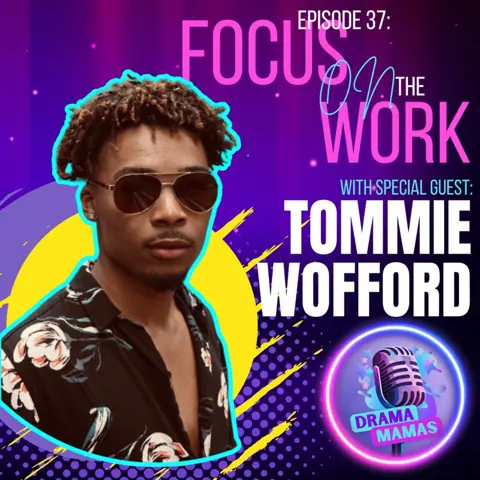
Focus on the Work
Tommie Wofford returns after his first visit in episode 3. When UArts closed, he had to find a new school and landed at Point Park. He catches us up on that move and the songs he's writing for a new musical.
Audio could not load. Try Play again.
Also in this episode
- After UArts closed, Tommie transferred to Point Park on a full-ride scholarship.
This transcript was made automatically and may contain mistakes; the audio is the record of the conversation.
Read the full transcript
All right, so session two, part of the Drama Moms, we haven't recorded in a year and a half and now we're just like, boom, we're going to do all the recordings today. Thanks to Tommy. Yes, it is actually, it's your fault, we started up again. Man, well, I'll take all the blame for that too. I'll take all the blame for the Drama Moms. So welcome to the Drama Moms, I'm Kristen. I'm Angela. I'm Kathy. And today we brought Tommy back. You were our first guest. Yes, episode three. And you said it, how long ago was it? That's so appropriate. We posted it November 22nd of 2022.
Wow. So two years. Two years ago. A lot has happened. Yeah, a lot has happened. So much to catch up with you, Tommy. I re-listened to our episode, I'm like, oh, there's so much that has happened. Yes. Two years ago. Yeah, we can't wait to hear all about it. I'm excited to share. I'm so happy to actually be here in person. Last time we spoke, I was in my friend's room in a dorm in Charlotte, North Carolina, and now I'm actually on the couch. I'm on the couch. You made it to the couch. I made it. We have a new couch, and it's like super fluffy.
It's our little SML couch. And you can recline too if you want. That's great. You guys are going to have trouble getting me out of this. I know. I'd be spending a lot of time on this couch if I lived here. Yeah, for real. For real. So, well, why don't you take us back, Tommy, kind of walk us through what you've been up to, and we want to hear all about it. Yeah. Yeah, when we left you, you were at school. In Charlotte. When you left me. When we left you. When you left me, I was doing Theater Gap Initiative, Corey Mitchell, who you guys actually have on the show.
Yeah, Corey. He was so sweet. And soon after we shot that, I received a full-ride scholarship to University of the Arts, which was really an extension from Theater Gap. That was what our goal was, to get me into school, and hopefully with a scholarship, and we achieved that goal. Full scholarship. Full scholarship. That's fantastic. Thank you. And then fast forward a little later into the process. Got to UArts, had a great first year, and then it closed. Oh, yeah. The university shut down. That was part of that. Where was that? Where was the University of the Arts? Philadelphia. Okay. Philadelphia. Oh, no. So, that was definitely a wrench in my plans.
Was not expecting that. I remember it was over the summer. I was just chilling in my room on social media, and then it was like the Philadelphia inquiry was like, Philadelphia Art School closes down. I was like, what? I remember when that happened. I remember being like, oh, gosh. It was like in July, and so they gave us like six weeks to find a new school. Oh, my gosh. Which was, it was crazy. Yeah. Just to speak to Corey, I remember him calling me and being like, are you okay? Yeah. And I was like, yes. He's like, okay, write me a list of the schools you want to go to.
And I was like, got it. And, you know, by God's grace, Point Park University, that's where I'm attending now. And what's really interesting about the whole thing and kind of ironic is Point Park offered me a full-ride scholarship as well. I turned it down to go to U-Arts. Oh, wow. U-Arts shuts down. So, I'm like, what? But graciously, I'm now attending Point Park on a full-ride scholarship, and everything panned out just right. So, currently in Pittsburgh, and I'm loving it. Absolutely loving it. Still doing cabarets. It's a fun town. It is a very fun town. I'm happy to still be in Pennsylvania, because I did not want to leave Pennsylvania.
Okay, good. But just learning, you know, life has its plans, and it's often, you know, not exactly what you were thinking, but it's not linear. You just keep living. Yeah, and you don't know why it happens until you get on the other side. Until you get on the other side. And I have, I mean, I've got countless friends, mentors at Point Park that I'm like, if that hadn't happened, I wouldn't be here. So, I'm all. It's all right. You took a path, and God just kind of twisted you a little bit. He twisted it. He was like, hey, no, this is where you're supposed to be.
We'll let you sit in this for a little bit, but you're going to get where you need to go. And the people that I met at UArts were incredible. I mean, I remember the dean of my program, like, she worked with Jonathan Larson when he was working on RIT. Oh, wow. So, like, I received so much guidance and wisdom, and there's so many friends who were at UArts who transferred to Point Park, so we were all like, oh, yo, you're a UArts refugee. What's up? It's really cool. We still have that UArts family kind of sprinkled in at Point Park, so it's cool. So, you're technically a sophomore?
Yeah, I'm a sophomore. Okay. I'm a sophomore. And what is your, like, track called? Yeah, so at UArts, I was a DPP, which stood for directing, playwriting, and production, and now at Point Park, I'm theater arts. Okay. I still haven't picked the concentration yet, but I'm thinking it's going to probably be playwriting. Okay. So, yeah. I'm really in the story structure. Yeah. Yeah. Oh, love that. That's really cool, though. Yes. Very cool. And last time we talked to you, you were getting ready to go to, I always want to call it Studio 54. No, that's what it was called. That was the previous name. Really? Yeah, Studio 54.
So, it's the same? And now it's, now it's 54 Below. Right. Um, and, and yeah, that was, that was for Malcolm X and Selma. Wait, like, the Studio 54? Yeah, the Studio 54. Where, like, everybody would go down and call the drugs and yada yada. Yes. Okay, all right. And this is the, this is the basement of what Studio 54 was. So, that's why it's 54 Below. Okay, thank you. Oh, I love that. So, Angela, you're not really wrong. I'm not wrong. See, we're all learning stuff still. Yeah. That's been such a crucial part. I remember you guys, I met you guys and, like, started speaking with you guys.
It's such a pivotal part of my life because I was doing TGI and it was, I was doing the Malcolm X show and it was, I got a text from, um, Kion Hersey who was, like, he's an incredible songwriter, arranger, um, composer who worked with, like, Lin Miranda on Hamilton. He, like, transposed Lin's demos. And so, he, he, he had saw some of the stuff I was doing online and texted me and was, like, hey, come and do this show at 54. And I was, like, what? I mean, all my friends went crazy. And so, like, now to still be doing shows at 54 and still have those connections, now looking back on it, it's like, wow, I never knew that it was going to take, you know, form that way.
I mean, they've been, become such a supportive, um, really just artistic home and any idea that I throw at them, they're like, yeah, let's, let's, let's pump it out. Let's make it happen. So. I love that. Incredible. That is really incredible. That's one of the things you talked about last time, about making those connections and using those people to help feel you and point you in the right direction. Yes. Sounds like you're still doing that. Yes, ma'am. Deeper, deeper. Deeper in that hole. Yes, ma'am. I love how small the community is, but not at the same time. Like, I, that's just such like a unexpected thing.
Yeah. I feel like, like, I wouldn't have thought it'd be quite so easy to make that, like, jump to somebody who's been doing this for a while, who is willing to actually take you on and teach you stuff. Yeah. It sounds like Tommy's been hustling. Yes. Yeah. Also that. Sometimes it feels like, I would say it feels like 50% hustle, 50% just blessing, you know, just luck. Yeah. Just like, you know, I was doing all the work that needed to happen to get that text, but I wasn't, like, anticipating it. I mean, I still, I remember the moment we were sitting there watching a movie and I was like, yo, Kyan Hersey just texted me and my mom, my friend's like, what?
And it was like crazy because he's this guy that's like written on, you know, so many popular musicals and worked in so many incredible spaces and just wants to give you a shot. And also, um, shout out to, uh, Mia. She's the, one of the associate producing directors at 54 who put that, um, the Black Rider showcase it was, she put that together. And to this day, I mean, anytime I reach out, they're like, yeah, let's, let's do a show. Do you find that most people are willing and excited about bringing up new young artists? Like that community? I think, I think that sometimes musical theater writing can feel oversaturated right now.
Um, but I think that when you, when you're not trying to knock yourself into circles and you're just, and you're in your own lane and you're doing what all you can do to make yourself successful, people will notice that. And they're like, yo, who's this? Like, and, um, and so that's what I've learned is like that people want to help and they want to bring you up, but they're, they're only going to do that when they see you're doing all you can to help yourself first and doing it for the right reasons and doing it for the right reasons. And, and so, yeah, I mean,
in the, the journey comes with incredible, um, it comes with incredible, you know, successes, but it also comes with incredible disappointments, you know, but at the same time, it's like, you, you got to take the good with the bad and, and pursue your dreams. That's, that's all, all we're here to do really. Right. Stay on the track. And stay on the track. And learn, learn from the disappointments. Yes. Even when your school shuts down. Yeah. I can't even imagine that. Wouldn't wish that on anybody. It's how terrifying that they've briefly been. I know. They didn't like send out anything and say, Hey, heads up. I mean, there were so many like lawsuits out.
Like the fact that they weren't, they didn't tell us, like we found out from a popular news outlet. Like, that's great. You're like, I just had class. What are you talking about? Just had class. I said goodbye to my friends and thought I'd see them again. Some of them I probably won't never see them again. We were also dispersed. But, but again, like we said, take the good and the bad and, you know, and keep going. And another great opportunity opened up. Yes. You know, where you're at now in Pittsburgh. Yes. So tell us about what is the musical theater vibe in Pittsburgh like? What is, is it alive?
Is it? It's alive. It's, it's, it's extremely alive. I didn't know just how vibrant musical theater was in Pittsburgh. And just the theater, theater in general. Like there's lit, it's like a mini Broadway street in Pittsburgh. Oh, nice. There's the Pittsburgh Public. There's the Benidim. Of course, Point Park and, you know, Carnegie Mellon's not too far away. Okay. Oh, well, there we go. Yeah. It's so rich with art and culture. And I love it. I mean, I think that even once school ends for me, I'll probably stay in Pittsburgh for a little bit just because I'm already noticing like, well, there's so much theater. There's so many theater companies.
There's so much interest in new work and there's not a lot of writers in Pittsburgh. So I really can see myself as being someone who can emerge in that scene and give back to the- Find your niche. Find my niche. Yeah, exactly. And there's a lot of spaces, but a lot of, a lot of people creating new works in Pittsburgh. And I'm like, now I'm letting the secret out. Right. But it's, uh, shouldn't have let that one out. But no, it's, it's a, it's a really unique space and the city is filled with a lot of diversity and, um, I'm loving it. I'm really loving what I see, the possibility to see Menless in Pittsburgh.
So. Oh, that's good. Yeah. And even as a Florida boy. As a Florida boy. Even when I'm freezing. Oh, goodness. And I'm like, you know what? I just got to see it through. I just got to see it through. It'll be okay. Now, have you been in any productions recently? Have you been on stage yourself? I have not. I have not. Now with, when you're, I'm sure, you know, your kids will all learn this soon, soon enough are already learning this. You have to do production assignments. Okay. For my production assignment, uh, this past semester, I was, um, scanning tickets. Okay. So, uh, but hey, no, every job is- There's no small job.
There's no small job. Every job is important. It all puts it together. Exactly. And, and so that was fun. What, what really is great about COPA, which is our, our, the name of our, um, theater, music, dance, production, um, school, is that COPA really does connect us with, um, not only working staff, but also guest artists. And so the best show that I was scanning tickets for, uh, it was, they called The Trees. It did a production at Playwrights Horizon in New York, off Broadway. Um, they actually brought in the playwright and did like a workshop with us. Oh, how cool. Um, and, and it was really cool because, um, make myself sound, uh, a little, I was tardy this day.
I walked into the workshop a little late. I think it was like five minutes late cause I was, uh, spending time with family off the family weekend at college. But I, it was my, to my benefit cause I was able to sit right next to the playwright. And like, um, name is Agnes and just like really took time with me. It was just like you, like, I'm going to invest in you in these, this hour of time that I have and just like share with me, talk with me and just was really investing in me. And so, um, even though, you know, I wasn't able to participate artistically in the process, I got to see their play every day, um, and then have a one-on-one dialogue and, and, um, just build rapport.
So, um, I'm really appreciative of their, their, their, the, the emphasis they put on us speaking with, you know, artists that come in and working artists and all our faculty works. So yeah, I love that they bring in the guests and you get to have some, you know, like hands on, hands on, hands on and, and just knowledge, you know, knowledge. And sometimes as an artist, you, you think, man, like I'm a sophomore, right? And I'm like, what am I going to do with this theater arts degree? And like, I'm getting a, uh, I'm on a fast track for a master's in business as well. Um, so I'm like, what am I going to do with this?
Like what? And then, but then you see someone like them and then like, okay, well here's their play playing at a university and doing, we've sold out pretty much every night. So it's like people are doing this and they're making a living. They're putting together great art. They're putting out a message into the world that they, that they met, that matters to them. And I'm like, okay, this is, it's possible. You can do that. I can do that. You can totally do that. It's really great affirmation. I was like, okay, we're good. Yeah. It's okay. I can make a living doing this. I can pay my bills, have groceries.
I'm sure Grandpa feels really good about that. He does. You know, pay for a Netflix subscription. If I can do that, you know, flight home to see family. We're good. You're good. You're good. We're good. No, absolutely. Well, very cool. And be happy at the same time. And be happy. Yes. That's a real feat. Yes. It's a real feat. Yes. And this, this next project that's coming up at 54 Below was really birthed out of a lot of that. Okay. Like it was birthed out of a lot of, you know, I, I definitely fell into like at UArts and then with the closing of it, I definitely fell into a, you know, just a, a bit of a depression and just, just, just a little funk.
Yeah. Yeah. Just being like, what's, what's going on in life. And, and, but then learning like, oh, but that's needed for what I do. I write. So I need these moments. Yes. I need these dark moments. You gotta have something to write about. I have to have something to write about and, and almost like a mirror to hold up to myself and be like, okay, now I have something else to, you know, to, to regurgitate in my music and my, my writing. So, yeah. So what are you working on right now? The Bard. The Bard is like my, my mind is on that continuously. And,
uh, it's actually, I didn't, this wasn't the case when I reached out to you guys to do this, but, um, it's actually going to be produced at my school this spring, uh, and in the season for Ghost Light Theater Company, which is a theater company at our school. Okay. Um, so we're doing the 54 below and then Ghost Light right after at Point Park, which I'm like super excited for. It keeps me busy. Um, and the Bard for me was, I was really, I was like over the summer and also kind of last spring, I felt like this kind of like a, kind of like an identity crisis a little bit because I grew up in church, right?
I grew up around like R and B hip hop music, but then I also grew up in theater. And so I felt like my, had like two feet in different worlds and I didn't quite know what to do with that. Um, and then just, just soul seeking, you know, like apparel. I was like, I was like, I think over a couple of months ago, I was like wearing like hoodies and like, and, and try to rock the J's. And I was, I looked at myself in the mirror. I'm like, bro, this ain't even you, bro. Like this, this, this, this, you know, this Nelly look is not, it's not, it's not, you're more of a Lynn Miranda.
Just, just embrace it. You're more of a Jason Robert Brown. Just embrace it. So I had to get rid of the hoodies and buy, you know, more sweaters and rocking the standard cloth now. And, and, but I had to see that. Like you don't, don't let anyone in society make you feel like, because this is what's culturally normal, that it's your path. You know, you did grow up in church and you also grew up in theater and that's okay. I love that. Yeah. And so, and so that was, I was like, I have to make a show out of this because there's other, there's going to be other youth coming up that are going to have those, you can look at my siblings.
I'm like, you can, you can play football and like Westerns. Like don't let them tell you you can't like both things or tell my sister, like you can listen to SZA and also listen to, you know, Taylor Swift. Like don't, those, those aren't contradictions. It's just you being a more unique, holistic person. Yes. So I was like, let me craft the show and the show took structure after just writing different songs. And I was like, I'm going to call it the Bard because I looked back at Shakespeare and I was like, how would he feel growing up in, you know, the Renaissance also during the Reformation.
So that's a lot, you know, especially in a time where, you know, the church kind of, you know, bash theater is like, oh, it's evil, it's sin. And I was like, that couldn't have been an easy predicament to be in. And so I'm like, how can I take that as the backdrop and kind of insert some of my realities into that? And so I'm excited to, to see how it takes, takes shape. So. I love how thoughtful you are about all of this. Thank you. Like it's so like wise beyond your years, to be honest. Thank you. I appreciate it. And what an important message for kids to hear.
Yeah. It's really just be yourself. Absolutely. Just be true to who you are and that's where you're going to be your happiest. Yes. You know, it's, I, I'm still learning that as an adult. Like. Oh yeah. You never stop learning that lesson. Yeah. No. Yeah. Like boundaries are okay. Yes. Knowing who you are is okay. Not everybody's going to like you. That's okay. Yeah. Yeah. You know, like you got to like you, you got to be comfortable in your own skin. Right. You have to be. And that's where you've already come across that. Yes. And you've already accepted that. Yes. So I think your love of the arts has helped you figure that out.
It's helped me embrace it for sure. Yes. Yes, ma'am. So that's great. So how far are you with the show? Like, is it, is it completely done? Are you still in the process? Like, where are you at with it? At first I was just kind of like, let me just, let me just write like 10 songs. If I can write 10 songs. Just 10. Just 10. I wrote, I was writing music over the summer. Um, and then I was like, okay, this is kind of starting to take structure. And, um, like, I'm not, I'm not a, I'm not too much of like a mystical person, but I started seeing like Shakespeare this or like, I remember I was working, doing summer camp at the arts council, teaching theater.
And like, there was this, I think it was like the air conditioner on Hillcrest Elementary where we were doing classes and it said Bard. And I was like, whoa, I just, okay. I was like, all right, it's a sign. Right. And then, and then a couple of weeks later there was this girl and like, it's actually when I got to college and she was walking down the street and like her braids were going down her, her, her, her hoodie. And it said Bard. And I was like, what? And then she moved it and it like, it was a, it was a full word and it was like a, maybe like a school or something.
But I was like, but wait, that's crazy. And I'm like, okay, let me like start writing songs. What? And so I keep writing songs and wrote like wrote, uh, I think we're at, at 10 now finally. And I was like, okay, this is just going to be, let me just email Mia. I was like, Mia, is there a slot at 54 below? Cause I got this crazy idea. And she was like, yeah, let's do it. And then slowly performers start coming on. And so I reached out to a lot of my, my, my, um, just my, my norms, um, Oscar Williams, who he was, uh, fun home Broadway, original cast, um, uh, reached out to, uh, my, man, I'm super excited to have her Gabrielle, Gabriella Pozzolo, who was Susie and Stranger Things, uh, original Matilda on Broadway.
And she was like, let's do it. And so like the cast started forming and I was like, okay, I'm getting these heavy hitters. Let me write, write, write, write, write, write, write. And, and, and then now it went from just, okay, let's just do a great concert at 54 to we're doing it at my school and that's a full production. So right currently right now, like on the plane, I'll be like trying to figure out, okay, how do I take this from 10 songs and a song cycle to 10 songs and a somewhat live performance with monologues and hopefully some scene structure. Um, but the school and ghost light theater company is really just giving me the, the space that I need to figure out what it's going to be.
Um, and with really no serious strings attached, it's just like, Hey, here's a theater. How nice. Here's the, yeah, here's a cast, here's a production team, you know, make whatever you want. So, so yeah, that's so cool. Yeah. I think that if we had to do like a percentage, I think that like structure for the show and this concept, I'm like 70% there. And then in terms of what it will actually look like, I'm probably only like 40% there, but I've got more time before the spring, before the full show. So I'm like, let me just get through a good 54 below concert, which I know how to do cause I've done two now.
And then after that we'll, we'll start thinking about proscenium. It'll just, it'll organically. It'll take shape. It'll take shape. And I mean the people, I, I, I'm getting, I'm definitely getting a little intimidated because as you start working with more and more professional actors and stuff, you're like, man, I gotta, like the song has always got to be good. But when you've got, you know, people from, I mean, I think Jeffrey Cornelius, he's from Dear Evan Hansen. I mean, it's, I'm, I'm blown away by the people that have agreed to be on this show and it's affirmation. Like, okay, you're in this game now. You're really doing it.
And then it's also like, all right, these, you better get back there and rewrite that song because that was a little pitchy. I play stuff for my friends at college and you, you know, when you get a, they give you a look and it's like, okay, got it. I'm going to go back to the drawing board. We love you. But like, yeah, it's so hard to get honest feedback. I feel like from, especially from friends. Yeah. Cause they're like, oh, I don't know. But if they give you a, you get squinty eyes about a song or something, you're like, oh crap. Well, my friends are honest.
They're very honest. Like they'll be like, Tommy, that's incredible. And then they'll also be like, okay, dude, what were you thinking? That was like, that needs to go into the clay bin, like put that away, maybe recycle some of it, but some of that just burn it. Like, okay, okay, okay. But it's, I, I really do think that overall, because I'm surrounded by artists right now, we all just care about making good art and like the best idea wins, no matter, you know, whose ego gets hurt. Like, bro, you're going to have about, you know, 145 people watching it and you never know who's there. So you better make sure that it sounds good at all costs.
So you seem very calm for somebody doing such a big project. Yeah. I'm excited. I really am. Oh, gosh. I know. Yeah. And I love it. And I love that we get a front row seat to like some people, right? Yes. Yeah. So when is it going to be at 54? January 26th. And it's, it's my birthday weekend. So I'm really excited. Turned 21. Oh yeah. Nice place to be. Oh, big year. Big year. When's the actual birthday? January 24th. So that's my daughter's birthday. What? And like 30 other people's. Yeah. We have lots of theater people that have that same birthday. That's incredible. That's actually my grandma's birthday too.
Oh my gosh. Oh dang. Yeah. I love it. So the show is, it's the 26th birthday weekend and we're already, already thinking of like me and my friends like, okay, how are we going to like, of course we got to practice and soundcheck and, but then like, how are we going to, what's, what fun is going to be had? Yeah. You got to celebrate. You got to celebrate. So I'm excited. That must be such great validation to have all these people wanting to come on board. Yeah. Yeah. And you, you get, you get nervous. Like, you know, I think it was, Gabriella was, I mean, I was kind of nervous to send that text.
I was, cause sometimes like you get one shot with people and it's kind of like, that's it. Am I willing to risk it? Am I willing to risk it on this? I mean, how do you get their contact info? For Gabriella. Is that something we can talk about? No, yeah, for sure. For Gabriella, it was kind of a mutual thing, mutual friend thing. Like she knows Oscar. And so I really, I think it's like, it's like, oh, you know him? Okay, cool. Like sometimes it really, I think the Kelly Clarkson thing really helped for me too. I think that people are just like, oh, you met Kelly?
All right. Like, it really is like, they don't really know my character. And sometimes they even heard the music yet. They're just like, oh, bet. Okay, cool. Yeah. Thanks, Kelly. Yeah. Thanks, Corey. But, and then, but what really is cool is then you start developing relationship with people and then you get to see that, wow, they're growing in their career and I'm where I'm at. I mean, I think of my friend, Nick, Nick Barron, who won the Jimmies last year. He's going to be in the Bard. Yeah. Nice. And he just did, I forget the production, but he just did a show at New York City Center, you know, and that's a huge space and incredible for him.
And so, you know, you start seeing, you start looking around and seeing the peers that you have and being like, okay, we're all on a, we're on a track here. And this is exciting. You know, I think about some of the power cast that I look to, you know, I think the definitely that, like the Hamilton cast was like the Greek gods to me. Oh man, for real. You know, like I thought like Chris Jackson and Phillip, but like those are, and how Lynn pulls his teams together, you know, same thing with, you know, the Dear Evan Hansen cast and just how people were kind of brought up in that.
I kind of think, okay, I want to surround my people, myself with people who are growing in their craft and also in their character as people. And, and what, what dream cast can we create in the next five, six, seven years in our careers that the next generation of theater artists are like, oh, you know, that bard cast, you know, and then inspires them to, to get to it and get to work. So, so yeah. Well, it sounds like you're doing it. Yeah. We're trying. We are, we are. Yes, you've got this. I mean, it sounds like you're the next Lynn. Yeah, man. You know what?
Someone said that. I know it feels like a big statement to make, but it sounds like that. Someone, someone said that. I did a, uh, don't jinx it. I know I don't want to jinx it. Someone, I did an interview with a stage podcast, a good friend, my name, um, Andrew, uh, out of, out of New York actually. And he said that. And I think grandpa texted me. He was like, yo, he called you the next Lynn. And I'm like, bro, y'all can't be putting this pressure on me. That is definitely my idol, man. I definitely look up to him a lot. I mean, it sounds like your process may be similar to his.
Cause like I've heard him talk about, you know, he's done a lot of podcasts and stuff. I think I saw him on something once where he was talking about how he kind of starts with the songs, you know? And it's like, you make the story through the songs, which maybe is why Hamilton is primarily music and hardly any dialogue, right? Right. Not without music in it anyway. Right. It's completely operatic as we do. Yeah. You know, what's the cool thing about Lynn Miranda is, um, I listened, I listened to his demos all the time. So like, I hardly listen. Like I love his music, his musicals, but I go to his SoundCloud.
This is a, it's a hack for all musical theater writers that are coming up. Go to people's SoundClouds or their YouTube channels and listen to their demos. Cause you can study their strong, their song structure. And then I'll like, I'll listen to like some of the demos from Heights and then I'll go listen to the cast album. And this is me learning. Like how did it take structure from transformation? Yeah. From, you know, Wesleyan to, you know, to, um, Eugene O'Neill to Broadway. And I do the same with Hadestown. I'll go listen to, you know, um, to her demos. And then I'll go listen to the, well, I think there's like three different cast albums for Hadestown.
So I listened to how they, they, the songs took structure and changed and evolved. And then I'm like, okay, great. Now I have a song now that maybe in the year will sound completely different because I know that this is how songs take structure. They, you know, I, you never want to write a song and be like, it's done. You write a song and be like, it's good. Progress. It's a journey. And you want to see, you want to let, let it have the time it needs to take form. Well, and I assume some of that formation or change over time also comes from the artists who end up performing it for you, correct?
Yes, for sure. We, we did, when we were doing a coalition at 54, Malcolm X and Selma, um, my friend Oscar, he sang a song I wrote called Lost Time in such a, I wrote it in a reflective way, but he kind of gave it this like jazz tone to it. And, and that happened in the, in the rehearsal room. And there's sometimes that you write a song, you want to hold to how you wrote it. Right. And then there's sometimes when you're like, okay, all right, Mr. You know, been on Broadway since, you know, eight years old. Just go ahead and do your thing. I'm going to just sit back and watch you do your thing because the same way I'm in school to learn how to structure songs and structure stories.
He's in school. I think it was the pace to learn how to bring those songs to life. And so you don't want to stifle him in his creative process. You want to let him do what he's supposed to do, um, with the work that you brought to him, you know, and, and it takes trust, but that's why you, you know, you want to surround yourself with true genuine artists. I mean, but that's what, that's what doing theater really is anyway. And I didn't know that prior to being super involved in theater the way that I have been, um, you know, in the, with the production
teams being the stage manager, being the production manager, as I am this time at curtains and, uh, like to see, okay, the director has a vision for how they want to do this, but they're also offloading the responsibility for that part of the vision. Like the scene is the, the set is the set. And, you know, like we brought Nick Judy on contract to do the set design for curtains, um, you know, from theater Warner Haven. And he's so talented, so just let him do his thing. He's been doing it since he was like able to walk practically. Right. He's from a theatrical family. Yes. Yeah.
Yeah. Yeah. We'll get him on the podcast eventually. Please. The first one to stream it. Molly, Judy, Nick, those are all, I mean, I think about his mom, you know, like, yeah, she's the first person I pitched my script and like, she was the first person that was like, let's get this musical on theater Warner Haven stage. And I don't ever see them, but like, I just, I think about them all the time. I'm like, man, these people really, they invested in me, um, long before, you know, scholarships and, and, you know, interviews and all that. Like they just were like, oh, kid with a dream.
Let's help them. Yeah. And they're still doing that to this day. Yeah. They are. For so many kids. Yes. But to, you know, to see his creative process and how that fits in, like they'll have like production meetings where the director will talk. Okay. So I see this in the script we've got, cause like, you know, we've been given, we've, we got the rights for curtains. We get the script. We start looking at it and sure, it has some stage direction in there and sure. There's been people who've done curtains before and you can look at the original Broadway or whatever. Like you can get an idea, but you don't have to do it exactly that way.
Uh, we did into the woods in the black box space at theater, winter Haven now two years ago. Um, or yeah, almost two years ago. And the way that, um, Tommy, uh, over there was the director. And so he wanted to do into the woods, but he wanted to do it a little different. And so he kind of worked with chat GPT to help him figure out an idea that he had kind of brewing and he turned it almost like a tech dystopian. Version of it sort of. And that was kind of how we kicked off the show. And it's just neat to see how just that little bit of creative process influenced, okay, well the set will be designed this way and we'll add all of these lights so that we can do this stuff in the beginning.
And we like did isolated lighting on key objects like Cinderella's shoe. We placed all of this stuff around on the deck and it, we would just slowly bring up the lights and it was like the narrator came out, he found the book and he would like direct people to go pick up their items sort of. And then we would start the show. And I thought, how cool is that? You know, and it's so different, it's so different. And to just have that creative freedom a little bit. And then he, he took that vision and said, here's kind of what I'm thinking. And he says that to Nick Judy and Nick Judy's like, oh, I got an idea for that.
Like no, no real time to think about it, but it happens. And you see it cascade across all of the sort of departments that work together to put on a production. Like you got costumes and you got, yes. It's so neat to watch that happen, that process happen in, in an established story, let alone now really getting to go through that process from something. Yeah. You know, about Nick and Tommy, like those guys have been working together for, like you said, for so long that I, when I was a student at Theater Winter Haven, I would watch them articulate thoughts without saying things. Mm-hmm. Yeah. And I'd be like.
What just happened? What kind of like hypnosis is this, bro? Like I would, I would see Thomas, like Tommy give a look and then, and then it'd be like, you know, Nick or maybe Kadeesh and then he'd be like, okay, got it. Like, I'm like, bro, did you just send a thought to him? Like what? Yeah, beamed. Beamed, right. And, but I mean, those guys, man, I, they, they, the foundation and they're still, like I said, they're still doing it. I didn't know like that Tommy, I didn't, it never crossed my mind that Tommy worked professionally like until he told me. Yeah. He was, cause it didn't cross my mind because for me, Theater Winter Haven was and is professional theater.
Like I didn't think, at 13, I wasn't thinking about New York or, I was just like, oh, this is, this is the thing, you know? And, and then like, oh, but you, you've had, you've lived in that world and now you're coming back and you're investing it and you know, it's the same way. Giving back to the community. Yeah. In the next generation. Yeah. Giving them a place to have, you know, we had, when we had Dan Chesnicka on the podcast for Theater Winter Haven. Yeah. And we had him on, that was an eyeopening experience to me about, um, the way that community theater should always be and how it operates and how it benefits the community.
Like Dan's, his way of putting that, articulating that into thought or from thought into words. Like he was able to kind of just open my eyes like, oh, this is all about how you give a professional level experience to folks who will, who don't do that professionally. Right. And how, how maybe they want to, how you build that. Yeah. Like, it's just, it was so awesome to have that, um, experience with him and have my eyes open, but it's changed the way I look at all of it now. Yes. He's incredible. I love Dan. Yeah. Well, for sure. I've never met another human quite like him.
He is awesome. And he, and he understands like cheerleader and he, he, he's really not about him. Like he's not about himself. He's not about theater winner. He's about the community. Yeah. And bettering the community. Yes. Every person in it and through the arts. And through the arts. Like not even just theater. Right. Like he does so much. They have a marching band. Right. Concerts. Yeah. Yeah. I know. And the Ritz. Yes. The new Ritz. Yes. Yes. Yes. The new Ritz. I mean, he was just on Facebook the other day cause he had too many turkeys. Yeah. And he was like, I got turkeys. He needs a turkey.
But he had three. So we had three initially. And because those went so fast, suddenly magically he had six more. Right. I know. They were falling from the sky. Yes. Turkeys fall from the sky. We see through you, Dan, but we love it. Yes. Dan is in a plethora of resource. Yes. From theater spaces to Thanksgiving turkeys. I know. Do you find you've taken what taught from Dan and others? In those communities, you're putting in practice with your communities? For sure. I think that, I think that I get to take what Dan and like specifically Molly, because Molly was like an administrative at, you know, the academy.
Sometimes I'm like, wow, I'm taking a lot of the things that I learned that I'm implementing them at like Lake Wells Arts Council. Cause I teach theater there over the summers and we're actually trying to put together some year round stuff, like maybe over spring break or like winter break when I'm home to teach there. And Winter Haven and Lake Wells aren't far from each other, but I mean, for some parents, they just can't, they can't do that. Yeah. It's far enough. It's far enough. And there's not a lot of scholarships for every kid. So it's just like, okay, well, I'm from Lake Wells. My parents, they, they made the investment to make the drive, the 30 minute drive.
But I'm from Lake Wells. So how can I give back to Arts Council, Lake Wells Little Theater, anything that's on the ridge, how can I do that? And, and so I'm definitely helping in that space. At Point Park, not so much. I really try to, I really try to keep my mouth shut and just like learn because I, in my past, I've, I've had a, I've had a, a pattern of, of speaking up really quickly and then people being like, eh, that's cool, but you're 18. You know, you know some stuff, but there's still a lot more to learn. And so at Point Park, I really, I really just try to, I try to keep my mind like, this really is like, this is your school, bro.
Like everything here is to soak up. But then I try to, like a sponge, soak it all up and then come back home and, and give back, you know, um, we, over the summer, we, we made sets out of cardboard boxes, you know, and, and it wasn't, it didn't, they didn't look great, but it wasn't about, oh, guys are making these sets look great. It's about working as a team and learning how to be resourceful and whatnot and keeping in mind, like every kid I teach theater, it's like at the arts council, every kid I teach theater, maybe two or three may actually pursue it, if that.
Um, but the, the team building aspect, the character building aspect, the creative, the creativity that's cultivated through that, um, that's what I'm looking to. Not, it's a tool for you. It's a tool. It's a tool. And I'm learning too, like for Dan and those guys, they saw it as a tool. They didn't know this was going to be Tommy's career path of choice. They just saw, okay, 11, 12 year old kid who needs to learn, you know, so much. And theater is just, it's, it's the, it's kind of like, you know, when you've got, you know, medicine, you give it to a kid, you wrap it in chocolate, you know, like they were teaching me about character building and how to work with the team.
And they just wrapped it up in a little musical and gave it to you. I'm like, it was yummy. You know, we say that all the time that these kids are learning so much more than they even realize they're learning. Yes. Yeah. Right. Like my son. Not just how to perform. Yeah. No, absolutely not. I mean, he's 14. The stage is not where he wants to be in any way, shape or form. He comes because we do it as a family. Right. And, but he enjoys working backstage and like, he has found his love for, you know, drills and like stuff like that. So in the middle of a show, he's like, those breaks on the couch need to be fixed.
You know, just crazy stuff. Um, but the important part is exactly what you're just saying is the things that they're learning in the environment. Yes. And it's just, I mean, you can't even put it into words. It's just wonderful. It really is. It feels very intangible, but it's, it's so cute. Yes. But that's kind of been my experience with the arts because I grew up as a band nerd, you know, like, like the way that music impacted my ability to learn just from the very beginning was so substantial. Wow. Yeah. Um, like the way I like conceptualize in my own brain complex problems comes from that musical background.
Yeah. That theory. Yeah. Yes. Yes. Everything that I know about music, which isn't as much as I ought to know. Right. Obviously you stop at high school and I didn't go to Harrison. So like Michaela came out of Harrison years with years more knowledge about music theory and all of that than I never got. Wow. Um, I just was normal, normal school. Um, but like you think about math or whatever that you use in the daily. Like I still go back to in my head thinking about like music notes. Right. And you have to know that stuff. Yeah. You have to be smart at math to know how to fit this couplet, this rhyme or this melody, you know, when you're writing a song and you're like, okay, these next three bars need to match.
Okay. That, that's, that's multiplication. You are dividing up in your head. And so for me, the art saved me. Right. Because I, I was good at math. I was good at science. I didn't think so. I told myself, I'm not good at it. Cause I thought because I'm good at art, I'm not good at that. Now looking back in hindsight, I'm like, wait, no, no, no, no, no. You were good at math. You were good at science. And, and the arts became your medium in which you express those ideas. Yeah. So I'm like, oh, well, thanks mom. You know, for the investment. Thank you for taking me to theater, Winter Haven.
Thank you for, you know, buying those Hamilton tickets that, you know, we probably couldn't afford, but you made the sacrifice so that we could go and have that experience, you know? So, yeah. What is your coursework like? Speaking of like math and all that. My coursework now at school. Yes. Yeah. What are they? Oh. Do you have like general education that you have to take? For reference, just a little bit of backstory. We had Bo Bailey on who had, had gone off to Florida State. Yeah. And he was in their musical theater. He is in their musical theater. He's a junior now. We had him. God, he's a junior already?
Going into his sophomore year, I think we had him on the podcast and he's like, well, I did all these AP classes in Harrison. And so I didn't have to have this and this and this when I got to Florida State. So he's just taking MT classes. He didn't have to take anything else. Yeah. Thank you for that. Yeah. Bo, wow. I saw him in a production of Frozen at Lakeland. He was great. Oh, yeah. Our kids were nuts. My coursework, all of my credits from UARTs transferred over, right? Oh, nice. So that was great. My coursework now, I feel really spoiled because my classes are all art-based.
Oh, same thing then. Same thing. Perfect. I have a class called stage movement where I, it doesn't feel like a class. It feels like gymnastics, but I love it. You show up and move your body? You show up and move your body, and it's sweet. It's sweet. It's at 8 a.m. in the morning, so you are a little groggy, but it's great. That's a good way to start the day. It is a great way to start the day. It's better than any other workout. It's great for your mind. It's really great for your mind. So I have stage movement, I have improvisation for the actor, which is extremely great.
I have voice and speech. I have contemporary plays. I do have an oral comm, which is like public speaking, which is, I mean, it's still utilizing that right now. Yeah. And that's it. I only have five classes this semester. I'm chilling. To get to go do what you love every day like that. It's pretty easy. I don't want to say easy. I enjoy it. Right. So it makes it enjoyable. So what did you do to set yourself up to get to this point, to only have to do those classes? Did you, like, was at your other school, did you have to, like, really kind of buckle down your first two semesters?
Did you do a lot of, like, gen ed? Is that what you're asking? No, there were no gen ed classes at UArts. Oh, okay. So my classes at UArts, I took directing, I took acting, I took collaboration, which is like a class about collaborating across the mediums in theater. Oh, nice. I took stagecraft and costuming. I mean, like, it was an art school. I'm in the conservatory at Point Park, so I don't have to take math, science, or whatnot. I'm strictly just art, theater. Have you been surprised by a class? Like, oh, I didn't know I would enjoy this so much? Um... Being more on the composing and that side of it?
Is it that movement class you're taking? It's the movement class. It is the movement class. That's so funny. And you know what? You know what's so funny about that class is we get there, and, like, I love my teacher. He's so cool. He has, like, these, like, interesting, like, chant, like, songs playing, like, Humbara, Humbara. And we're, like, dancing. It's very tribal. It's like... Is this the Lion King? Yeah, it feels like the Lion King. You know what? It feels like you're, like, entering into this, like, I don't know, like, it's, like, monastery. It's, like, Buddhist monastery. And it's, like, all right, balance on one foot.
And then, like, okay, now levitate. And I get on the ground and move. It definitely, we feel fancy in that class. But, I mean, that's what, you know, conservatories are meant for. You know. Made them feel, make you feel that way. I'm reminded of something. Okay, so Angela helped me clean out a space at Harrison earlier this month. Okay. And we were trying to clear out this, they call it the Pilates closet off of the green room in Harrison. And it had a whole shelf full of all of these, like, VHS tapes and some CDs. Mm-hmm. And we were just cleaning it out and putting it in Renfro's office for her.
And they were all her things. But how much of, like, just totally wouldn't expect this to be the music that she had in there. She had a lot of jazz, which makes sense. Yeah. Right? Because she's a dance teacher there. Mm-hmm. But she also had, like, um, like, the throat monetary guy, you know what I'm talking about? Yeah, yeah, yeah. What are they called? She had, like, some of that stuff in there. And I was like, why would she have this? But maybe it was something like that. Yeah. I think what it is is, because it's funny, he actually shared the playlist with us right right before the end of this semester.
We were like, can you send us your playlist, like, the class playlist? And we were like, yo, we love this stuff. This is crazy. I'm going to play this, like, during my exercises. I think what it is, is there's a lot of, like, pulsation and a lot of, like, balance and stuff like that. And so it helps. I mean, like, some of this stuff is, like, again, it's, like, it's, like, African tribal music. And then, like, the next song is, like, just, like, just, like, ocean sounds. Like, ding, ding, ding, ding, ding. You feel like you're, like, in the... It's crazy. Maybe it's just about, like, grounding yourself.
It's about grounding yourself and being present in the moment. I love that. One thing I'll say about being a part of a conservatory that I've learned is, like, it will make you very, very preppy. Like, I get up in the morning and I go down to my dining hall and I eat my great breakfast and then I go and learn about, you know, playwriting in the, you know, the something such in century, 19th century. And then I leave and I go hang out with friends for about five hours and then I take my second class of the day and then I'm done. It's my homework. And what I've had to learn is, I'm extremely blessed and privileged to have this as my school.
Like, sometimes we, you know, we complain about, like, oh, man, my 8 a.m. ballet. And then it's like, girl, did you hear what you just said? 8 a.m. ballet? Like, sure, it's at 8 a.m., but you're doing ballet. It's like when you're sipping on your latte. It's like, we're really privileged to be in this position. How can we give back? You know, how can we be good stewards of this, which is not common for many. We've talked about the difference between conservatory and, like, a regular college university. Gabby, my daughter, she was able to go to the Boston Conservatory, not this past summer, but the summer before.
And the people that we got to interact with, like, just the way that you're explaining that, I mean, that's what, that's what they were doing. That was summertime. So they were, those kids were there teaching. Oh, that's awesome. Yeah. And then they had their, the regular professors or whatever that would teach during the school year were there, too. But, I mean, the kids, they were just so happy and so excited to be able to. But that lifestyle that you're talking about. Yes. That's very much, you know, what they were doing. They're like, yeah, okay, well, now we're going to teach you. You're going to learn top now.
Yeah. Or now you're going to go, we're going to do ballet. Or now we're going to go and do voice. It's luxurious. That was, like, their day. Yeah. It's luxurious. You know, I didn't know for sure what Michaela's experience was going to be like. Because she's, her first semester is wrapping up. Okay. And as it's wrapping up, she added the second major. But her first major is music performance for tuba. And so I was like, gosh, well, she's picking out her first semester of classes, you know, this is in the summer. And it was all, like, easy stuff. I mean, you have a gen ed requirement at Florida Southern.
They have a bunch of classes and she picked criminology because she's interested in that. She is hyper-focused on criminal minds. It's a whole thing. So it was a good fit for her. But, like, she could have just as easily picked the, like, learn about Florida Southern. Right. You know, and the history of Florida Southern class, for example. Mm-hmm. Anyway, but otherwise, it's a very easy course load. Yeah, course load, I guess. She's not taking biochemistry. Right. She's not taking anything crazy like that. And I think she's finding that she's also very fortunate in that way because she talks to her peers who are criminology majors, so now we know what she's in for.
Right. And they're like, oh, yeah, well, I had science today. Yeah. And you're like, eee. I had to take, you know, A&P. I'm always, like, to my friends, they're like, guys, let's go to the point. It's a very, you know, a park that we always hang out at. Like, yo, let's go to the milkshake factory. And then they're like, y'all got homework. I'm like, oh. Homework? I'm like, oh. Tell her how it sucks to be you. I'm like, man, I just got done reading this play. I answered three questions. And, you know, but I mean, in that, though, I mean, you're reading a, you know, a play that's, you know, 60, 70 pages long.
And that takes work. But I mean, I think that for me, being a theater arts major, they really want me to focus on being exactly that, a theater artist. And so they're like, how can we create a space in which he's learning and he's progressing, but he also has time to live and write. Like, he needs to do that. And when he leaves college, he has to have a resume and, you know, he has to have catalog. And so I feel like I'm building a nice catalog in school. And that's, I have a lot of time to do that. And it feels like they're giving you an opportunity to build life experiences.
Yes. Which is like what you were saying before, is where then the thoughts and inspiration come from later. Life experience, plenty of time with friend, I mean, drama, all of it. I'm like, okay, great. Great. Friend drama, great. It's going in a song. Exactly. Little did they know. Little did you know. You're the inspiration for this. Great. Track number four. Right. But how fantastic. You're not forced to like, oh, let me go take this math class. I don't know how I'm even going to apply this into. You're just focused on what's important for doing the thing you want to do. Yes. And I guess I didn't expect that.
I went to college, but I have an AA degree. So like it's limited. And so like I'm learning a lot through Michaela's experience as the first child to go through all of this for our household. And, uh, and then talking with kids that we've seen kind of growing up through theater and I'm like, oh, how cool is that experience that you get to focus on what you want to do? Yeah. Yeah. I mean, I went to college. I had to take like a Chinese American government class. I was like, what is this? So what was your major? Biology. So there you go. But it didn't make sense though.
No, I guess not. I wanted to be in the lab. I want to do science. You wanted to be hands on. Yeah. I don't want to be learning about, you know, I didn't care about that. The distance system. Maybe college has changed since we went and they do allow for more of that. Well, I went to a liberal arts college. So that's probably why. Okay. Because that's what they want. That's their goal, right? They're going to teach you all about the world and all the different things. Not necessarily a specialized, even though I had a major, you know. I mean, when I went to nursing school, way different.
And these are the things that Corey Mitchell drove home to us at TGI. Because he was like, God, like even when I was looking at my schools, right? The reason I chose UArts is because I was like, UArts is a art school. Like from the moment I Zoomed with them, I was like, that's the school I'm going to. I want to go to that school. And he was like, okay, great. And I'll say the difference between UArts and Point Park is with Point Park, I'm an artist, surrounded by artists, but outside of that rim is still business majors, you know, sports, communications. There's, you know, there's other majors outside of performing arts, which at UArts, everybody was a, I mean, say it was a drama-filled school, that was a drama-filled school.
I never know why we're so worried, or not worried, but like surprised, right? When drama comes out of shows, we're like, hello, look who they are. Look what they do for a living. They pretend for a living. Of course they're going to. Do you have a preference over the two? Like just the community? Man, we have this conversation all the time with like other kids that came from UArts. I think that we all miss UArts because UArts, we felt like, it felt young. Have you ever seen the Tick, Tick, Boom movie? It felt like that. Yeah. We just did that. It felt like that. Was that last year?
Tick, Tick, Boom just happened in March or April this past year? Yeah, it was last season. Yeah, so good. The end of last season. Lickland? Yes. LCC? Cool. And actually, not to completely like cut you off here, but when you had mentioning before you were telling us your story and how, you know, you want to write and you want to do this and your passion, I was like, I totally was thinking of Tick, Tick, Boom. Oh, yes. I got it. Tick, Tick, Boom. The whole time. Yeah. Yeah. But yeah, you know what, I have a story about Jonathan Larson. Yeah. There was, we had this room called the DPP Lounge that only director played writing production majors were allowed to go in there.
Oh, it's like the skyline. It was like our little, you know, secret cave, right? Yeah. And we were going through this box of, this is so much like Philadelphia theater history stuff. And we find a note card and it was Jonathan Larson's handwriting. He was like, Jonathan Larson, here's my number. Like his email, his address in New York. He was in Philly trying to shop his musicals and he was like trying to get his name out to people. It's like a homemade business card. Yeah. Literally. It was literally a homemade. We were like, Jonathan Larson's handwriting. Frame that. I gotta know. And then when they closed the school, I was texting my friend, I was like, did you get the note card?
I was like, we have to take the note card. We didn't get it. Like, man. But I got a picture of it. It was really cool. Yeah. It's like, where did that go? Hopefully, hopefully not the trash. Yeah. Hopefully. Some guy's clearing out the room. He's like, oh. It looks like trash to me. I don't know who that is. That's such a treasure. It's so sad that that school closed. Yeah. I know. I know. I remember when that was, when it happened and I was like, oh, that sucks. Was that, was that autumn school? Yes. Well, it's like connected. And it wasn't. It was a fun of them, wasn't it?
But I don't think her's closed. We have a really good friend who, who is at Marymount, right? Isn't that right in New York? Yeah. Well, so we had Kat on the podcast as well, her mom. Yeah. When they were going through the process, right? Of auditioning for schools. She ended up in New York at Marymount. At Marymount. And they got there. Yeah. Yeah. I guess they're, are they sisters and brothers, those two schools? Are they part of the same? Okay. I don't know. This is T. I'm going to Google it. Oh, T. Oh, this is T. They're not in any way connected, but here's the connection.
And I don't care. I don't care what the world says. I'm going to say it. It's going to get broadcast into the world. I don't care what anyone says. I stand on 10 toes down. You heard it first on the Drama Mama podcast. The same president closed the schools. Okay. So that's the connection. Yes. They're not connected, but a lot of the same people were involved in the pulling of the cord between the schools. Yeah. Which is disheartening. But I mean, how I look at it is, you know, schools close, institutions fall, but the artists that were there aren't going to do great things no matter what.
But I think her, I mean, she was still open. Yeah. But there was a time where she wasn't sure. Yeah. I think it got like consumed by another school. I think so. Yeah. Yeah. Yeah. That's a great word. Yes. That's actually one of my dreams though. One of my, one of my, I think my like 30 years. To consume another school? No, no, no. Yeah. I'm coming for you guys. No, what a, me and my, me and my close friend, we have, we have dreams of starting our own conservatory. Yes. Nice. So, um, are we going to, I mean, again, this is like years down the line, we want to start our own literary school for poets, playwrights, songwriters.
Cause you know, I'm a, I'm a theater art artist who writes, who's in a theater program, but I would love to see more schools specifically for writers. And so that's one of my, one of my dreams is to get that going. Nice. Yep. Very nice. I'll get my degree first. Yeah. Get your degree. Finish school. Put it on the list. So no, it's on a bucket list. We'll get it. I don't, I'm not in any way rushing us, but I know you have a plane to catch. Are you good? That's at nine o'clock tonight. Oh, you're good. Plenty of time. Okay. Plenty of time. Yes. So what's next on the books for you after the Bard next on the books for me.
It really is continuing to, um, to build up this stuff here in Polk County. You know, I, I did a camp this past week. Um, and, and Tommy Frank, who is the head of the arts council, he's done a lot of great stuff in Lake Wales. He was like, yo man. He was like, we had a conversation about doing year round stuff with kids. Um, and he was like, yo, he was like, let's, let's talk about that more. Um, and I was, that was really refreshing for me. Um, my summers are like Florida, like Florida, Florida, Florida. I spent enough time outside of the state throughout the year that like summers I want, I want to be home.
Um, so that, that's what that is, looks like. Um, also just, I mean, tons of projects. Um, I'm friends with some cinema majors at Point Park and some dance majors. And I have ideas for some visual album stuff or some visual musical theater stuff. I'm finding that, um, as blessed as I am to have be introduced to a lot of live performance spaces, it's a lot easier to get into like film houses. And so I'm like, how can I take my musical theater writing, my songwriting, um, get it on camera and then get it to the people via the film side of things. And so there's a lot of crossover going on, a lot of crossover happening.
And now that I'm collaborating with a lot of people who've been in the film world, um, I want to kind of pull them into the, get their perspectives and just get their experience, um, on the camera. Um, so I'm just writing, I'm really writing, I'm really writing and just, I'm like, I'm just trying to flood the scene these next two years. Cause I know that once I graduate, I want to graduate with a quiver full of, of stuff that I've already worked on. So. Are you one of those? It's just like, Oh my gosh, I have an idea and I have to write it down right now.
Very much. Cause it'll leave me. I mean, I'm always with my notepad. Um, I try to stay with the pen and pad and not my phone just, just, just for the aesthetic and just like, there's a tradition in that, you know, I don't want to get lost in the notes and all that. I really try to stay with the notepad. Someday somebody is going to pick out your card from a box. Yeah, exactly. Someone's going to find my notepad one day. Hopefully all my ideas are flushed out into the world by that time. But, um, uh, and then just also trying to figure out how can I, I know I'm young, but like how, who can I like invest in?
You know, um, I think about like, I don't know if y'all know Thomas though, Bratz. Yeah. Yeah. Thomas and Kendall and all those great guys from Harrison. And I'm like, they, there's going to come a time where they're going to graduate from Harrison. And, you know, I'm, I'm constantly talking to Corey, like, Hey, I think I got, I think I got a kid for you to go to TGI or, you know, um, through the college audition process, I met so many people like from, um, you know, uh, there was, uh, what was it called? Uh, it's escaping me, but this, the college audition project in Atlanta that we did with Corey, um, unified, um, teachers that I know no longer get to see, but I still have their contact information from you arts.
And so I'm like, okay, I've been blessed with all of these connections. How can I be a good steward of them and, and, and utilize them for what I'm doing, but also, you know, utilize them and point them in the direction of other people that they can help them too. So yeah. Sort of paying it forward. Paying it forward. I'm big about that. Really big about that. Yeah. You've had a lot of people pouring into you and now you get to start pouring into others. So many. And so that, that's what I'm, I'm doing. You know, I think that the bar for me is, is going to be, I want, my goal for it is, of course, 54, uh, point park.
And then I want to try to get, um, a production, maybe like, uh, maybe in Charlotte, North Carolina, um, back with the TGI people and just kind of, I want to tap back into that. Cause I miss those guys. I miss those, you know, they have a lot of great, um, faculty that I'm, I want to just stay connected. You know, I, I often feel like I'm ping pong between like Florida, Charlotte, now I'm in Pittsburgh, you know, uh, people in New York that I know, you know, but I'm like how I want to stay equally connected with all of these ecosystems, you know, and that's why I, that's why I DM the Java miles podcast.
I got to, I got to plug in with them, you know, so. Yeah. Chris, Chris was like, he feels all of that contact stuff for us. And, um, he was like, Hey, Tommy wants to record again. And I was like, what? Yeah. Why? He knows we haven't recorded in like a while. Right. Yeah. He's like, I told him resurrection recording and I love it. I noticed on the social media, I was like, when's the last time they put something out? I was like, it's been a minute. It has been a minute. We kind of all got busy. It's like this time like just flies, right? Yeah.
Like that's how it feels. It does. And we get busy, right? Right. With our kiddos and they've all kind of gone, you know, um, once they start doing Harrison, then it's like, that's a totally different world. Right. It gets real hard to do anything other than Harrison. Yeah. Like it's real hard, real quick. And that's what I'm learning about the social media space. I'm learning that it's when you, when you're not posting, you're actually working. Yeah. And I'm like, how does that work? Like, I'm like, man, I haven't posted something in a long time. And it's, I'm like, well, I haven't posted because I'm putting, I'm curating.
Cause you're working. Right. I'm working. And so people are always like, yo, Tommy, where you at? I'm like, yo, I'm, I'm putting together a 54 show. Like I'm doing school. Well, I, I had, I wrote a note for myself actually in my phone, uh, yesterday I was like, focus more on the work than being seen by the world. Oh, that is true. Cause when you're focusing on the work. The other thing will happen. Drop in some real pearls of wisdom. Yes. I think I see a title. Uh oh, there you go. That's exactly what I thought. Focus on the work and, and not being seen by, cause that'll come, you know, when, when that's your focus, it, you know, that, that, that shouldn't be where your mind's at.
You should be on, on, you know, the, the, the goal and the mission. What a fabulous mentor you have to offer. Yes. Well, the youth. I'm here. So because you're here in the summer, I think we need to get you connected with Jordan Jones at the education director at LCT because every summer they do kid camps and they're always looking for masterclass. Um, yeah. People to come in and teach these kids. What you have already learned. Yes. You know, I would be so down for that. Please connect me. And, and you know, what I want to do is. Like you saying, I love the thing about the domino effect or the, this, you know, second, third degree separation, you know, when I'm in those spaces, I'm able to say, okay, cool.
Now, you know, Hey, such, such and such actor that I know, could, would you zoom in with the kids? Yes. So they can see a Broadway performer who's, who's doing the thing on a different level. And, you know, cause sometimes where I'm at, I'm like, I'm, I'm cool, but I'm, I'm know a lot of guys that are even cooler than me. You know, how can I connect them to these guys? You know, they don't want to talk to me. They want to talk to, they want to talk to Gabriella. She's doing Stranger Things. Like that's a lot cooler than what I've done, you know? So, but if I'm able to be that, that, that connecting piece, then please.
So let's, let's get it. Well, it's all about exposure. It's kind of like you're doing it at your school. You never know what's going to connect until you're exposed to it. Yeah. There may be kids in that theater camp that want to be playwrights, who want to do that stuff and don't realize that's like a thing for them. Right. Yeah, exactly. And don't sell yourself short just because you weren't on Stranger Things or you haven't done it. It doesn't mean you don't have anything to get. You have a wealth of knowledge, a wealth of experience, even though you're 19, 20. Don't let any of that imposter syndrome strike you.
Yes. No, none of that. Likewise. You guys are, come on now. We're just some moms. We're just trying to figure it all out. No, no. Y'all are putting them through. Y'all are rearing up the next generation of Harrison students. They're like three in Harrison. That's great. That's awesome. Yeah. It's keeping us busy, that's for sure. It is, definitely. Yes. Keep those gas tanks. I know. Yeah. My mom would be like, boy, you want to do another show? Mm-hmm. Okay. What is this gas going on? It's a lot of driving, a lot of money. I do want to touch upon that because we do have your grandpa here.
Yes. Yes. And that's amazing. And I know in our first episode, we talked about a lot heavily on family support. Yes. And, you know, that's huge because there are a lot of families that want to support their kids. They just don't know how to do it, which is kind of where we really started with this. And I just want to do a shout out to you. Yeah. You know, grandpa has kind of become, he actually, he made a joke. He said, I just want to drive the tour bus. There you are. And, and, and, and, you know, um, you know, anytime that, you know, I'm flying because I'm constantly traveling, you know, and so anytime I'm flying in, it's grandpa, you know, you need to get picked up from the airport.
Yes. You know, uh, or I say, Hey grandpa, I know you're taking me to the airport tonight, but I actually got an interview with the drama mom. Can you take me? Yes. You know, send me the address. Send me the address. Let's get it. And, you know, speaking to the family support, you know, my parents, they, they've always supported me and, and I'm sure you guys will, you are, you're probably already learning this with Michaela and you guys will learn it too. Like then the support, it never stops, but it just changes in its, in its mode. You know, my mom used to be like, you know, who, okay, cool.
You want to, you want to exposure, but who are you talking to? The internet's a very wise to who he's talking to, who are you collaborating with? She's not doing that anymore, but the wisdom that she put into my mind is it, I'm still carrying with that, you know? And so, and, and so we had to learn that from a, there was a, there was a definitely a time where, you know, you go from asking my, Hey mom, can I do this to making the decisions on your own? And, you know, mom's like, Oh, you do another show in New York? Oh yeah. You know, I'm sorry.
I didn't tell you about that, you know, but it just changes, you know, you're making decisions on your own or, you know, having to be like, you know, mom is, mom is mentor. Mom is support, but mom, mom's going to give different mentorship than Corey will, you know? And I may ask Corey a question, right? I may ask such and such teacher a question that it just doesn't make sense for me to ask mom because mom's not in the theater industry, you know? And so, but then, you know, mom will be okay, boy, you know, sure. You was on TV, but that trash is overflowing. So, and that is so important.
You gotta balance all of that. You gotta keep it balanced. You know, it's all, it's all useful. All useful. Yes. Taking a little bit from everything. Yes. Blending it to make the perfect. That, you know, I bring him up a lot because he's such a vital part of my life. Corey, right? Mm-hmm. We had a phone conversation and, um, I was like, man, how do you stay humble? You know? And like, cause I was like, you, you've done so much. Like they're right now to, you know, toot his horn, but he, they're making a painting of him to put in the North Carolina theater, like a portrait of him.
Oh, wow. And I'm like, dude, like what? Like, it's so crazy. And, and he, and he told me, he was like, man, it's like, that's cool. But he, in so many words, he was like, that's not the, the investment that's in you. That's not the investment that's in the other students. Like that's a, that's a cherry on top, if you will. But that's not the actual, again, focus on the work, not being seen by the world, you know? And, and so those moments are like, you know, or when you, I'll even go this far. When I was, when we did the show, when we, him and I taped the show, my dad was like, you gotta ask Kelly about these, these Grammy wins, man.
You know, my, cause my dad, he was always big in the music industry. He was like, ask her about those, those Grammy wins. And I'm like, all right, bet. So we're taking our picture and I asked Kelly, I'm like, so you've won four Grammys, right? And I'm like, how does that feel? Like what? Like, and she looks at me and she's like, you know what, Tommy? She was like, it's cool. But she was like, it's when you start thinking that that's why you do what you do, you're in trouble. And so she was like, just that, that could always chase after it. That's great. You know, but you don't do it for the accolades.
You do it because you love it. And I was like, what? That's crazy. I'm going to always hold that close to my heart. And, and so, you know, just, just, I'm a big about taking wisdom and, and, and utilizing it and cause those people have, they've already traveled roads that you haven't traveled yet. So if you can take that wisdom and, and, and walk in it now from where you're at, then you're set up for success. Yeah. The minute you think, you know, at all, you're in big trouble. You're in trouble. Yeah, exactly. You are in big trouble when you think that. Yeah. So true. Especially with parenting too.
Right. We think we got it on lockdown. It's just life in general. Yeah. I'll make sure to DM you guys when that, when that comes to me too. Hopefully it'll give me, give me like 10 more years. Yeah. Yeah. I got my own little feeder baby. What do I do? Yeah. We got you, Tommy. We got you. Fill up your gas tank. Yeah. Fill up your gas tank. Get an EV. I know. That's been the best. That's been the best. We got a hybrid. I was like, I can't do this anymore. You know, every couple of days filling up the gas tank. Man. I got a pickup truck, so.
Oh, yeah. Well, I'll throw them in the back. At least you drive. A lot of kids these days don't drive. My kids don't drive. They don't drive? And we have a, we're a one car household. What? Yeah. Why don't they drive? So I drive everywhere. Why don't they drive? Yeah. Huh? Why don't they drive? Well, I mean, they're afraid of it. Oh, okay. See, that's leading the list. They're afraid of, because, I mean, you see how it is on the road. Oh, no, yeah. People drive crazy. A lot of drivers, we, we different. Yeah. We are different. Yeah. And Lakeland's grown a lot. Like, we've been here, I was trying to think back, and I'm like, I think we've been in Lakeland now for, like, about 15 years.
Maybe a little more, a little less. I'm not sure. Wow. And so, in that time, there's been a lot of growth in Lakeland. Yes. And so, it went from being real chill on the road to being super not chill on the road. Yeah. And now, it's like, oh, I have to drive here like I used to have to drive when we lived in Orlando. Mm-hmm. Poe County has a whole list. Yeah. Poe County is, like, exploding. It is very, exploding. Yeah. And so, they see that. And, of course, I'm probably not helping that situation, because I say a lot of shit behind the wheel. Right. They're fine with mom being chauffeured for now.
Yeah, yeah. They're like, we'll get drove around. They're like, she can be stressed. I'm good. We'll just sit back here. The second that you can't, and they want to start going places, that you aren't able to take them for whatever reason. McKayla's starting to feel a little bit of that, because she's not here. Yeah. Yeah. So, she feels trapped, I think, a little bit on the campus. Right. Living there, and whatever. But, her friends are only willing to chauffe her so much. Right. Oh, man. In Pittsburgh, we got the bus system. So, I hop on a bus, and I'm good. So, you don't have your truck?
No. No. No, no, no, no. Yeah. My truck is, it's parked, and then it will stay parked as long, because gas money? No. Oh, well, yeah. Also that. Point Park hit us up with, hacked us up with free bus passes. Yeah. Nice. I'm all set. That's awesome. You know that schedule. Yes. I know the bus schedule. I know where to go, how to get there. For free. I love free. Free is good. Yes. Free, it's for me. Free is always great in college. You don't need a job pulling at your attention. Right. You just need to focus on stuff. If the listeners take one thing from this podcast, free.
In college, look for that word everywhere. Free. But the colleges are good about, it seems to me anyway, and definitely our experience at Florida Southern. They do so much to help their students find those free things. You know? Free museums, free bus passes, free theater shows. Just, I love that word. Yeah. Well, and Mikayla's required to attend all of these. She has to attend so many recitals. Yeah. It just so happens that that's the exact number of recitals that will occur. Mm-hmm. Why? Because it's the seniors that are doing the recitals, and I think maybe some juniors do recitals. Yeah. That'll affect your grade, too. You better go.
Yeah. Yeah. Gotta go to all those. Mm-hmm. Yeah. Yeah. Oh, speaking of Florida Southern, we just saw Spring Awakening. Oh, yeah. Oh, yeah? Yeah. Over there. They just did a, and I had never seen the production before. I had heard about it, but I had never seen about it. Yeah. That was a not younger child-appropriate production, correct? No, we left the kids at home. We had to read that at Uarts last year, and it was, I was like, yeah. Yeah. It's pretty intense. It's my understanding that they took a more conservative direction with it. Yeah. Yes. Yeah. Like, there was no nudity. There was no whatever.
Yeah, because high schools will do it, too. Yeah. I was like, how do you go to that in high school? Okay. So that's scene. I know absolutely nothing about this production, by the way. Okay. It's pretty crazy. It touches on every single teen topic that is, I don't know, controversial is not the right word, but. That's ever existed. That's, yeah. Yeah. That's, yeah. Really. Exactly. Yeah. And the parents not helping the kids. Suicide. No, it's a story. No, it's one story. It's one story. It's like Matilda on steroids with a bunch of different crazy teenage dilemmas. Yeah, it's like Matilda on steroids, Dear Evan Hansen. Yeah.
Yeah. Yeah. Exactly. Thank you. Yes. Okay. I had to read it. I was like, ooh. And they always, like, when you have to read a play at college, they'll give you trigger warnings. Like, the teacher will say, hey, next week we're reading next to normal, you know, if you, if substance abuse and, you know, this and this and this, mental health, it strikes a chord for you, just let me know, you know. And I'm like, oh, I'm fine. I'm fine. And then you get there and you're like, ooh, I got stuff out for a second. You know, it's a lot. It's a deep stuff. Yeah. But it's, it makes me more conscious when I write about deep stuff to be like, okay, let me do this with care.
Because when someone else comes to this music, comes to this text, I don't want them to feel like I'm doing it from a place of, I'm nonchalant about it or that I'm loose. Let me do it with, with intention and, and be purposeful with it. That's very important. Yes. Because not having gone through different things, it must be hard to write about different things. Yes. Or have them, or different things that, you know, one of the things we talk about in the bar is grief a lot, you know, and I kind of found myself in the process of writing the songs, dealing with my grief, because we've lost a lot of family members in the past year and a half.
But then also grief that my family members have, like my dad, you know, my dad's brother, you know, he, he took his own life, you know. And so when you're writing, I have a song in the, in the show called Wave to the Sun, which is basically, it's a song about, you know, kind of overcoming depression and, you know, waking up one morning and seeing the sun and being like, oh, hi, haven't seen you in a bit, you know, and, but, but having, writing those songs and having conversations with your dad that you've never had before, like, yo, how was that? Like, that's, that's no one, that's everyone's worst nightmare, you know, and, and, and kind of talking through those things and being like, okay, I've got the context.
I haven't gone through it, but someone very close to me has. Let me transcribe it in this medium so we can touch somebody. And think about what that did for the relationship between you and your dad. Yeah. Right. That's a totally different level. Yeah. He's probably ever expressed to you. Yeah. I send, I send him music all the time and he, he gives me feedback on it. And, you know, he, my dad's been through a lot more than I'll ever have to be through. You know, he was incarcerated for, for a time. He's lost his brother, um, just a lot. And so sometimes I'm writing about things.
This is even during Malcolm X. Like I was writing about people being in jail, but I'd never been to jail. Right. Right. But then talking to my dad who has, and he's, oh, you may not want to say it this way. Right. You may want to change it this way. I'm blessed to have people in my life who, who've been through some things that I fortunately haven't had to go through, but because they've been through them, um, they can give me context. That way, when I write things, it comes across realistic and, um, it comes across respectful. Well, spinning those events in such a positive, you know, way, I guess.
Redeeming them. Yeah. Yeah. Exactly. Redeeming them. And being humble enough to know that I don't know at all. I don't know. I need to reach out to people that do. Right. Right. You know, Shakespeare, I think what is so super inspiring for me about Shakespeare is Hamlet was birth out of his son dying, you know, um, which is who wants, no one with the loss of a child is like the most horrific, I thought to ever cross a person's mind, let alone living through it. And so be like, okay, this man was going through a lot of grief and a lot of introspection. When he wrote this play, I have to, I have to recognize that.
And I have to kind of put myself in that position as I write, you know, as I use strokes from his life. And it's kind of like, that's when the dramaturgy comes on. And then you study like, oh, no art comes from a vacuum. Like you don't just, you don't listen to any song or watch any play. Like it didn't just poof from the sky. Lives were lived, things happened, and then people from their feelings and their emotions and their experience birthed the art from that. And so that's one thing I'm learning a lot from like my dramaturgical brain is like, oh, like, no, this is more than just we're watching a movie.
It's like every single thing that you watch or you experience in an artistic form was birthed from an experience that someone actually lived or thought about. Or thought about. Yeah. Yeah. Exactly. Yeah. Which can be scary at times. Yes. Absolutely. Yes. What is going on here? Watch them horror movies. I don't watch horror movies because I'm like, I don't know what they were thinking when they were out there. Not anymore. One thing that I've definitely heard you mention, you've mentioned Shakespeare a lot in our conversation. But then you also mentioned Lynn and you mentioned all these things. So I love that you have a very eclectic spectrum of influence.
Yes. Which is great. So you're not, I don't see you as being a pigeonholed artist. No. Like I think you're going to bring in your future. You're going to bring lots of different perspective and different productions. You know, I love that. Yes. Thank you. And what I try to do is I try to find the similarities between me and whoever I'm inspired by. Okay. So like for Shakespeare, right? There's a lot of things that I won't, him and I are experiencing completely different, different times, different, different families, different, you know, ideologies. But the thing that him and I really had in common was the connection and relationship with the church.
Right. I grew up in church. Right. And it was, it was during the Malcolm X play that I really felt kind of disenchanted by the church because people in my church didn't, they didn't quite know how to take that production and what I was trying, the things I was wrestling with and the perspectives that I was wrestling with as I felt kind of ostracized a little bit. And so I find that, that, that similarity. I said, okay, I felt hurt by some of these communities. Shakespeare also did. We're not the same, but there's a similar experience. Yeah. You know, or take, take Lynn Miranda, you know, um, here, here's this guy who writing musicals, not a lot of, you know, Latinx guys writing musicals, you know, it's not a lot of African-American guys writing musicals on a, you know, huge spectrum.
So there's a similarity. We may not have all the same things, you know, that have led us to be where we're at, but there are different, different things that are similar. And so I try to find those similarities and, and then follow suit with that. So, so yeah, but I'm inspired by everybody. I mean, I mean, I went to the, uh. I love how you're so open. I know. Like everybody has something to give. Everybody has something to give. Right, and everybody, yeah. My friends are like, yo, let's go to the Nicki Minaj concert. It was like the second week of school. I'm like, I don't know, I had never listened to a Nicki Minaj concert.
I went, I was like, whoa, what? This is crazy. And like, it's just how theatrical her stage show was. I was like, oh, I couldn't be inspired by anybody, you know, and, and, and it's a buffet. Just how to play it up and, and see what, see what makes you better. Wouldn't the world be a better place if everybody thought, I could actually learn something from this person and this person and this person, and we all have something to give and to be inspiring. Yes. That is a great mindset. Yes. We need to breed more of that. Yes, we do. Yeah, totally. Absolutely. I know. Ah, goodness.
I feel like we could talk all day. I know. So you sent a track over. I did. And I attempted to play it this morning for the Drama Mamas because I was having to, I tried to forward it last night to them. Okay. And my email was being wonky. I don't know what was happening. And it just like, Mailer Demon came back and it was like, no, you cannot send mail. And I was like, well, okay. All right. So then I tried to play it for him this morning and it, it had me ask for permission. So we didn't actually get to listen to it. You know what?
I'll, I'll, we can, I'll send you guys a wave form and you can tag it in here somewhere. Yeah. Yeah. That'd be fantastic. Tell us about it. Yeah. So tell us what we missed by not listening to it. Oh, okay. The song I sent was called Transfiguration. Um, and it, it, it's called Transfiguration because, um, it's, it's really a song about, um, it's a song about death and it's a song about grieving, but also asking all the questions that you'd want to ask to, to your family who's passed on. Um, so the lyrics are, um, can you tell me what heaven's like? Are you dwelling in heaven's light?
Are you all right? Are you happy to say the least? Were you at peace? Were you ready to make the leap? Do you have angels wings? Um, by the way, do you feel alone? Do you even consider this home? Is there a throne? Is it everything you could dream? Are there really gold streets at your feet? I've been thinking, who'd you meet? Can you tell me what peace is like? I've been one, um, I've, um, I've been struggling to sleep at night. Hold me tight. Are you singing me lalabies? Um, are you catching the tears I cry? Are you the comfort that God provides? And so I'm just kind of going, going.
I said, I can't ask these questions to grandma or grandpa. We lost four family members in a year and a half span time. Oh my goodness. Uh, and that was like, I was, I'm still processing that. Um, well, I can't ask them these questions actually, but I can put it in song form and it can touch people. And so once you guys tag it in, people will be able to listen to the demo. Yeah. Yeah. Um, I'm, I'm, I'm super excited to see the impact that it has on people in a, in a live performance space. Mm-hmm. So. Just the poetry of it. Yeah. Oh yeah.
Just to read it as a poem. I was really like, how many questions can I kind of throw in here? You know? And, um, yeah. When you guys hear it, it'll, it'll, it'll make more sense. Was it healing for you? Very much so. Very much so. Um, I'm not going to sing it, which is, I think it's going to be even more kind of freeing. Let's let somebody else take it. And, um, actually the vocalist who will be singing, his dad passed away. Um, so he's connecting to it. I'm sure. Yeah. And so it's just like, man, we, we, you can't create these moments. You can't like, these aren't manufactured.
These are just, this is, we're just living life and, and trying to be good stewards of life and, and, and utilize the things that are happening in our life to put in the art. So, so yeah, I'm excited for you guys to hear it. Sorry. I didn't, it didn't come through. No, I, yeah, I, it was kind of last minute and we started recording at about 11 o'clock and I went to play it right before then. Yeah. And it just, I was like, oh, I should have tried it last night. No, it's all good. I'll send you guys, I'll send you guys a version and it's called Transfiguration.
And I just hope that anybody who's dealing with, um, grief and the loss of a family member finds it to be comforting to them. So. Yes. So yeah. And healing for them. Well, and that's interesting because there's a documentary on HBO about Spring Awakening. And that's one of the things that they kept saying. Cause one of the issues they deal with is being molested and how helpful it was for audience members to have somebody articulate it and talk about the feelings. So I feel like your work can do some of that as well. That's true. It is sometimes hard to live that whatever experience it is and, and be able to articulate anything at all about it later.
Right. Right. Yeah. Because there's so many steps you have to go through before you can even do that. Well, that's true. You have to think about it. You have to live in it. You have to be a lot further along in the process. You have to accept it. Right. Yes. Yes. And then, then you can, I think a little bit of healing has to happen before you can even think about, you know. You can't heal what you never reveal. Yeah. You know, if you keep stuffing it down, then it's just gonna. Say that again. You can't heal what you never reveal. We got, we got these great little.
I know, right? There's like so many little snippets that need to just pull out. Oh. Yeah. I love that. Good. Well, January 26th. January 26th, 54 Below the Bard. I, guys, like, I can't, I cannot, like, get across how excited I am for it. And there's definitely a little bit of anxiety that's, that's kind of bubbling up. But I think it's because. That's normal. It's gonna be my biggest 54th show yet. And, um, and because of that, I'm like, all right, let me, this anxiety is good. It's gonna keep me on my toes and keep me. And then, you know, the, the school production soon after will be a great way to just see it fully imagined.
So, uh, January 26th, um, I'm hoping that it touches people and that people know that two things, that, um, it's okay to sit and to hold your darkness. It's okay. And then also, um, that the things in life that pull for our, um, our identity or they pull for our sense of self that seem to be opposing. If we stop letting them, um, if we stop viewing them as opposing and we see them start seeing ourselves as holistic human beings, talking about that, the identity crisis thing. Yeah. Um, once you accept it, it becomes so much more easy and you're like, oh, well, yeah, I'm just, this is who I am.
The bard. Yeah. Yeah. That's who I am. Have you thought about getting a degree in therapy? I'm getting, I said, getting the business, theater arts. I've actually thought about, um, thought about a degree in divinity, which is kind of, kind of similar, but, uh, it is, but I think we know somebody who has a degree in divinity, right? Isn't that what Cassie has? She has a few things. Well, that's what my husband has. I was just going to say that's what our cast. My husband's a pastor. Oh, awesome. Yeah. Well, I mean, my, my art is, hopefully my art can be my therapy. Yes. You know, people who listen to it and engage with it, whether that's in person or listening to it, that it's therapeutic for them.
So we all need a little therapy. I mean, let's just put it out there. This right here, this right here is therapy for me with this comfy couch. I know. That's what we used to say, you know, we still do, right? About our group. Yeah. It's like, this is our therapy session. Yeah. And it's funny because after we've gone a year and a half and then we just had like a Friendsgiving get together last Saturday. And, um, so a week ago, exactly. And you said afterwards in our group text, oh gosh, I didn't realize. I didn't realize how much I needed that. Yeah. And it's like, yeah, same.
That's incredible. Because it's just like a comfort, you know, just feel good. So you kind of just get wrapped up in the daily. The life. Yeah. Yeah. Yeah. That's so true. There it is. Well, we're going to have you back in two years and you're going to talk about all your fabulous stuff. Let's do it. You'll be turning 23. Hopefully by that time we'll have a show. I think that my goal is like, I'm not like, oh, I have to have a show on Broadway or like, but I think that my, my, my, my six, seven year goal was like, I want to have a show to do at least a successful off Broadway run in New York.
Like this is commercial run. And so, yeah, but two years, I mean, maybe, maybe in two years, we don't know. Things are picking up. I mean, you're going to be back in the summer. I will. I mean, you're very level headed and realistic about setting that goal or at least saying it aloud in the universe. I try to be. Put it out there. Put it out there and they'll come back. Positive vibes only. Positive vibes. Hashtag positive vibes. Yes. So there we go. And look for those affirmations. Yes. The word will be everywhere. Yes. Yes. Absolutely. Thank you guys so much for having me. Thank you so much.
Thank you so much for reaching back out and kind of rekindling this. Because, yeah, I didn't realize how much I needed it. Yes. Yeah. She said it's the resurrection of the drama podcast. Yeah. They're back. It is. If you do nothing else this year. Don't call it a comeback. No. No, it is. They're here for years. They're here. Yes. I'm happy to be a part of it. Thank you. Well, when your show opens on Broadway, we'll be there. Let's do it. Yeah. Absolutely. You guys will be the post-show, like, on-stage conversation. Yes. We'll all be, like, you know, matching colors of the purple and the pink and the blue.
Uh-huh. So, yes. Listen, if we could get up there in January, we would. I will send you guys a link so you guys can watch it. Oh, great. That would be fantastic. Put it on TV. Yeah. We'll do a watch party. Oh, yeah. It's a watch party. That's awesome. Definitely. That'd be crazy. Yeah. We'll do a watch party, and then we can record after. Yeah. And talk about it. We can unpack it. The review. Yes. The bar review. Yes. That'd be crazy. Yeah. Awesome. Well, thank you. And thank you, sir, for being our point of contact. Yeah, I know he's. And helping conduct all of this.
He just relayed messages. He wrangled us, actually. Not even, not even good at it. No, you're perfect, man. Come on. This is great. This is great. Break a leg. Thank you. Yes. All the legs. Yes. Keep us updated. Yes. We'll do. Like I said, I got a late flight tonight, and then Sunday, we'll church and sleep all day. And then Monday morning, we got that stage, that 8 a.m. stage movement. So I'll be in there doing some weird. Maybe we'll do some 8 o'clock movement, you know, in honor of you. Yeah. See how that works. Yes. Do it. Do it. Please. Y'all have the perfect space for it.
I know. So no. But thank you guys for having me back on. I appreciate it. Thank you. It can get really hard to, not hard to promote, but just unique ways to promote. And so I'm like, we have, I've done two other, I've done one interview, have one next month. And then between these three interviews and posting and then some visual stuff we're going to put together, I mean, again, 54 is only, I'm a little worried that we won't have enough seats just because the social media aspect, I mean, Gabriela has like 700,000 followers. Yeah. I assume they're all going to be posting about. It's going to be crazy.
Is it just one showing? It's one night. We may have to do like a, sometimes 54 has like two slots, three slots a day. And so if we do sell out, we may have to say, all right, let's, let's add another slot. But I'm hoping we can just do the one and just, I can have one successful show and get the footage and the audio so I can take that and take it to my school and make the, make the show happen. Yeah. Then that'll be great. But this is, this is so vital. So thank you. Thank you. Yeah. We're super proud to have you. Happy to be part of that process for you.
Thank you. And blessings to y'all's kids. Thank you. Thank you. Thank you. Yeah. All of them.