Summer Intensives and College Prep
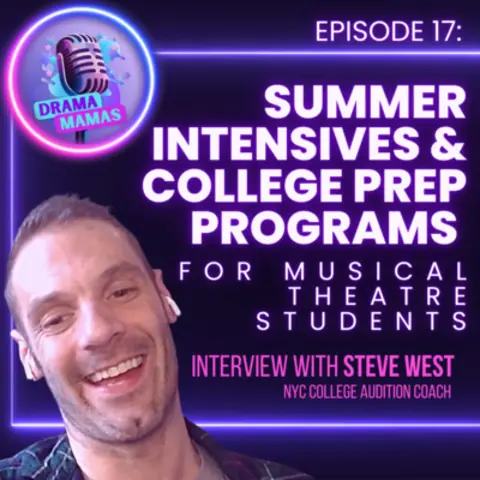
Steve West of NYC College Audition Coach helps us sort out summer camps, intensives and pre-college programs. Which kind makes sense for your child, and how does it connect to a BFA application?
Audio could not load. Try Play again.
Also in this episode
- Local introductory camps usually let you register without an audition.
- Steve recommends starting dance and voice training before the college application years.
Steve West
NYC College Audition Coach (when we recorded).
This transcript was made automatically and may contain mistakes; the audio is the record of the conversation.
Read the full transcript
So I'm Kristen. I'm Angela. Hi there. Hey. And I'm Cathi. So good to meet all of you. Yeah, thank you so much for coming on today. Um, this is, uh, Steven, I suck at names. I'm sorry, Steve West . Steve, I think you like to go by Steve, don't you? It doesn't matter. It really doesn't. Okay. Okay. Awesome. And you are part of, I'm gonna get this right, I hope college audition Pros.
No, that's Drew Boudreau, who's a friend of mine.
Oh shoot.
We actually just met at Unified in New York, this test, uh, a week or so ago. Um, my New York City college audition coach is what the company is we called. Okay. That's the one thing I didn't write. We'll use that as part of our bloopers by introducing you.
Okay. I'm the smartest again. So we have that and I can cut. Well now I don't remember what he said.
It's early. It's early. It's early now. It's Stand in Steve. It's live. It's live. Oh my God's live. I did this one last minute on, and it's eight. It's, we just, everybody has dry tech today. . Yeah. Well, no, we had to kind of squeeze it in early. . Steve, why don't we do this? Why don't we let you introduce yourself?
That's a great idea. And that way everything is super accurate and you can get across whatever. You can stop up. Yeah. And you don't have to rely on us crazy mamas over here to get it right. Oh my goodness. Okay, so sorry, I need to apologize. I'm so sorry. I did do my research. Look . Oh goodness. You're fine.
You're like, I cannot tell you how fine it's, it's no big deal. . You should go anything with us sometime, but we're gonna be in New York soon, so. Yeah, I'll be here for, you know what? Um, that's really exciting. Well, I keep kicking my ring light. See that's what I'm doing this morning. Kicking my ring light. Um, Let me introduce myself as soon as I balance this thing.
Okay, . Um, alright, great. It's, now we're here. Uh, my name is, uh, Steven West and, uh, I'm the founder and artistic director of a company called New York City College Audition Coach, um, which is, there goes my ring light again. Um, which is a company that, uh, just like any other college company, coaching company, um, helps students and families navigate the absolutely wackadoo college audition process.
Um, and part of that, cause I know that you've had folks on the podcast, uh, to that have talked about that process, but part of that process, um, that I haven't heard on your podcast is, um, the summer intensive situation mm-hmm. , which, oh, yeah. Yeah. There's lots and lots of, yeah. There's lots and lots of options for what kids do in whoever that kid is.
Right. What they do with their summers. Um, and with theater kids, it's, it can be. pretty important if you have desires of studying in college. But even if you don't, I think it's summer intensives or summer programs. Summer camps, they're an investment, right? And so why aren't we choosing very carefully and making sure that the program that we do invest our money in is gonna be a program that's a right fit for the kid.
Um, and that's going to, um, enrich their life as well as maybe their abilities and technique, uh, as a, as a performer or a theater technician or whatever it is that they're, they're into in the arts. So, and this is about the time they would start. Um, do you audition for a summer intensive or how does that work?
Yes. So it depends on the summer intensive and I think if I can share my screen, I think I'm allowed to, let me see if it works. I don't want to go crazy with the tech here, but, um, entire screen, I guess. Yeah. And then yes, can also email it for us. Oh yeah. Chris said you can email stuff so we can put up too.
Can you see that? Did, did my screen come up? It did. Yes. So, in, in terms of, I'll start talking about this as loading up in terms of summer programs, there's lots of different options, uh, that one can do. Um, and it starts kind of, it can start as, uh, simple as a, uh, like a local high school will have as some, a theater camp, right.
For ages four through 13 or four through 17. Right. And, and you kind of go from there, from like the local high school, uh, camp. Uh, and that you kind of move on, uh, through that, be before you decide, but you want to, uh, what you're sending your kids to, you want to think about lots of things, but these are just some of them where you're sending them how long they're gonna be gone for or how long the experience is for any sort of covid or health and safety concerns, of course.
And then are you sending them to there to sleep over and stay or are they coming home each night? And then obviously, um, in sometimes, most importantly, the cost of the program. Right. Uh, and there are, like I was saying, lots of different types. It can start at a local high school or some sort of local studio, right?
And those experiences are oftentimes introductory. So there's probably not an audition. You just kind of register your kid and they go, and it's an introductory experience, uh, to, to acting or to the lots of parts of the process of, of making theater. Um, then you can maybe, uh, in terms of, uh, growing intensity I guess, and financial commitment and, um, Just experience, I guess you could think about sending your child to a sleepaway summer camp.
Um, there's frenchwood, there's Long Lake Camp for the arts that I've worked at in the Aurora Mountains. And these are usually fairly highly priced and um, they're very intense cuz you send the kid away and they're doing eat, breathe, living theater all the time, all the time. And then professional regional theater companies often have camps.
Those experiences, the training level can kind of be a little bit higher, uh, and the talent level of the student. And then when I would consider the most intense or here in red would be a college prep or a pre-college program. Oftentimes yes. You are auditioning, um, for the regional theater experience or, or the college, pre-college, uh, summer programs.
And that is usually in the form of video submissions now that we are post covid. Okay. So yeah, that's kind of the, that what you wanna consider and what experiences you, you. Uh, have available to you. So those types of summer intensive programs, you kind of had 'em color coded as you progress through those color codes towards the red, you're also increasing in age, right?
Yes. Yeah, absolutely. And I mean, a a, a sleep late summer camp is gonna serve children very young to probably close to 16, 17 years old. Um, but yes, as we got closer to the red, that would be a student that is one serious about their studies and two, yes, more older than like 14, 15 would be the minimum age.
Uh, usually more like 16, 17. So those are, those intensive programs are important for a couple of reasons too, right? Like, so it's not just the experience for the kids, but it's also getting them in front of people who could potentially want them in their programs and what else? Y y absolutely. So the college prep and the pre-college programs, it, it's.
All but a necessary part of the process, in my opinion, uh, the, the exposure to the faculty is unlike anything else you can get, right? So you're going to this program and you're literally meeting people and working with them in a really, really intensive way in studio. And they're the same exact people that you're gonna see six months down the road when you're auditioning for their school, right?
And so they know who you are when you walk into that room, which that is an advantage that you just can't, uh, you can buy it, actually, you do, you need to buy it. , which is, to be honest with you, like, uh, one of the unfortunate parts of this, it's like a pay to play thing. Uh, but it, it really does help the college audition, your college audition prospects.
I mean, we're looking at numbers like 0.75 to 1.5% at the most elite, uh, schools as an acceptance rate. Anything that you can do to help your kid be in a place where they're gonna be, uh, have a leg up, uh, Is wonderful. Do you have to do that? No, but it's, it's helpful. What does that compare to? For like Harvard or something?
Like for an acceptance rate? That's a, that's a great, uh, question because Harvard's acceptance rate, uh, Harvard is around four four, uh, between four and 4.6%. Wow. And so it is significantly more difficult to get into musical theater school than it is to get into Harvard. And if you are a white female identifying person, and you audition on average for 15 programs on average, you'll be accepted to 0.7 of them.
That's not one , that's not one, right. Gosh. Point seven programs. That's terrifying. Yeah. Okay. Yeah. , this is a little terrifying. So you tell right? No, it, it really is terrifying. You know, it, it really is. Um, but that's why I think that th this whole college coaching thing is becoming more of a thing because you need.
Help. You need help because there's so many schools and there's so many requirements and all the things, um, that is, uh, really difficult to manage for a student alone. And, and even with an involved parent such as yourselves, um, it's difficult to to navigate the process. Yeah. I know you, I've watching, picking up on that, strung through your toss and you kept saying it's not, it's the processs That's crazy.
Not you, you say that a lot and that Yeah. That, that really is, it's the base of my business. I, I am really big on being able to walk the walk and talk the talk and do the theater thing, but also encourage my students to have a life outside of the theater because that will serve them in their work in the theater, right?
We're supposed to play these characters that are all these different types of people. Well, if all you ever do and think about is theater, that's not gonna serve you when you're trying to play someone else, right? You need to have different life experiences and, um, the process is crazy. So I try to instill.
A lot of mental health into the process and make it, uh, a process in which the parents can participate in a way that is as cheerleader and like, yay, this is great. As opposed to like task master of like getting this and this and this done. Like, I like to take that role on myself as accountability, uh, police, I suppose, um, and allow the parents to, to be the cheerleaders and to, to hopefully make this a celebration of who the student is because if they're trying to be anyone else in that audition room, the, the faculty will see right through it.
And so really, while it is very intense and it can be nerve-wracking in all these things, I try to instill a lot of mental health into it and a lot of, let's celebrate the person that you are where you are right now. Right? I'm not gonna make someone that's not the greatest musical theater performer into Sutton.
I can't do that, you know, but I can, he help you identify things that you are really wonderful at and help you pick material that's gonna showcase that and help you walk into a room in a way that celebrates you and helps people realize that, that you would be an asset to their program. So mm-hmm. , that's kind of what we do.
Yeah. And I like that you, one of your videos where you're like, stay off social media basically is what you were saying to the kids. Like, your process is gonna be different from their process and their experience is gonna be different from yours, and you can't keep comparing yours to theirs. I thought that was wonderful.
Yes. It's, and that's, it's so true. Um, a a lot of kids, I think I, I hear all the time, like, what summer program did you go to? What summer program did you go to? And there's. Hubub on social media, and then it gets to the audition season and it's like, where are I pre-screening and what schools passed? What schools did I pass and what schools did I not?
And that is only going to lead, uh, to negative things. And so I encourage them. It's kind of ironic that I'm on social media telling them to not be on social media, but, um, yeah, but you gotta go where they are, . Yeah, exactly. Right. Exactly. Exactly. And that's where they are. And I, I love that they're there. I just think that it is best to keep their, your process, um, between you and your family until you, until you announce, uh, close to May 1st where you're gonna be going to school.
So, so where in the process do you come in? They, they submit their applications and all that, and then you come in and kind of fine tune what they're going to present? Yeah, so I, I usually like to start with the family. Well, first of all, I like to start with the family whenever they seek my services out.
If it was an ideal world, um, they would start probably, Around now, maybe a little bit later, depending on the family and what's going on. But you start to, I have an initial consultation with the, the family, and we talk about, again, the realities of the, of the process which we just covered. And then I say like, okay, let's get rid of that and stop thinking about that and start thinking about how we navigate the way through this process.
For you as a family, college is a very, as well as summer programs, it's a very personal decision for your family and for that kid. And it's gonna be different for every kid. And so how do we carve a path to your kids' dreams that will help them achieve those dreams, but also in a way that when they move to New York or to LA or to some other market that they can keep their own lights on and they're not drowning in student debt, or, it's really important to me that I try to give the most balanced view of the process.
So it usually starts around junior year, the end of, toward the end of the year, uh, junior year, and we start discussing schools that. I think could be a right fit. And we generate a list of, you know, reach, target and safety schools. I'm sure you've heard those terms before. Um, and then we go from there, we start looking at material and, and it, and it, and then we're filming Prescreens by, by the fall.
So, so you're helping 'em figure out what they need for each school? Do they need a monologue? Do they need a, you know, yeah. Ballad, all this. Stuff. Yeah. So, and the requirements, uh, there is now a common prescreen requirements that lots of schools are prescribing to, but a lot of schools will be like, we're gonna use the common prescreen except for this part, this part, and this part.
Right. So I have like a massive spreadsheet that is kind of just like plug and play for families to use. Um, that is really easy to, to, to put the information in that way. And then they'll have, we'll be able to easily amass everything they'll need to film, uh, for each school. But that's a part of what makes it so difficult is that there's all these requirements and they're often different for each school.
Mm-hmm. . So, yeah. Yeah. And you, um, oh gosh, I just lost my question. Oh, you feel strongly about the slate, even like starting out, like don't just stand there and introduce yourself, but make your, explain that. I like the way you do that. Yeah. That's a great, that's a great question. Yeah. The slate is important because it's an important part of any audition, whether it's for college, for a community theater production, if they're having you slate in the audition, or a professional audition is the time for you to go into a room and to interact with people that you're going to be working with in a way that is not a character.
So college auditions, they're not casting the characters that you play in your monologues and songs. They are looking for students to spend four years with. So it is important that you are, um, I like students to walk into a room and right before they walk into the room, think of something that makes them like really happy.
So for me, when I walk into a room, I think of little babies and golden retrievers , because that makes me really, like, I watch videos of those that when I get sad, great. , I'm serious. Um, and so that's what I like to think of, but so put something in your head that makes you really happy. Bring a good energy into that room, and then your slate is supposed to say, this is who I am.
I'm really good at this, and I wanna show you how good I am. Uh, and let's knock it out of the park. So it's like Peter Pan and have a happy thought . Yes, yes, yes, yes. Absolutely. Because it, they really do. I mean, these schools see, uh, video after video, or they see kid after kid in person and they're terrified and they're trying to do it right, and they're trying to give this coached performance, and they just wanna see if you're, if, if the student is able to take direction in who they are as a person, and the, I mean, to be honest with you, the talent is either there or it's not.
Mm-hmm. . And so I would encourage people to worry less about getting all the notes right, or the steps or the, you know, acting the right intention in the monologue and worry about entering the room as you are. Doing your material that is very well prepared, like we prepare so well that it's, it's not, we don't prepare, I don't know what the saying is.
It's like you don't prepare to not get it wrong. You prepared so it can't go, I don't know, something. What are those saying? You, you have to, yeah. You have to be really well prepared. But that's the baseline. Everyone's well prepared. Mm-hmm. , I wanna help students walk into a room, uh, again, celebrating themselves and, and bringing joy and their love of what they do into that room and to expose the faculty to that.
So, yeah. Cause at that point, everybody's talented. You're not in that room if you're not a super talented person. So you have to have something that kind of makes you stand out a little bit. Sets your part Yeah. Starts right there with the slate. Yeah. Absolutely. That's one of those things too, that I hear even from like directors, when you're doing like an audition, they, you know, they can hear that you're talented.
Mm-hmm. or they can see that you can dance, you know, that kind of thing. But what they can't tell is your personality. You know, so like they're looking for some of those other things. And it sounds like they also are, when you're auditioning for the schools Yeah. Like they're trying to see if you're gonna be a good fit for their program.
Right. Exactly. Yeah. Right. Yeah. Yeah. And so it's just important that you are exactly who you are. You're not trying to be anyone else, and that you, um, enter the, like I said, enter the room with joy and, and, and, uh, do your best work. You know? Mm-hmm. . Okay. I'm still terrified at that 0.7% that get accepted. . I know.
It, it really is. I mean, the numbers are really, it's, it's striking, you know, and it, and oftentimes it's for a, you know, there's all this competition to receive a degree that is not an engineering degree or a medical school. You don't, you're not gonna medical school. School. You are not going to, if you are a student that takes on debt, you are not probably going to pay that off right away easily.
Right. And so, um, it's, it speaks to how amazing. This art form, is it cha, like I've heard you all say it changes people's lives. It changed my life. Like on a dime. My entire life in high school changed and now I have a career based on something that my life in instantly in high school changed. And, um, yeah, it just, it, it speaks to how amazing this is because the prospects of employment, the competition to even get into school is so, is so, uh, crazy difficult.
Yeah. And you, one of your videos, you posted some of the, um, tuitions. I literally about fell outta my chair. If I had not been strapped in my car seat belt. I think I'm probably, and I wasn't driving, I was at the pickup line, right? You were in car. I was like, Carnegie Mellon was 80,000 a year. Like that's outta control.
And you were being very real with the students saying, um, it doesn't pay a lot when you get out of school and you're going to, you, you really have to think about the debt that you're going to accrue maybe in a half a million dollar, uh, situation four years later. Holy shit. And it's, yeah, you ha yeah.
funny. You, you, I tried and tried to try to give, uh, students perspective on that because I have seen so many people in this city, like their debt shackles them. It really does. And it, it, it prevents them from doing lots of things and lots of the human things, you know, that are not even theater related, but they don't get to be a human being because there's that additional bill, right?
So it's talking to the students about like, what is your cell phone bill? And then what is your rent going to be and what is your a grocery? All of that stuff, um, comes into conversations at the end of the process when we say, okay, you've been accepted here, here, here, here, and here. Hopefully that many schools, sometimes it's just one or sometimes, you know, um, but what do you want to do with this?
And, and do you want to go to that $80,000 school or do you want to go to something that's a little bit more affordable? But like, , low key, you'll get the same training. Mm-hmm. , right? Like, um, that school might have more prestige to its name, but what you need is a training. Schools, schools can't get you jobs.
Mm-hmm. , some of them can get you into a room. Some of them like University of Michigan, Baldwin Wallace University, Cincinnati Conservatory Music, Boston Conservatory. That will get you into a room that won't book you a job and they don't carry, you went to school once you're in the room, they really don't.
Oh, that's an interesting point right there. Well, yeah, I mean, that's the same conversation. So my older daughter is currently in orchestra at an art school, um, in high school, and she's getting ready, like she's gonna be a junior or she's gonna be a senior next year. She's a junior now. And we're having these discussions about, okay, so what, what do you wanna do when you're done with high school?
Because I don't know that anymore. College has to be the pack. Mm-hmm. . Mm-hmm. like, yeah. What advantage does it serve for? What you want to do is the bigger question. Mm-hmm. . Right. Exactly. exactly like it's necessary. You're gonna be a doctor. Yeah. Go. Yeah, exactly. You wanna be a lawyer, go. You wanna, but, but I don't know.
Is it, is it necessary in this field? It's, that's a great question and as someone who coaches students through a process that, you know, the, the aim most of the time is to land at a four year university or a conservatory style training program. Um, I am really big on, in the very beginning saying, if you don't wanna do this, you don't have to.
And that's okay. That is okay. That is fine. And you can participate in patronize the arts in many different ways as a doctor or a lawyer, or a school teacher, or a whoever. And so, I, I don't, especially if I meet a kid really like, well before they audition for college, I think sometimes they don't wanna disappoint me or something.
Like I, I'm proud of my students, whatever they do and wherever they go to school. So it is about what, what do you want out of life and how are you going to. To get it. And my job, if you do want to have theater as a part of your life in terms of what you're studying, is to help you make the most informed decision for you and to help you present your best self, um, to the, to the academic world as it were.
Uh, yeah, that's, so that's my feeling on that. And, and what you do with your degree, nobody really uses their, I don't know, some people do use degree of course, but what you learn from theater, whether you're doing it at the community theater level when you're seven years old or you're having a BFA and musical theater, you're learning soft skills, right?
You're learning communication, you're learning team building, you're learning to show up on time and to work collaboratively. And those are in the corporate world called soft skills, right? And those skills are important. You're not gonna be a computer coder if you don't know how to computer code, but the technology is.
Rapidly changing so quickly that everyone is constantly learning new skills. So if you go into that interview and you are wonderful to be around and you can read the room and you have empathy, all those things are what theater teaches us. So you might get a degree in theater and to do something completely different.
And I know for as many people as I know that have like left the industry or left the city in, in ways that are not the most great, I know people that have left the industry and live in the city and make out like obscene amounts of money, and they are very transparent about the fact that they would never have that job if they had not done theater.
Mm-hmm. , whether they have a degree in it or not. Yeah. Um, yeah, we've heard that over and over, that kids that participate in theater kind of have a leg up on the other kids because of all the things that you're saying, all the skills that they're learning outside of just the singing, acting and dancing, just working with others, collaboration, listening to direction, all of those things.
Yeah. And, and something I I want to build out in, in my own business is, is to help students as they go through the undergraduate process of making sure that they are looking at the skill, those skills in a more serious way and how they may be transferrable to other industries or how they can use them to propel themselves as entrepreneurs.
Cuz now the thing is, I don't know if you've heard the, the term multihyphenate artist, you have to be able to sing dance act. You should probably tumble and yodle and you know, no sign language in all the things, right? . But also you should be able to create content and have this social media presence. So it's, it's about learning all of those skills and learning how to monetize them so that when you get to a city you don't have a job that is a survival job.
You have a job that helps you thrive, that will make, that will help your work as an actor. Um, because that. Oth, otherwise you're going to burn out really quickly unless you're a really, really, really, really dedicated person. But it's easy to burn out in these big cities. Mm-hmm. . So Steve, a quick question for you.
So, you know, we're surrounded by kids. All of our kids, they love doing theater. We have friends that are just got back from Chicago and New York and doing auditions and unified and all of these things. Um, if the end goal, let's say, is to be on Broadway, right? These kids, they all wanna be on Broadway. This is their dream.
Is it completely outlandish? Like, do you need a BFA to be on Broadway? Like, is that something that they will look at and say, Hey, this is great. I mean, I know you said certain schools will get you in the room, but does that degree do anything for you getting on Broadway? That's a great question. Um, I like to answer that question like this.
It depends on the person. Mm-hmm. , I needed to go to theater school because I was an athlete my whole life. I didn't, I didn't do my first play until I was a senior in high school. Mm-hmm. . And so I needed the training. I didn't know what I was doing, to be quite frank. And so I would've never worked at a, as a professional actor had I not gotten that training.
Can you get training outside of a four year, uh, degree program? Yes, you can. You can move to New York, you can move to Chicago, you can wherever. You can be in Florida. Where in Florida are you guys, by the way? Lakeland, we're kind of between Tampa and Orlando. Okay. For some reason, I thought I read Winterhaven.
It's close to there. Pretty, pretty close to that. Yeah. We do things at Haven as well. That's where my parents, they're like snowbirds in Winter Haven, so. Oh, okay. Yeah. Oh yeah. Yeah. Very cool. Um, anyways, uh, yeah, so depending on the, on the person and you, you know, you go to Broadway shows and you'll see when you're, when you're here, if you're seeing shows, look at where they went to school.
You'll see a lot of theater degrees. Most of the people will have a theater degree, but someone will have studied biology or someone will have not, not gone to any sort of higher education at all. It is not a absolute requirement, but I think it's important for the student or the, the actor to know themselves.
I needed the training and I also, it was important for my family that I have a degree, that I have a bachelor's degree in something. Yes, , which I think as, as time progresses, is, is that important or not? I'm, I'm not sure, but, uh, it was to my family and so that's why we, we selected the. The college route, so mm-hmm.
Gotcha. Okay. That makes sense. Well, I always find college to be kind of a little training period between childhood and adulthood. Like you're not, you're on your own, but you're not completely out there stranded, figuring out you've done high school, you know everything. Right. Yeah. and, uh, supposedly anyway, you need to be beat back down a little bit.
Yeah. And that's what college is there to provide. Uh, yes. And I, I think when you graduate college, you feel like, you know, any, everything, and then you go into the, into the real world is like what I'm learning in my, my almost 37 years now, is that I don't know a whole lot, but I know that I want to be a kind person and put that into the universe and lead with that and just try and do my best.
And we're all just figuring it out anyways. All of us in any industry, in any, you know what I'm saying? Like, we're all just trying to figure it out. Yeah. So. Well, and speaking of that, I know you have a business and you're out to make money, but I feel like for you, it's almost as important. You're like the advocate for the kids.
Like I can tell you passionately care about these kids and you wanna give them good advice and you want to steer them in the right direction. Where does that come from? Where does that passion and that desire come from for you? Um, I appreciate you, you, you're noticing that cuz I really do, uh, feel that way.
Um, I come from, uh, a family of, uh, like my parents worked really hard when I was a kid and they gave my brother and I a wonderful life and we never needed anything. But I came, we grew, I grew up in a, a fairly affluent area just outside of Detroit. And when all of the other kids, when we turned 16, everyone got a brand new.
My parents bought me a car, but it was like a 1992 Sunbird, which I am eternally grateful for. But I always felt like I wanted things. But my parents worked really hard to, to have, uh, give me private tennis lessons and to give me private this or send me here to do that to, to they refinance their house, to send me just to, to college and to study at the Moscow Art Theater School in Moscow, Russia for a month.
They worked their tails off. And so it's important to me that when I work with the family, I will go to bat and to bat and to bat and to bat for you. And I don't stop until we found the place for that, that kid in that family. Um, and I don't like the relationship to end once they signed their school. I have relationships with all the families that I've worked with, um, into college.
And I'm always here as a resource cuz it's hard. This, it's a hard major to get into. It's a hard business to get into. And so if there's things that I have in my head, yes, do I need to make a living? Of course I do. But they're in my head. I have it to share and I want to share it. So, um, do you feel their joys and pains as deeply as they feel them, like when they get accepted or rejected, , is that hard for you?
Yes, and I'm working on that , um, each, each year it's like, oh gosh. Oh gosh. Oh gosh. Um, but I'm getting better at it. But, uh, that's, you know, when I lay my head down at night, that's why I go to bat and bat over and over and over for each kid because I'll know I've done absolutely everything and I want them to know that they've done absolutely everything, because then it's not up to us.
Mm-hmm. , it's not, and that's a part of this process, and it's a part of life. There are things that aren't up to us and we have to, you know, roll with the punches, as it were, but. , the things that we can control, we should, right? And so we should do everything we can to achieve what we want. And if we don't get it, then we have to have a plan B, but mm-hmm.
you know? Yeah. You talk about, um, Mike, I'm gonna get the phrase right here, diversity, equity, and inclusion. Um, you feel pretty passionate about that as well, and calling out schools that don't, they say they're doing that, but they aren't necessarily showing it in some of the things they do. Yeah, I think, um, we are finally just beginning the conversation about diversity, equity, and inclusion.
Um, and these are, they're hard conversations that we are all, um, hopefully engaging in, um, in every facet of our life. Uh, and the college theater world is no different. Um, it, it used to be that you would look in a studio picture of, of a musical theater class, and there would be like one, one actor of color.
what is, what is that? Right? Like that needs to change and schools need to actively be recruiting students of color. And on the other side of that, like, and this, this might be a hot take or a controversial opinion, but like, what that will mean to, to be frank, uh, is yes, it will be more difficult if you are a white female identifying person.
It will be right. And that's your, your thing that you need to deal with. But in the grand scheme of things, it's where the country is moving and where it should move. And, and you are, and everyone is a part of that, right? So, um, and the calling out the schools thing is like lots of schools are saying they're doing it and they're not in terms of their curriculum.
Like what plays are you producing, right? And how many students of color are you accepting into your program? Uh, and I think it's important for all of us that are involved in the industry in any way, whether you're a coach, whether you're a faculty member, a parent, a student, , it is all of our jobs to be vigilant about that and to play a part in that, so mm-hmm.
um, cuz it will make, it will also make better art too. Yeah, absolutely. To have a diverse Absolutely. Population. Absolutely. Um, some of your advice, cuz I know some of these kids are applying to 20 plus schools and, you know, beyond the tuition they're facing is all these application fees. And you recommend, you know, if someone is struggling with that to write the school and ask for help with that.
Can you explain that for us? Yes. So there are these things called fee waivers. So I have a student who, um, found me off of TikTok on her own and she requested a meeting with me and she was super transparent and very honest and she just said like, my family didn't have a lot of money. Like, I don't even know if I can have this meeting.
And I said, of course you can have the meeting. Let's, let's talk. Um, and this young woman is the hardest working. like person I have ever met, and she is at every turn doing every single thing that she can do to a avail herself to these schools and to this process. Um, and there is one particular institution that she applied to the school on a fee waiver, and she then went to sign up for an audition.
And she was not granted a fee waiver. No. Yes, it was for her audition fee. And they, they wouldn't grant her a fee waiver and she called the school and, and explained the situation and they still would not grant her a fee. Finally, there were some other phone calls made by some other FO folks, and she had that fee waiver by the time she got here to New York and she went into the school to audition for them.
But you might have to ask for it, but if you need it, it is now. For most schools, not that one particular school, and I won't mention the school of course, but um, this ring light, uh, it, um, it, you have to ask her what you need. Uh, and I think schools are getting better about, about, um, availing that money to those students because you don't need, if you don't need that student's $50, you really don't.
Right. And it's obnoxious to ask it of them, in my opinion, you know, so. Right. Cause you're paying an application fee in all kinds of different fees. Speaking of that, you talked about, um, coalition app versus common app and Yeah. Coalition versus common. Yeah. We care about common app a lot. Tell us about coalition app.
So there are a few other things outside of. Common app that will allow you to apply for multiple schools on one application. The coalition app is, is one of them. I know that the state of Texas has one. There are a few others out there. But the thing about theater people or theater kids sometimes is they will max their common app location out.
You can only apply for I think like 20 or 25 or maybe 30 schools, but lots of students will max that out. And so if there is a school on your common app at the start, that is also being Zed by the coalition app. You want to get that school off your common app so you can then put another school in its place, um, just to be able to apply.
Right. And I think bottom line, bottom line, if you approach a school and you say, I, there's no room on my common application. How do I apply to you? They're not going to say no to your application fee and, uh, to seeing you. But, um, that can be ways, uh, to alleviate your common app, which often for theater students will fill up quite quickly because they're auditioning, like you said, 20, 25, 30.
I had a student approach me this past cycle with 42 schools and I said, no, no, no, sweetheart. We'll not be doing that . But yeah, it's, and that's a lot of schools. That's a lot of schools a lot. And that will make you crazy. Crazy. And it's, it's, it's, it's the audition process and all the requirements and all that artistic rigamarole, but also the academic application.
It's basically applying twice to each school. And you need to be accepted on both ends to get into the theater school. And it's, so that is difficult too. And oftentimes kids that are applying to arts majors. Are given more supplemental essays to write in addition to your essay for the common app. So it's that part of the process too is an incredible amount of work.
So it's, it's intense this scholar process. Well, and it, I parents need to not wait till their sophomore, junior years to start understanding all of this. They need to be like, yeah. Processing it and gathering information and because it's always coming down the pipe helps you better implement when it's time.
Yeah. And, and, and if you do that, I mean, honestly, like if, if you do start, I, I would say this might not be the best thing as a business person, but if, if you do start as a sophomore and, and you gradually learn it, maybe someone like me wouldn't be as necessary or you'd only need a coach for the artistic things.
Right. Not the academic things because. If you do take that time, then you won't panic. Because I think what happens to parents and students is that they're constantly going through the process and feeling like they are catching up or they messed up, and now they need to cover for that. So if you understand it from the start, that is a great leg up and we'll do, we'll do your student a great service, uh, in terms of their anxiety level and what they're bringing into the room eventually.
But, uh, yeah, it's, that can only help you if you, um, are that prepared or start that early. Yeah, and I think we forget because we're so involved in the theater and we have friends that are going through it, so we're hearing all this, there's a lot of parents out there that aren't, they're kind of out there isolated on their own trying to figure this out.
So having somebody like you to help them through the. Yeah, it was a real gift. Yeah. And it, it, it's early preparation too. If, if your student says to you, I wanna study, I wanna BFA a musical theater. And they're saying that in middle school, there are things that you can do to help start preparing them.
And you know, like we start talking about in the beginning of this podcast, like, I, I, I love when my students play on a soccer team. I love when my students got horseback riding and things like that. But if they really do want this, you know, definitely start taking dance classes if you haven't started taking them yet.
And voice lessons if you can. And, you know, there are, there are more affordable ways to do those things then, then the traditional, like really high price, the most expensive voice teacher in the, your community or the most expensive dance studio. So there's ways to expose your student to those things that will be important in the process and will help get them a leg up on the competition if they are identifying that they really want to do this in college at an early age.
So mm-hmm. well in. Speaking of, you have a pretty heavy dance background. I don't wanna skim over all your qualifications. Can you tell us a little bit about that? It's funny that with me in the dance experience, like I, I move well, but I'm, I, I have friends that work at the New York City Ballet. I'm not a dancer, , and I, I, I move well and was an athlete most of my life.
And so I think it's, it's funny, like oftentimes, like I'm rehearsing a show right now and they're like, everything that is movement related, they're like, you do it. You do. I'm like, what? ? Um, yeah. I just move. Well, and I'm, I'm tall. I guess I'm six foot four, so I'm, oh, I don't know. I, yeah. Have good lines, I guess.
Mm-hmm. , it's all those tennis lessons, you know? Yes, exactly. Exactly. It's all those kinda, was that your sport? You keep talking about being an athlete. You were a tennis player. I played soccer, uh, most of my life until high school, kind of, and then I started playing tennis in high school, and then I was the captain of my team, the number two single player, singles player on the team.
And I had been playing on the team for four years, and I was the lead in a play. And I had my mom drive me from a tournament to the tech rehearsal. And that's illegal in the state of Michigan. If you go somewhere on a school bus, you have to return on the school bus. And I did not know that. Oh. And my Kenneth coach's response to that was to kick me off the team as a senior and the captain.
Oh my gosh. It was, I mean, at the time it was devastating. Yeah. It was, it was really, really, really a terrible thing. Irrational. . Yeah. It's extreme. Pardon? That's extreme. Yeah. It seems a little irrational. . And, and the director of the play went to, to her, the, my coach and said like, he, yes, he does need to learn a lesson about overcommitment, but he's a good kid.
That's why he's in this situation cuz he is involved and she wa just wasn't happening it. Wow. Um, so sounds like they made an example out of you. You know, they did. And, and in the end of the day, my counselor, my coach was actually a counselor, not my personal counselor at my school, but my personal counselor obviously knew her and was counseling me through this awful thing that was going through my, I was going through in school.
And she said, look, like you're not gonna be a professional tennis player. You don't want to do that. You do want to be an actor and you wanna go to theater school. So, yeah. You know, it wasn't to say like, oh, you're fine, nothing happened to you, but at the end of the day it worked out. Mm-hmm. . Yeah. Um, but, but it was.
You know, I also went to a very large high school. There's 6,000 kids. Oh my gosh. And so there's things were really competitive and it was oftentimes difficult to do multiple things. Yeah. So it kind of sounds like in retrospect, not to get too deep here, Steve , but like, it definitely sounds like that kind of needed to happen to spark and fuel your theater love.
You know, like, I mean, who knows what would've happened if you stayed on the tennis team and weren't able to fully immerse yourself in the theater piece? So, and that looking back Exactly. And I think it, yeah. You know, I'm a firm believer in most things that happen in life that are for a reason. Yeah. And they're dared to, you know, as a door closes, as the window opens and whatnot.
It's such, um, and it's the theater thing. It it, I caught the bug so, so hard and it's because of the community, my. Best friends from high school theater are still my best friends from today. Mm-hmm. , like their children are like, like my children and my heart beats outside of my body for their children. And we are still best friends.
And also our mamas were the drama mamas. Before the drama mamas were the Drama Mama podcast. But like, yeah, when we, when we were rehearsing our final show, 42nd Street and at 10 30 at night, our director. set your costumes and props We're going from the top at 10 30 at night. Oh gosh. I ran up and like the cast groans and I stand up and I'm like, big quiet.
Set your costumes. And we're going from the top and like running out to my primitive cell phone with like my Nokia brick on a cell phone. And I'm like, mom pizza now. And they're like 15 minutes later. Here comes Jean West with all the pizza and like towels from our personal bathroom, like our family's bathroom cuz you can't eat in costumes.
So she's like, put this on your body and eat it . And like we, you know, we left at two 30 in the morning and there you go. And our friend Ashley's mom, Ashley's mom, like, designed our costumes. She literally had like a sweat shop in her basement. Oh my God. For like a solid four months and like, made the most insane costumes.
Like it So it, it's, it's the community and, and yeah. Yeah. Um, it speaks to when parents are involved. The, the impact that that can make. And so I, I wanna take a, a second to thank you guys. Uh, what you're doing for your kids is amazing. Regardless of what they end up doing with their lives. Um, it's, it's really commendable.
And this is just like the podcast is above and beyond . Yeah. Listen, I wanna meet your mom. I know. She needs to be on. We had your mama. We need to have a Queen og, right? Yes. Drama Mama . Yeah. Cause Lord knows I do not know how to sew . Oh gosh. And, um, yeah. That's, that's amazing. But that's what it's all about, right?
Yeah. Steve. And that's what you're trying to perpetuate and support with what you're doing, you know, it's just Absolutely. Yes. Yeah. Um, because if you do, if you do want to take this, cuz it's, it's this nurturing environment and if you want to then. , it, it's, it's kind of sometimes jarring that you take it from this like, feel good place that's safe, and then you put yourself in the lions den of this college audition process that's very competitive, right?
Yeah. And so I try to, um, again, encourage them to realize that you have a life outside of theater and that will help you in your work as an actor. And also mental health. Mental health, mental health, and making sure that your, uh, students and families are taking care of themselves through the process. Um, and that, uh, it's, it ends up being a celebration of that student and who, the person that they are, and that hopefully the, the families have a little bit of fun while they're doing it.
Mm-hmm. . Um, that's, that's I think oftentimes hard. You, when you're stressed out, , that's what it's hard to do when you're this and you got dry tech and you gotta go here and you, oh my God, there. And I mean, like, you know, we're living that life now. We love it. We wouldn't trade it for the world, you know?
Yeah. But, uh, it's, it's all worth it when you see your child happy and thriving, you know? Yes. Yeah. And that to, to kind of loop back to summer programs. So there's all those summer programs that are the types of experiences, but there's also other things that you can do. And specifically, I can talk to you guys more about it when you're in New York and um, I want to, uh, hook you up with the artistic director of the company.
But we do something called the Broadway Experience. And what happens is you rehearse a number in Florida and you take that number and you bring it to New York. And on Saturday you see a show that the artistic director does about her journey from California to here. And then, uh, that's Friday night. No, that's Saturday Night Sun.
I'm getting outta myself. Sorry, . It's okay. Yeah. Friday night is the show that you see Jackie do and then. Saturday, you take that number and you go into a studio here in New York City and you work it with a Broadway performer and that performer also performs with you. And then on Sunday, the whole, all the, the whole company comes together.
So you have a pro professional music director and Broadway director, and all of the groups from all over the country. There are several groups that come, you all rehearse at once and on Monday you, your students will go through the stage door at the Gershwin Theater where Wicked Plays and they will make their Broadway debut in a concert that Monday night.
Oh my gosh. I bumps . So cool. Okay, so when is ? Yeah, if I, if I can, I don't know if you guys will be able to see it, but if I can just try to share my screen one more time. There's a, a we video that I can share with you, uh, that will kind of sum up the whole experience. I think that our drama mamas and we as students would have like lost our minds, like Yeah.
Uh, And it benefits autism awareness. So it's a good cause, and it's, it's really a phenomenal, um, it's one of my favorite, uh, days of each year, um, in my calendar, so I bet, um, yeah, definitely send us that in. Yeah. Yeah, yeah. Please do. That's amazing. Please do. So, yeah, I certainly will. You give a ton of info.
Stop hearing on TikTok. How can people find you on TikTok? Cause you, I was having so much fun just watching . Yeah. I, I, I, I, the TikTok book, I, I got that one hard too. I was like, woo, this is actually kind of fun. . Um, so on all social medias on, uh, Instagram and TikTok, uh, and Facebook. Facebook and YouTube, which are horribly not taken care of by me.
But, um, it's all New York City and, well, NYC College audition coach. Okay. NYC College audition coach. Okay. And then let's promote your business as well. Tell us about how they can find you and, yeah. So. Uh, through all those social media platforms and then@www.nyc college audition Coach, uh, is the website.
Um, and you can book sessions right there. Uh, and that's, that's how you get in touch with me and I'll, I'll, I'll send you guys my email address and whatnot that you can put in show notes. I think, uh, if family's want to, uh, connect with me that way, I too. Awesome. Yes, because I'd like to just pay to hang out with you for a couple hours.
Salad. . When you're in New York, we're gonna hang, I hope. Absolutely. We're here. You take, we go get drinks. We'll have so much fun. Yes, yes. I love it. Let's do it. . Yeah. Cause you kind of embody what we're trying to embody, which is Yes. Advocating for the kids, informing us and others mm-hmm. so they can be successful and just your positive spirit, you know?
Yeah. We are huge about positive and you can pick that up on somebody, you know? Yeah. Oh yeah. Right away. And you just exude it. Mm-hmm. and so, Yeah. We, we respect that immensely. And you're just fun to be around. Jean West must be very proud of you. . Oh, yes. . She's, she's, she's, she's, I'm sure she'll watch this.
We
maybe we'll FaceTime her when you're in New York. She got timer. Oh my God. Awesome. Yeah. Oh gosh. So we're certainly looking forward to that. Thank you so much. Yeah. And we can't wait to get some more information mm-hmm. on that program and, um, all that good stuff. Yeah. Help spread the word and, yeah. Mm-hmm.
And you said you're in a show now? You're rehearsing now? Yes. Uh, it's just a, a little educational tour. It's a, a theater company that I teach with, that you in school, residency work with, we're touring to, to the schools that we teach at. So it's, it's not a, a big deal per se, but it's just a show that. I'm working.
Every show's a big deal. Every role's a big deal. Yes. Yeah, no, you're right. Anytime you get to perform in New York is a really big deal. Absolutely. No, thank you for that reminder. . That's what we keep hearing. You live in New York now, correct? Pardon? You live in New York now In New York City. Yes. I lived here.
Um, I, I went to school in, uh, Detroit at Wayne State University. I worked two years regionally at the Great Lakes Theater Festival, which I was super grateful for, uh, learning how to go to work in learning how to go to rehearsal as work. It's not, it's no longer your avocation, it's your vocation. It's your job from nine to five.
Right. So learning to do that in Cleveland, uh, in a beautiful, like recently, uh, renovated, uh, theater that was really beautiful and it's a big AC actors equity company, and Tom Hanks and John Lithco had worked there. It was amazing. Um, and then I moved here in 2011, which seems insane. Mm-hmm. , because sometimes I feel like I'm in middle school and I'm like walking down the street and I'm like, where was my chaperone?
Like, what, what's going on? Like life, life happens fast, you know, it's quick. Oh, I goes fast. This thing. Yes. I still feel like I'm in high school. I can't understand what happened. He's adults today are not adults. No. I think overall we're all just kids. Just you knowing it out.
Yes. Is ridiculous. Sometimes when students, I think they get like, they're like, oh, New York. I'm like, seriously? I have a bike in my room, , there's a bike in my room. Like, you don't need to be nervous. There's a bike . Um, like, I, like, I like I have, I I've had a great career. I love my job. I'm good at my job. I know these things, but like, life is like that.
Your camera falls sometimes. Mm-hmm. . And there's a bike in your room and your voice is tired cuz you're in rehearsal. Yeah. So like that's, you know what happens sometimes. Well, and kids need to see that. I mean like, we're pretty transparent about what idiots we are. . Like they need to see that. People are just people, no matter what you are, you're, you see it all the time.
The kids put so much pressure on themselves to be perfect, and it's like nobody is, and they just need to realize that like shit happens. Mm-hmm. , and you just gotta, it's more about how you roll with it mm-hmm. Yes. Than it happening in the first place. Yes. So not happening. Absolutely. And that is, that is so true.
In an audition, you need to tell your kids, the most interesting part of an audition is oftentimes if the actor makes a mistake, why? It's because they are actually present in that moment thinking, oh shit, I made a mistake. As opposed to I'm doing what I practice a gajillion, gajillion times that the actor, especially the student actor, is finally in the room with you when they're making a mistake because they're having to deal with it.
And so it's not that I encourage my students to make a mistake at their college auditions. I don't. Right. But if they do, like you said, roll with it. Mm-hmm. and, and you're probably more present than you would be had you not made that mistake. Mm-hmm. . So it's very smooth. Yep. Yeah. You smart actor. So yes.
Absolutely smart. And all of these little situations and things that we're exposing our kids to is only going to Yeah. Help them, you know? Absolutely. Um, our two children are doing a Arts Alliance thing today at a nearby park that's here. Okay. And, um, forgive me, I forget the actual name of it, but anyway, this was like a last minute thing that our community theater, you know, was like, Hey, would your kids come and represent us?
So anyway, so we're doing that today and that was a total last minute thing. And so our kids had to feel like, okay, what song are we gonna sing? What's this gonna be like? You gotta get the track. You know? And so all of putting them through, Little pressure of Yeah. Oh gosh, I gotta do this right now. You know?
Well think he hates all the last minute stuff. Yeah. So, I mean, even driving her home yesterday, it's yesterday, she was stressing out about it. Oh. Because she's like, I don't wanna sing Lamest Place in the world again. It's such a hard song, . It's like, you've been doing it for like six months. How is this so hard?
And you got superiors. Yeah. At, at district. And it's, and it's, uh, state and at all county, like on that. Wow. Like, just, just do great. It's like, but it's hard. , . Kids are just wild, you know? Yeah. They're so, they're like, everything's a big pressure cooker to them. Yes. Everything's pressure. And they need to realize it's, it's not the end of the world.
You're doing this for fun. We're not being judged today. Yeah. We're just going up there. It's experience. Yes. Experience. It's experience. And I guess that's, that's the point, right? I'm trying to make mm-hmm. Everything that we can help expose them to is so important. Yes. And, and you know, the layman's place in the world, this is a hard song.
It's from 13. This is hard. Right. But they're going to go and they're going to do it and it's going to go however it goes, but they'll have done it. Right. So, um, to throw in another tennis reference, Billy Jean King says that pressure is a privilege, and pressure is a privilege, and you are, your kids are learning to deal with pressure.
Mm-hmm. , uh, through all of these experiences. So, yeah. That's awesome. Yeah. , that's cool. So, any last minute advice or last minute, last piece of advice that you haven't shared that you want to share? Oh gosh. Um, you know, I, I think people are often told if there's anything else in the world that you could think of doing that's not theater that would make you happy, you should run and do that.
That's what I was told. Um, I think that's fine advice, but I would add this caveat to it. . If you can't think of anything else to do that would make you happy, you better at least try and do this and try and do it really well. Because then you won't wake up at 40 and have like a quarter life crisis or a midlife crisis about having not tr tried.
Right. There won't be regrets in your life. So if you, if there is something that you know you'd love to do, go ahead and do it. And if there's not, do this and do work really hard and do it to the best of your ability, but then you won't have to say that you didn't. So that would be my family. My mom was good about that.
She was not a drama mama, but she was, I was an athlete and she let me try anything. I wanted to try. I did horseback riding, I did gymnastics. I did it all until I found what sticks. And so if you don't try the other things, you're not gonna know what you really, really enjoy. Exactly. Yeah. I love that. Yep.
Well, we appreciate you getting up at eight o'clock in the morning with us . Yes. It's an early morning for all of us. Yes, that's great. No worries. Thank you. I feel like you might have energy anytime of the day, so I don't feel that bad about it. Well, and if you don't, I often do time you take a nap, . Yes. But you, you guys are going into text today, right?
You gave you a text? Yes. Yeah. We got Dry Tech today. Two different shows. Kathy and my husband are doing Chi Chitty Bang Bang at the Lakeland Community Theater, and then Angela and I are doing Into the Woods at Winter Haven's new Black Box Theater. So there you go. Yes. Tell your parents to go see it. Oh yes, yes.
Oh, we can meet Gina. They're down. Yeah, I have to figure that out. But if they are, I'll tell them. Go. Yeah, I could totally lean. We can lean Jean. Tour , tour Sophie and Jean . Come find us. We'll be wearing black . They're, they're, they're also always trying to get me to go down there, so maybe I'll just come down there.
You'll come up to New York. We'll just have a whole thing. There you go. This absolutely. It'll sounds fantastic. Oh, we are your new besties and vice versa. That's right. I'm so excited. . Love it. Well, you're thank you to our Well, thank you guys so much for having me on. Thank you. Yeah, you guys, you're amazing.
Thank you so much for Thanks. Coming on. Take your time with us. Yeah, have a welcome. Thank you. Yeah, I'm wanna go out with him. I know we're gonna have so much fun in New York. and he's like, we'll meet up. He's gonna meet. Help us up with the artistic direct. What? Yeah girl. We might need to, have you paid for Destination Broadway yet?
Cuz I have not. No, no. Not yet. We got time. Yeah, I, I was. Thinking about that the other day, I was like, we need to get, cause we haven't done the audition process, we haven't done like fucking anything. We just know we're going to do it this year. Mm-hmm. . Yeah. Yeah, yeah. But I assume we're getting down to it so we gotta get down.
Something else pops up that's, we think is gonna be better. Like we're not sold on that mean this good time last year, but again, it was our first time doing any sort of intensive. Yeah. I don't have anything to compare it to, you know. Well I, you know, it's funny cuz I didn't really think about it in the same kind of vein as like those, the, the ones that high school students are doing is they're headed into college.
Yeah. But I guess they really kind of are. Yeah. Like the, the stepping mm-hmm. Stones through that and Destination Broadway has a whole separate section just for kids that are getting ready to go to college. Oh, okay. So they combine it. There's a whole, a whole seminar. We didn't choose to go to it cuz Right.
We were young, you know, obviously. So we're not quite there yet. But you can probably leave that running for a minute. Um, but you can go ahead and. attend that piece of it. Mm-hmm. that they did, there was quite a few. So it was broken up to like A, B, C by age group. Okay. So C's your youngest, so Gabs was in the C and then B is like that middle school, middle age, I don't know, probably like 14 or so.
And then a's were like your mm-hmm. High School. Okay. The same kinda idea you're with like professionals with the Broadway people? Yes. And the cast. Same thing. Yeah. Mm-hmm. . Yeah, yeah, yeah. Same thing. This, this is just a different experience. I mean, depe, depending on the timeframe, cost, et cetera. I mean, feels like a New York trip for next year, depending on when it is.
Yeah. Depending on what it is. Absolutely. And if it's just a quick little weekend. Mm-hmm. . If it's a Thursday through Monday, it can be a Tuesday. Cause you perform Monday. Yeah. Too true. And then maybe you get in Wednesday, I don't know. Or Friday's the show. So maybe you get in Thursday. I don't know. But anyway, I mean we could potentially do both.
Mm-hmm. , I mean, I don't know. We just have to look at what else is going on. Yeah. Um. And, you know, if we decide to do destination, L c T has their two week at the same time. So it's like, what? Yeah, I know Pinky this year isn't planning on doing the ones that are local here, so she wants to do that. And if it's not that, then we'll probably look at what some of the regional theaters doing.
Yeah. Because Strat has one. Yeah. Well, and I, and I know Orlando has one too. Okay. Yeah. Um, but yeah, like she's starting to realize, and this is great because for so long she was adamantly not wanting to go outside of this bubble mm-hmm. because it felt safe, I think. Mm-hmm. . Yeah. But she's starting to realize more and more that she needs experiences outside of this group.
Mm-hmm. , she needs to stop being the big fish in the small pond and start, you know, trying to get out there and go through the process with new faces. Mm-hmm. new people and mm-hmm. , you know, cuz it's, it's good for, from a learning aspect, but it's also like, It can be really good for your, um, internal, you know, ego, I guess maybe to Absolutely.
To see what that is like when it's against different people for a change. Yeah. Well, and I think too, this was like with teaching, I always thought of it. You got a little something from every teacher, a little something different. So if you get expose yourself to different directors and different choreographers, you're gonna pick up something different from each of them, and then you're gonna be this like super well-rounded Yeah.
Person because of it. Yeah. Yeah. If you're always staying the same person who'd be fabulous, but you're not learning it in a different way. Right. So I think it's It's so true. Yeah. It can't hurt to get different. Right. Absolutely. Experiences. Yeah. Yeah. Just makes perfect sense. Means a little more time on the road and
Yeah. Commitment from the mamas. Yeah. Like, it, it gets a little bit harder, you know? Especially if you, we can't convince our kids to all do it together. Gets starts. Yes. It does Difficult. We can't rely on each other, like our schedules right now. It's hard. Like, you know, as, as the show's ramping up, we're not together.
Mm-hmm. I know this time we're split. This is our first time you guys. I know. And we're getting well-rounded too. We're Oh my God. . But, but we need our kids to go get well-rounded together. Yes, we do. They need to travel in a pack, so make it easier. Be well-rounded together. Yes. Yes. Selfishly . I know, I know.
It's a little bit selfish about that. Yes. Yeah. I know. It is. It's so hard. Oh goodness. It's do depressing. That's, that's what I love so much around about our group is that we've found each other mm-hmm. and we're, you know, we're our own support group. We are , you know, when you're stretched thing. Yes, yes.
And we can, can step in and help like this weekend, you know? Mm-hmm. , it helps shuttle kids from place to place. Mm-hmm. . Yeah. It's important. It's important to have that support group. Yeah. You need it cuz it takes a village. It really kind of does. And you know, I, this, I feel that's part of like, Our, our mission is to help these parents mm-hmm.
who don't have the help, but there's this other part of it that we can't help with. And I, I hope they find their, find their people parent group that helps them kind of have that piece that mm-hmm. that it's so necessary. Yeah. And we're gonna sound like a broken record, but the way to do that is to get involved.
Yes. It's by volunteering, by getting your face and there by meeting people. Yes. Having things in common. Yeah. You know, and experiences in common. That's how you build relationships. You're not gonna build it, just dropping your kid off and picking them up. That's very true. Yeah. So, and honestly, if you're trying to help them navigate what it's like to actually do this professionally mm-hmm.
um, and to, to the process of ramping up to do that, you know, you, you can't do it if you're blind. You've got it in there and talking teacher, you gotta jump in teachers and talk with your instructors mm-hmm. and mm-hmm. , you know, get involved in tech. Mm-hmm. And try to understand as much as you can understand, because every face of that is important and every person that you meet will tell you something new.
Mm-hmm. and, and. , you know, more light bulbs will go off for you and you'll, you'll learn in that process. Mm-hmm. . Yeah. Can I start as simple as something as volunteering at the front of the house to take tickets or sell raffle? Exactly. Just meet people. Just being present. We just gotta get out there and meet people.
Yeah. It's so true. Yeah. I mean we had, we experienced our little village just in the past couple days, so, you know, gab chose this other song to do for this thing today. Mm-hmm. and Jordan Center. The track, it's a little bit different than how Ms. Frito plays it on the piano and there's like this little space in the middle of the song that's, it kind of pauses and I, I guess it gives a little creative whatever for the vocalist to figure out what they wanna do there.
To act. Yeah, to act or, well, there's words, so you sing them or you talk them, or, I don't know. It's like an awkward piece. Gabby didn't know what to do with that, you know? And what is she singing? It's um, . I probably don't know it. I dunno why I'm bothering Alreadys. It's like other, it's like, because you do this face.
Oh, that one? Yeah. Yeah, that one. Oh, I know that one. I still know that. Oh, I love that song. It's a super song. It's called Like Other Girls sang Sing Together Karaoke. Right. Whatever. . Exactly. Well listen, wink . Yeah. I didn't know it either. And I told Gabby, I said, you know, you're picking a song that folks probably aren't gonna be familiar with.
Mm-hmm. . But I think at the end they're gonna walk away and they're gonna be like, that's a really pretty song. Like where is that from? Right. And you might educate. Yeah. Right. Exactly. So it works both ways. Right. So anyway, so we got the track. She tried it the other night when she was home from rehearsal and she was tired and you know, it.
She wasn't quite sure where to come in on the song because the track is different. And at least for her at the time, she was perceiving it to be different. And so that just like set it up in a snowball. Oh yeah. So once they get in the head space, it's dangerous. Oh yeah. It's like 10 o'clock at night. Like I don't even know why we attended it.
Stressing herself out for no reason. Totally. Totally. That's what our kids do. Yes. So by the time I put her to bed, she was like, okay, it's okay. And she didn't know if she needed to pick a different song. And I had texted Jordan Jordan's like, I don't think so, because I've already sent all the checks in, you know, da, da da.
And I was like, no worries. We will deal with it. What, what we need to do. Right. Well that morning, following morning, I'm texting fried at seven 30, like, Hey, we needed an emergency, like stat consultation, , something needs to happen here. And so she was like, man, I am just slammed book, but send me the track.
I'll see if I can figure it out. So then she texts me and Are you ready for this? I already told this one. I said, are you ready? Okay. She goes, Kathy, Gabby comes in at 11, like 11 seconds I guess. The song Vamps Twice, and she's like, I know what that means. And I was like, shit, I know what that means. Yes.
Cause of our last little podcast and we talked about it, you know, I'm like, I know exact that. It loops. It loops twice. And I was like, Gabby, there it is. You're used to maybe looping once. This track loops twice. Oh, okay. So that was helpful. Mm-hmm. . Yeah. So even though Ms. Frieda wasn't available to see her in person, she could give her a thing.
And then Ms. Jordan stepped in and got to work with Gabby yesterday afternoon. They went through the whole song. Life is Good. They figured out that little awkward piece, what they're gonna do, and it's gonna be fantastic. Mm-hmm. . But I mean, it's just those things, right? Yeah. Like stepping in and being supportive and knowing your resources.
Yes. And developing those relat. Mm-hmm. so that you know when things catastrophes happen, right? Yeah. Because you couldn't do that for her. Heck no. Even if you were musical, you couldn't do that for her because she wouldn't listen to you the way she would listen to someone else. So yeah, you gotta, that's why we're so grateful for Jordan being, yes, God Pinky's vocal instructor slash life coach, because she's nailing it.
Yeah. And she is, yeah. and if she ups her rates, you know, because she's, we've now gotta pay for the life coach part of that equation. . It's priceless. That is, that's what I told him. I said it was priceless. Charge me what you wanna charge me. Well, cause because the kids are the kids and you're their parents and they don't listen to you.
And they believe like, when you're like, oh, you sound so good that you're just placating them and whatever. Yeah. It doesn't because they're so overly critical of themselves. Yeah. Mm-hmm. and that's why like, they don't have big heads about the how good they are. No, it's the opposite problem. I wish they had a little bit more self-esteem.
Yeah. Pump that head up a little. It's like a little head. Just, just Yeah. Right now, just like normal size would be good. Yeah, yeah, yeah. Instead of like a raisin. I know. And my heart is breaking little, little ra your head. Like in beauty juice. I had the little head , but, but like, I was breaking my heart when she was having her little ish, like her little meltdown and she's like, but I'm gonna disappoint everyone and that's gonna sound so horrible and nobody's gonna like it.
Like, I mean, just her, that was how she was feeling. Mm-hmm. . She was so sincere in that moment. And I was like, Gabby, first of all, They probably don't know the song. I don't know how it's supposed to go. So even if you, you know, flub something here or there, they don't know. Nobody's gonna be the wiser. She's like, I know, but I'll know.
I'm like, oh, it's probably gonna be a lot like the mall performance anyway. Yes. Walking by and they're gonna stop and look at you for a second. Yeah, yeah, yeah. Right. And Undivided tell Jordan to put the hat out there, you know, so as their walk of bit, at least drop money in it. Mm-hmm. . Yeah. Make some money off of everything.
But anyway, that was, get a little monkey, bit like
all, oh goodness. I'm in rare form this morning. Can we shut these off so I can finish my story? . All right. You had a story you were doing. I did. All right. Yeah, we do that. Did you not remember? Goodbye everybody. Bye bye.