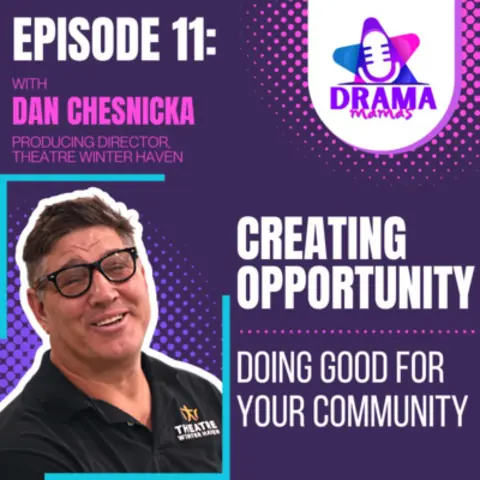
Creating Opportunity with Dan Chesnicka
Dan Chesnicka joins us from Theatre Winter Haven to explain what goes into producing and directing community theatre. He talks about the theatre's mission as well as the shows and events on its calendar at the time.
Audio could not load. Try Play again.
Dan Chesnicka
Producing director, Winter Haven Community Theatre (when we recorded).
This transcript was made automatically and may contain mistakes; the audio is the record of the conversation.
Read the full transcript
Happy New Year to you. Chris Superbody. Yes. Did you bring the Mac 2023? No. No. . No you did not. Macaroon. I was kinda hoping for that. Were you really? I should have said something. Yeah, you probably should have. He, he makes the best Macrons. He spent like all day rain. A way to make all day. Those are not easy.
MCNs or macaroons? Like depends on the potato. Potato. Okay. I like it. But there's a macaroon and a Macon. Okay. So, and a macaroon. . I think like the macaroon that I grew up with, and we may have already talked about this is more like the coconut. The coconut, right? Yeah. Okay, so that's macaroon. I believe so.
Okay. According to kids baking championship. Okay, well you know what, which is where I get all night saying it wrong. Cuz I thought it was just macaroon and he was making macaroons. I think he's making macrons bullshit. Whatever they're, they're really good. That's, yeah. There you go. So, And they're, they're, but they're good.
They're delicious. Call 'em what you want. Well, he was supposed to make 'em green this time. What happened with the strawberry inside? But I guess he just forgot cuz poverty got this like really pretty. Cuz we went to Hobby Lobby and got the dye. Mm-hmm. . And she like, there's like a good size panel where she can like pick out the colors.
Mm-hmm. . And she was like really going through the greens and she's like, I think, well is it this one and this one? I'm like, I don't know. One is more like a sage green and one's more like a Kelly Green. Yeah. That's intense. It was, I think he didn't even use them. Well you know what that means? And then, and then he doesn't even use the green.
He just has to make them again. Just test that out for next year. Yeah. , I feel like this is farther away than it normally is. I'm usually like this. I know. Cuz you're like, Scooby, dooby, Scooby Pop, pop because we're usually sitting on the couch. Sco popping a little. Yeah. You I can't help outfit. Well, I mean, you could probably, you could probably, I mean, I don't need it to be, I just feel like usually as long as eating pointed at you, I just moved.
Sorry. I know I'm horrible with the listen with direction after we had with Rudolph direction, direction. Right. Left. Tell me what to do. . Oh God.
So we had puppets, oh God. In, in the last show at Rudolph, at L C T I. So sad I couldn't go to that. But every single show was, oh man, you were busy it, yeah, yeah, you were very busy. Wow. That's no excuse. But every performance is the same as our performances. Right. So I can't, wow. You know, I have to be here. I know.
We, we tried to make, you were able to make it over to see. Oh, we just couldn't see, get the schedule to line up so we could make it over here. Cuz I wanted to see all, I was in EL when L c t did it and I was Deb. Oh, fun. Yeah. Like I've done, I've been on the stage twice and that was one of them. It was the first one.
That's a good roll. Excuse me. Yeah, it was a lot of fun to do. I was not, I'm not a dancer, so it was good that I was not in the ensemble. , you were dancing though, in those heels. I was so worried the whole time. I did. I saw, I was so worried the whole time. Then your, uh, the cover picture of your I think it might still be, yeah.
Yeah. I had a lot of fun with my like two little dance moves, but like, I suck so . Oh no. We thought it was pretty good. So it's about the attitude if you just look like you know what you're doing when you dance. Yeah. Oh yeah. Let's have battle. I can fake it, right? Yeah. Unless somebody who actually knows how to dance can look at me and go character dance.
I mean, how to Yeah. You know, you're just dancing like Deb. That was good. We good? Yeah. I think, yeah, I think he's like, I think everything's recording now. Oh. Oh. And has been for a hot minute, a while. good. Yeah.
Let's do, let's cuz we always forget to do this part, but let's do an introduction. Okay. Sounds good. All right. We do it about 45 minutes in usually. I know that makes it really difficult cause I'm like, so, so do I slide the intro in here now when I edit and I'll just do a hard cut, throw the intro in and everybody thinks for our podcast is done.
45 minutes in, we intro some else right now. Okay. So welcome to Drama and Llamas. . Yeah. I'm Angela. I'm Kristen. And I'm Kathy. And today we have with us. I'm Dan. Hi, Dan . Yay. Thanks for having me. Dan is the producing director at Theater Winterhaven. That's true. Yes. Yes. Thank you so much for I need my paper.
Yes. I almost forgot I made a paper. What is the paper? Was my like. Is that it? Shit, I wanna ask you . Oh, okay. It's Train of Scott Big. I know. So you can see it? Yeah. Oh, this is exciting. Wow. Speaking of a lot of paper things. Hold on, I gotta show you my Christmas present. Oh my gosh. Oh, this is the best. It is the best.
So we had a little get together last evening for Happy New Year slash White Elephant Drama. Mama Christmas Drama, mama Christmas and New Year's Party. New Year's Re-gift. Okay. Okay. So the fact that we got to do it after Christmas was great because we got to white elephant gifts that maybe we had received for Christmas that we were like eh, about.
Right? Yeah. So, well this isn't my white elephant. This is not a white elephant. They make fun of me cuz I'm old and I can't see and I never have glasses with me. So they're always trying to show me things. I'm like, I don't know what that says. . So they bought me a chain. . Yeah. So I can be like the little. So our last podcast, we talked about it and she was like, yeah, I need one of those things.
And we were like, yeah, now taken, you always have your glasses. Well, I was wearing it around the house, so like Kate was mortified. She was like, you're not wearing them. I'm like, actually I think I might. Cuz you know they're always there when you need them. I saw something the other day on the, like as seen on tv.
So you know the little thing I bought you for when we were backstage, it's got the little magnifying mm-hmm. with the light to it, but it's like handheld. They actually make like an iPad sized version of that that has like a way more powerful magnifier. Oh my gosh. And I was like, I have to fight you. Yeah, you do
You have to give tangible. I lose, I lose three pair a week. Really? Oh, yeah, yeah, yeah. Well maybe you need wear every other week. Another week though. Yeah. . I want it back though. They usually work their way back to me at some point. There's Oh, that's good. At least I'm sure there's 13 pairs scattered about backstage down there.
They can get kind of expensive though. Yeah. Not the ones I buy. Yeah, that's, see, I buy the Walmart three pack. Yeah. Because I, I do lose them a lot. . Okay. See we've already got off track. Squirrel. It happens. Sorry, Dan. Squirrel. It's gonna happen a lot. Anyway, I'm Dan Cheska Theater, winter Hater, . I know. We can bring it back around for us, Dan.
Good job. My Cause we're not real good at that. So, um, what, all right. Start with your background and tell us how you kind of got into this position that you're in now. Like what led up to this? Oh my gosh, that's probably a long road, right? Question. Yeah. Um, well, when I was a kid, I was a kid actor. Okay. Um, so, um, I lived in Massachusetts, you know, I did the school plays of course, but there was a.
Uh, professional theater in the town adjacent to mine called Stage West in West Springfield, Massachusetts. And uh, that's where I took my acting classes on Saturdays and such. And then I got into a few plays and it was super cool cuz you know, there were matinee you got off of school. Mm-hmm. for a couple of weeks to do these matinee and you know, I'd have to go, my grandparents lived closer so I'd have to go live with my grandparents for a couple of weeks at a time.
And that was kind of cool cause they would spoil me. So I was kind of in that world and I did it all through high school. Um, both at, at school stuff, but also at Stage West. Mm-hmm. , um, which was great fun. But I was also an athlete and I got a scholarship for my athletics when I went to college. So when they're paying you to do athletics, there's no time for you have a job.
Makes sense. Yeah. You know, I was a, I was an athlete, so that was who I was for four years. What sport? I was a diver on the swim team. Wow. Oh, nice. Okay. Google me. Oh, totally. No, . Um, . . I'm curious. So, yeah, so, um, I spent most of my time through college diving and focusing on that, and I occasionally did some schoolwork, um, but mostly diving.
And then, um, flash forward 15 years. And, uh, I had kids about the same age as your kids. Mm-hmm. . And, um, we found our way over here to theater Winter Haven. And, um, I, at that time was an inventor, so I didn't really have a proper job, you know, I was, I invented products. They were found in Walmart and Bass Pro shops and all.
So I was kind of living off the royalty of my products and every now and then having to go. Paddle them at a trade show or go to China to visit my factories or whatever, but mm-hmm. , um, I didn't have, like, I didn't clock in, clock out anywhere, so my kids and I spent a lot of time here doing stuff. My daughter Morgan worked virtually every show for the better part of her junior high and high school years.
And my son would occasionally come and help build sets and I would do that too. And, um, you know, my youngest daughter would be working the spotlight and, you know, we would, and they would all occasionally make it on stage, but also a lot of tech stuff. Mm-hmm. . So I was here a lot and I had a lot of time, so I would often volunteer a lot of that time, especially building stuff.
And, uh, I got put on the board of directors and so after 45 years, Norman Small, who founded theater Winterhaven announced that he was gonna retire. And we were a little panicked and we did a nationwide search to try and find. A successor to Norman. And it was a difficult process because, you know, a lot of people come in and they look and they talk about all the things that you should change, and we were pretty interested in making sure that we preserved a lot of the things mm-hmm.
that made us so, um, it was a difficult process. We ultimately offered the job to one of the candidates, and then he wanted too much money or whatever. There was a negotiation and ultimately fell through. So I threw my name in the, in the ring and, um, I probably, because of lack of other choices, I was, I was given the job.
And so it's my job to protect it for several years until the next person comes along. So, . That's a great story. So I'm a, I'm a theater dad, I guess. Yeah. Um, it's that progression. Yeah. You start volunteering and you keep moving up the ladder and next thing you know, you're running a theater. . Yeah. Uh, I, if you had asked me, you know, maybe when I was 11, I would've said, yeah, I'd love to spend my whole life in a theater.
Mm-hmm. , but it hadn't been the focus of my life. Um, certainly not my professional life, although I did have 12 years at Disney, but mm-hmm. , that was all in operations, so, okay. Um, so that's kind of how I ended up here through, um, through loving it. Yeah. And well, that's kind of the best what it end up here.
Right. And loving what it did for my kids and my family and, um, you know, uh, that's my story, I guess. Well, I mean, that's, it's fantastic. It's a similar story to where we're at. Right. You know? Yeah. You're doing it for your kids. Yeah. You just get in here and. It's such a nice way to spend time with them.
Everybody's doing something together and it's supporting something that the kids love and well, and I also remember as a kid what it gave me, um, when I was involved, when I was 11, 12, 13. And you know, I think there's very few things in the world that can prepare a kid for life than working in a theater.
Um, for one reason. Even though you're 11, 12, 13 years old, your voice is every bit as important, important as every single one of the adults. You're carrying the show as much as every one of the adults that are in that show too. And you're treated with the same amount of importance and the same amount of respect.
And your voice matters every bit as much as any of the adults that are around you. Also, very often you're working with a lot of adults even though you're 11, 12, 13. And you have to learn to communicate and behave in such a way that will make you successful in that environment. And I think it gives. , all these kids who get involved in theater such an advantage at such a young age that just gets accumulated as they go through life.
So, um, I think theater kids, when they get out into the real world, are starting on third base. Mm-hmm. , you know, so, um, it's important to me, um, to make sure that we have as much opportunity as we can for as many kids in our community as we possibly can provide. You know, and it's why we've been expanding so much.
And even just beyond theater, you know, we have our dance programs and we have our community marching bands, and we have our community choirs because just coming into this building and being part of the ecosystem that we have here, Set kids up, I think for great success, not only in their young lives, but something that they will carry with them forever.
So part of my goal is just to be sure to cast a wider net for anyone. And when I say serving our community, I mean serving our whole community. You know, we also do programs over in Florence Villa at the, um, at the recreational center over there after school. Oh, nice. Yeah. And those are for, you know, at risk kids who they're in that program because their folks can't afford childcare after school and all that.
But yeah, I wanna bring theater to them too. So we're, it's important for us to get out into the community and get to the places where we can do the best, um, the best service to the whole community, you know? Yeah. Yeah. Community theater community's writing the word. So, yeah. It's not all about what happens on the stage.
In fact, that's just a fraction of what happens. You have to meet people where they are. And so it's that whole outreach thing. Yeah. Where everywhere. Yeah. Be there wherever they are. Yeah. Well, and that's kind of how this all started, is we saw what it did for our children and how it changed their lives and our lives together, and we want other families to experience that.
And so that's kind of how this all began. It's like, how can we help other families get involved in theater? So I'm right with you. You're killing it. I mean, I, I love this place. I love the people who walk in the door. I, you know, when I lay my head down on the pillow at night, I think about what's in their future.
And I think about what it is, what tools that, what resources, what tools do we have that we can help make this community great. Not just for the kids, either for adults, you know? Yeah. Mm-hmm. , I'm, I'm sure you've been around theater enough to know that. Mm-hmm. , people who walk into a theater often march to the beat of a different drummer, often, you know, and some of.
Some of the characteristics that they have there. I mean, we're weirdos. A lot of the people who go to theater totally are a little bit weird. They see the world a little differently and you have to, no one ever got a lead role by being just like everybody else. It's part of being different is celebrated at, um, at a theater, um, and in the arts in general.
But, um, you know, characteristics that might often get you bullied or made fun of in a school or an environment where everybody's trying to conform and be cool and all that kind of stuff. The thing that might get you bullied there is going to get you rewarded here. Yeah. Um, so come hang out with us.
We'll be, uh, abandoned misfits together, , and we're, you know, and we're going to succeed. I mean, I can see what's hap I, I look at the kids who have come through this program, my own kids included, and look at what they're doing now. And I think, boy, all of those advantages that they got, largely through the theater.
I don't want to give full credit to it cuz there's a whole lot of other stuff, but largely through the theater have really set them up for a great life. And so I'm proud, I'm proud to be part of preserving that and, uh, you know, guarding it mm-hmm. so it will continue for another 50 years, you know? Yeah.
Oh, we're so thankful for people like you. Mm-hmm. and you of course. Mm-hmm. for what? For being that safeguard. Yes. Like making sure that we always have this place for us and for our kids and for the rest of the community and making it such a positive place. Yeah. When we came over and did sical of our first experience here, we weren't sure what to, what was gonna happen, what would it be like, and everyone was so incredibly open and, um, well that's our job.
We're a customer service graceful is great. You know, we're really a customer service organization, you know, I know. , we're not a play factory, you know? Mm-hmm. every, I think every member of the staff is dedicated to making the dreams of those folks who walk through the door happen, even if those dreams happen in six weeks.
And if you're being awesome in a show or, you know. So, um, it's our goal to try and make it that place where you're safe and where it's an escape. Especially because, as I say, a lot of the kids who come here, adults too, are running from something or towards something, and this has to be that place where they can always come and land soft.
Mm-hmm. . Well, and the kids love you. I, they kept talking about, oh, Mr. Dan, Mr. Dan. I'm like, who's this Dan guy? They keep talking about . I love them too. . But I think that's because, you know, you show up for them. Mm-hmm. , right? You're, they will say, he comes to rehearsals, he's at every show. Yeah. They see you. Yes.
You're around and you're always support supported. They get to know you. Yeah. I never miss a, show's such a big, if I, I mean, I don't say never. I rarely will miss a show, especially an academy show. Um, and I try to go see them wherever they're Yes. You know, whenever it's out. Mm-hmm. . Mm-hmm. at different theaters too.
Um, well, you're an adult. It's like they're looking up to you and you're champ. You're a champion for them. You're supporting them. It's a big deal when you that deal it, it's a huge deal. It's a big deal. Well, that's, and it's such a big part of show last night as, as this, you know, person who's trying to safeguard this.
Kind of space, this safe space, right? Mm-hmm. for creatives, um, in the community, and for you to just take that little extra step. Mm-hmm. , it may seem like maybe it's not a big deal, but it is, it's such a huge deal and it's a big part of what makes it successful and, and feeds back into this thing you're safeguarding.
Like, it's, well, the bigger deal is, I think we're all the same thing, you know? I don't know that there is, I think all community theaters across this nation are the same thing. We're all really trying to do the same thing. So of course I'm gonna go , you know, if I can't, if I can, because I feel a kinship. Um, yeah.
And it's your safe space too, right? Yeah. Yeah. I mean, gotta feel that way too. It really is. Yeah. It's, uh, it's a place where, uh, I feel, yeah, I guess I feel safe too. Yeah. Yeah. So what are some of the challenges and rewards of producing in directing theater in a small, in a, um, community? Well, I'm not a director.
Okay. . So I wanna make that clear. You know, I don't consider myself an artist. Um, I don't know. I saw you working on some props down there that feels very artist. Well, I do a little bit of everything. You know, I, I, I, I'll touch a little bit of everything, but , um, the hardest part about producing is, um, I mean, I have to take care of the whole forest.
Mm-hmm. , I can't get too involved in any one, any single tree in the forest. Mm-hmm. . So in the theater, there are a lot of different constituencies, all of which have very different goals and often very competing goals. Okay. You know, so, um, like a lot of the actors. Come to me and say, how come we're always doing these huge toe tapping musicals and you know, this lo can't we do something really dramatic and meaty and all, but I have to keep in mind what the audience responds to.
Mm-hmm. , I have nearly 5,000 subscribers to theater Winter Haven, and I need to make sure that I'm giving them the things that they want to see. Because if I don't have those 4,000 subscribers, then suddenly I don't have the resources to be able to do all of these other things that I want to do. Um, like going into the schools every sec, you know, with drama time live or with every second grade, all these things that we do also that just bleed money.
So I have to look at it as a business, um, when I'm in there. So I. You, the hardest part about being a producer, I will say, is there are a number of different constituencies, whether it be the actors, the staff, the guest artists, the audience, our civic leaders. You know, we're in a city building. I have a real responsibility to do good work for this community.
All of them. Uh, the county, the county who gives us money because they want us to drive incremental business from outside the county to come here. So we generate tax money through restaurant and hotel, all that kind of stuff. Sure, sure. I have a role in fitting all of these truly community. Right. Yeah. And they don't necessarily, these pieces don't fit together necessarily well.
Mm-hmm. . So it's a, a lot of the job is determining which constituency you are going to disappoint just a little bit. Mm-hmm. . Right, right. You know, probably every day. So develop the scales a little bit. Yeah. So I'm keeping all these plates spinning. and I would guess that every, not guess I've heard that each constituency is like, why aren't you focusing on this one thing?
Mm-hmm. that I care so much about and I care about it too, but I also need to make sure that mm-hmm. , you know, 20 other plates are spinning, 20 other plates continue to be spinning as well. You know, I gotta write grants and do, there's a a hundred things, it's a challenge. Yeah. Just to make sure that you're not focusing on any one thing.
Mm-hmm. that kind of upsets the apple cart Oh, sure. More than any of the others. So finding your feet on that. And I'm not saying I do it right. I'm, I mean, I, I don't think I do. Um, but I do it right for me, you know, I do it the best way that I possibly can to, uh, to keep everything. . Okay. Do the plates help you kind of balance as well?
I like, do you get assistance? Sometimes. Sometimes I'll, I'll give you an example. You know, so during the process of a show, the, I have now learned that there's key points where. I switch my focus. So like in pre-production when we're planning something out, it's really about my guest artist, the director, um, the music director, if I've hired one.
All those folks that I've brought on to run the show and we're planning the lighting designer, all those folks, as we're planning it out. Once the show gets cast, my focus shifts a little bit from them being the central point to those volunteers, volunteer actors and volunteer technicians that come on to execute that.
And my focus is there. Mm-hmm. doesn't mean that those guest artists aren't important, still doesn't mean my staff isn't important still. Yeah, it does, but my focus is now shifted to that. And then once opening night happens, my focus has to shift toward the paying audience, the audience's coming to see that.
So whereas I might have a lot of time to talk about someone, uh, aga an actor or a technician's situation during the rehearsal period, and I'll, you know, Uh, once we're in production, that has to take a backseat now, cuz right now we're talking about what is best for the audience. Right. So I, I mentally make that shift.
And sometimes we even talk about it because once you hit tech weekend, for example, you have to say to the actors, actors, this is no longer about you. You've had the past six weeks to work on your stuff. Right now, this five day tech period mm-hmm. is about the people who are working the lights and people who are working the sound and you are serving them at this point.
Mm-hmm. . So you have to push in the clutch and make a and downshift a little bit. Yeah. To understand that you're now serving this process as opposed to the whole process serving you. Yeah. So, . That's an amazing way to put that. Like, I know it's probably seems to you like totally duh, but it's never been expressed that way.
That tech week is then the focus on, I mean, I know it's the focus on the tech, but mm-hmm. Yeah. To hear in, in words like that. Yeah. It just makes, yeah. Yeah. Okay. I just, well, and the people who, yeah. The people who do the best kid or adult are the ones who understand that this train is moving. Mm-hmm. . The second we start, for us, the trains, you know, us, the staff, the train starts a year or more in advance.
But once the auditions happen and we get going, we're now on the clock, you know? And that train has to go down. The people who are the most successful are the ones who understand that and make sure that it stays on the track. Mm-hmm. , if you feel it leaning, you know, they can counterbalance. Right. The ones that are the least successful are the ones who want to take detours left.
Right. You know, the ones that pull you off the track and stop the process or hit, you know? Yeah. So those people who understand that, It's gotta be constant forward motion, um, in every department are the ones that really, really do well here. Hmm. So, um, you've talked a lot kind of about the, the theater itself, but the community at large is very supportive and you're inversely supportive of the community.
How, how does that relationship kind of work with you and the city and you and the county for example? Well, you know, I always say that we want to be a spoke in the wheel of everyone who wants to do well in this community or do good, I shouldn't say do well, do good in this community. So, um, virtually every nonprofit organization in Winter Haven interacts with us in some way, whether it's, um, we set up lighting for their gala events, whether it's, we have some performers who do.
Mm-hmm. something. Mm-hmm. to open up their show, whether it's, um, I provide the ski team with costumes for their show. We are open to any nonprofit organization in this town who's trying to do good there. And I think you're more than a spoke. Yeah, I know. Sometimes with a hub . Yeah. Feel like, like that, that bit in the middle
Yeah. Whatever you call that thing thing bit in the middle. Let's just call that thing . But, um, you know, for example, there's a annual lipsync battle that raises money for the public education partnership and, um, the Cypress Junction Montessori School here in Winter Haven, and we produce that whole show for them.
Um, with ev you know, we get 'em all the costumes, we cut all the music, we do soup to nuts. We do that. To date now, we've raised, I think, nearly $300,000 for education here. Wow. In, in Polk County Theater doesn't get it done. Uh, you know, we don't charge at all for that kind of thing. Mm-hmm. , but it's part of our community.
Community service. Okay. We also have a lot of resources, you know, in our, in terms of our prop room and our costume storage room and all that kind of stuff, which is always open to, uh, schools that are putting on plays, other community theaters. I just dropped a grand piano off at Haines City. Oh my gosh.
Community theater. It's not easy to do. So it's a shell. I can lift, I can lift it myself. Okay. Okay. . Um, but we, you know, it's important to us that we recognize our role in the community. Um, we have our drama time live kids. I know you know 'em that well. Yes. . Um, so. And that goes into every single second grade helping with the reading programs here in Winter Haven, uh, concentrating on fables.
Um, so we help with that. And that was something we worked together with the Polk County School Board on, you know, we have a group of senior citizens called the Act four Players, the Act four players go to nursing homes and assisted living facilities and perform in those areas too. We just, um, our marching band is made up of at-risk kids who, um, need after school activities.
So we do that and we're in parades and all that kinda stuff. So the goal is, you know, if you think of a, like a Boys and Girls Club, that's, I guess, centered more around sports. We are a community resource. We're always open. That is centered around the arts. So if a school's getting ready to do production and they need a little costume help, that's something you guys would do.
Of course, we, we do it routinely.
Good to know. , our kids are getting ready to audition for Frozen and Rochelle. Oh, okay. Yeah, Rochelle, that's, we're all the same thing. Yeah. Yeah. You know, um, so, and Rochelle knows I think pretty well that we're happy to, that we're happy to learn. That's put you on the spot and everything. Well, I'm just curious.
it wouldn't be new. Right? That's great. So, so through all of that outreach, basically the people that see the, the benefits of that outreach turn in turn, turn around and help support the theater itself and just everything kind of feeds in on itself and make sure that it, it thrives. Well, that's the goal, but mm-hmm.
Um, even if it doesn't, who cares? I mean, we're still doing good in the Yeah. You know, I don't need to know that at the end of that line. It's somehow benefits the theater because I know at the start of that line is benefiting the community. Yeah. So, um, . So, so it doesn't have to be a symbiotic type situation.
You can, and I'm sure it, it, I prefer, it's not a parasitic relationship.
let's hope for Symbio. Yes. But, um, no, it doesn't have to be, you know, you have to meet people where they are. Absolutely. And sometimes, you know, especially in an organization such as ours, we have a lot of resources. I mean, look at all the space that we have and we have, yes. We have, um, you know, 50 years of stuff that has piled up and we have, uh, a great staff with amazing skills.
And, you know, it doesn't have to be, there doesn't have to be parity for sure. Right. You know? Um, sometimes I think we're committed to doing good in our community because we're committed to doing good in our community. Yeah. Mm-hmm. . Absolutely. Whether, whether we get something for or not. Yeah. Yeah. I think it's organic.
It's just natural. Mm-hmm. , you know, people are gonna want to come and support the theater because they know Yeah. What they're doing out there. You know, like if I know of my child's being taken care of and I'm able to take advantage of resources or whatever, I'm like, oh, well we're gonna go see a show.
You know, this is a city facility. Mm-hmm. . So clearly the city values us. Um, you know, we've been here since it opened, this building opened, and then when they did the construction over there, we got all this additional space to continue to, um, yeah. That manage the theater. We have second, we have a second theater now, so, um, so clearly we are a benefit.
Yeah, absolutely. In the eyes of our city leaders. Um, do you do any work directly with the city leaders or do you They just, they're Oh yeah. Seeing it organically on their own. Um, I, I have all of them, all the city. Commissioners in my phone, . Nice. That's good. That's good. Great friends with the, you have a good relationship.
The mayor and the city and the, and the city manager. So yeah, I think that, I don't think, again, I don't think there's much air between the city leadership and us, and we share the management of this building. So there's not a day that goes by where I'm not interacting with the city about something. Right.
And um, I hope we give as well as we get. Yeah. Um, I think they would tell you we do. Yeah. Mm-hmm. , I think the fact that they've supported you with extra facilities and stuff and it's pretty helping you update and, you know, keep this space thriving. Definitely speaks to their commitment to that. I agree. I obviously, without the support of the city, we would, what I, what I wonder is like, what is it that makes this so different as opposed to like, I know there's a community theater in Plant City, for example.
Like, why is that one. Not thriving in the same way that this space does. I don't know that they're not. I, I think to compare community theater to community theater is probably the wrong approach. Is it? Because every community's different and every community needs a little bit of little something different from their community, so.
Mm-hmm. , you know, Winterhaven, we are blessed in that, you know, theater is generally consumed by the young kids and older folks, retirees. And we have here in Winter Haven, a great resource of both, right. You know, so you lose, you lose people in the middle when they're making their livelihood and they're raising their kids and they're doing all that kind of stuff.
But, um, but you know, we have five or six retirement communities that are located right around us. We have, um, a pretty engaged youth program that, um, That people want to be a part of. And we're lucky in that our demographics are such that we're pretty lucky. We're also, um, far enough away from Orlando and far enough away from Tampa where to consume the art that's happening in either one of those locations, you know, makes it tough, you know?
Mm-hmm. a little bit of a further drive. Absolutely. Yeah. It's just not, yeah. High four. Um, we're also part of a great ecosystem of community theaters with Lakeland and Venice and Manatee and, you know, all of us who kind of share resources back and forth. So we're able to do productions that are, in my opinion, better than the traveling productions that happen throughout the country.
We have just those shared resources allow us to be able to do that. We have a great talent pool, um, because of Lar a lot, largely because of our location in the, because of the theme parks, Lego Land, Disney, univers, you know, all of the people. Around here are, or not all, but many are tied into the entertainment industry in one way or another.
So, um, we're lucky in a, in a lot of ways. Yeah. And we're also good, you know, we care. So, um, one of the things that I'm really proud of is that, you know, we put a lot of, um, effort and expense into our shows. You know, the, when we do a show here, we're not mailing it in, you know, it is, you know, our lighting designer very often we fly down from New York City where he was just recently working on some sort of, you know, Broadway something.
Mm-hmm. . Um, we try to find the best directors we possibly can, the best lighting designers we possibly can, the best scenic designers we possibly can, and give amateurs, um, an opportunity to perform. Surrounded by the best professionals that are available, um, and give them that opportunity to have a world-class sandbox to be able to play in.
And we're very successful in that. Um, yeah. You know, it's, it's funny cuz for a while now we've always kind of talked about as parents, like it feels almost like we're in this weird little bubble, this area that we live, where there's so much talent and there's so much opportunity for that talent to, you know, to grow.
To grow and, and to perform. And, you know, for a hot minute, like my husband and I, like, we were looking at moving and uh, for work related stuff and you know, when we were looking out in like Apollo beach area mm-hmm. , there wasn't as much stuff out there for our artistic kids. Sure. The schools weren't really kind of geared towards that.
Like we have here, like Harrison for example. I mean, . Yeah. There's nothing like that out there for them. And Right. I, I, I just, at that point, I started to realize we had this kind of special thing here, and I couldn't put my finger on why, but I think you've just explained exactly why, you know, why we have that bubble justification.
Yeah. It's, it's a lot of things though. Well, sure, sure, sure. But there are those bubbles. There's a million of those bubbles. Yeah. You know, um, part of the trick is finding it, but, um, there's so many talented people out there, so, so, so many wildly talented people out there. Um, and there are so many that would be given the opportunities.
Yeah. You know, that's one of the things I worry about the most is that, you know, like a couple weeks ago we had auditions for, into the Woods, we had over 160 people audition. That's a lot for 19 roles. So, I, I. , I worry, I don't worry about the 19, I worry about the other 140. Mm-hmm. , you know, and making sure that we have opportunities for them also.
Right. You know, so they didn't make it in this show, but that doesn't mean they won't make it in the next Yeah. Or come hang out with us on a Saturday and do a the Saturday or take a voice lesson downstairs, you know? Yeah. We have scholarships for everything. So we've made the commitment here that no one is gonna be excluded because they don't have enough money.
We'll find a way, you know, we'll find a way to make sure that you can be part of it all. Yeah. So, um, my heart is just, I know , so, um, yeah. So the trick is to make sure that we have enough stuff happening so everybody who wants to be part of it can be part of it. Mm-hmm. . And in a business where no is part of it, you know, you get a lot of nos, um, when you're an actor, you know.
Yeah, that's, it's definitely part of it. You should get more nos and you get yeses if you're in the right system, but I wanna make sure that we have opportunities for you beyond what that is. Yeah, yeah. And like you said before, no, may not be, you're not in the show, but you may not be getting the part you want, the lead part, you might be part of the ensemble.
Right. Which, well, for me, I don't know. The ensemble is the best place to be. Mm-hmm. , um, I don't know why people aren't lining up to try and be in the ensemble , because that's the place where you're gonna learn the most. You're gonna get the most stage time, usually you're gonna learn skillsets that you're not going to learn as, uh mm-hmm.
as a principal performer, you know, you gotta be able to harmonize, you gotta be able to dance. You got seven dance numbers. You gotta learn all that kind of stuff that you ha you're gonna have five quick changes and you know, there's gonna be a million things you're gonna have to do on as a member of the ensemble that the principals, uh, are kind of sleeping on.
I've seen it happen a lot where, um, Some of the people who are grad, who are in the ensemble a lot get better and better and better and better and better. And the people who are in the lead roles kind of stay at that level. Plateau. Yeah. They're kind of, okay. I'm, and then, you know, the turtle passes the hair.
So, um, it happens quite often. Um, my recommendation for any kid or adult is to do as much as you can, even if it's in, not even, especially if it's in the ensemble. You know, I'm always, you know, I give a heavy eye roll sometimes, and I know that this is necessary, but some people will say, I, on their form, they're like, I either get lead or nothing, you know?
Mm-hmm. , well, okay. Like, it's not gonna be worth my time. Yeah. It's not gonna be worth you. Yeah. And I, I know that totally. They knew. I know that they're not going to. Uh, I guess I shouldn't say I know, but I know that the people who do the best are the people who you can't keep away from this place. Mm-hmm.
Whether it's the ones that are in the ensemble, whether it's the ones that are in the leaves, whether it's the ones who are running the spotlight, whether it's the folks who are helping focus on a Saturday during tech, it's the, the people who just want to be here are the ones who are going to always get the most opportunity.
Um, and I would also advise everybody, as much as I say, being in the ensemble, also do a lot of tech. Mm-hmm. , yes. Mm-hmm. do a lot of tech. Um, cuz there's very often more magic happening backstage. Mm-hmm. than is happening onstage. The folks who are doing tech are incredibly skilled, usually at the things that they have to do.
Um, but I would say build props, build sets, work on lights, figure out how to work sound. If I see people here who are doing all of those things and are really engaged in learning all of those, I know that they're gonna have a great, um, a great experience and probably if they choose a great career, you know, there's so many people who have come outta here.
Um, and I don't wanna take credit for them cuz they've done a whole, you know, but there's so many people who come outta here who have now earning their living in the arts and in the theater arts especially. Um, a lot of 'em on the tech side. Um, but that's brilliant, you know? Yeah. I know as an 11 year old, if you told me I was gonna spend my last third of my life in a theater, nothing would've made me happier, you know, just living in a theater.
Mm-hmm. and, um, . Some people get to do that their entire lives, which I think is great. Yeah. Yeah. It's envious or I'm envious. . Enviable. Yeah. What are you one of those? All of those things. Well, and I love that you provide for the children this experience to be in a show and it costs them nothing. Cause I them nothing.
I have friends who are in other theaters or different regions and they're not only, they paying $250 to be in the show, but then they're having to buy every single costume. $800 worth of costume. That's how most theaters survive. Mm-hmm. , it's all, most theaters use the kids as a profit center, like a pay-to-play type of, it's all, yeah.
Not all. A lot of it is paid to play across the country. That's how they earn their money. Mm-hmm. . And then, um, that is, , they leveraged that to pay for some of the other stuff. So how do reverse, how do you do that? I don't know.
It's just one of the marvel. Here's spoiling a secret. . Well, here's the thing, nothing makes money. Mm-hmm. . So, um, you have to, this is a great thing cuz I owned a bit, you know, I owned my, yeah. My business. You're, you're a businessman as well. Yeah, sure. Um, but this isn't, but this isn't a business. Right. So that became clear to me in month two.
Oh, I bet that, that you can't, if I were to do what makes sense mm-hmm. , it wouldn't be what it is, you know, so you have to throw that away. Um, so I think theater might be better off if people stopped trying to be clever about their money. Um, you know, like I see a lot of people, oh, well we have a costume rental business on the side.
Just give the co, you know, How much you really make. You gotta pay the person to manage through that whole thing and do the whole thing. Mm-hmm. just loan out the costumes when, you know, that's why I think we're all the same thing. Um, nothing makes money except the whole thing. So, um, and that doesn't make money.
We're a nonprofit organization. Our goal is zero. Right. You know, that's the goal. Zero. And if you are bragging that you're banking X number of dollars, well put it back into your community. Put it back into your, you know, there's no, that's a great point. You need to have reserves as we found out during the pandemic.
You know, there has to be that, we know we have to have the, that reserves in order to have a healthy business. But our primary goal is not to generate revenue and we're not going to, uh, I've never really saw. Off a community theater that's someone's getting rich off of mm-hmm. . Right. You know, so stop it.
Um, and just figure out how to do the best way to how to serve. Mm-hmm. , you know, we, we have nearly 5,000 subscribers, but we keep our prices artificially low. We know that a number of people in this community are on a fixed income. We know that. Um, we know that people can only have a certain threshold. So we price our tickets not at what we think the most the market can bear.
We charge it the least that we can do to still mm-hmm. . Yeah. Kind of get, make even buy and then, and then we go hunting for grants and we go hunting for gifts and we beg for money and we do all of those things that we need to do in order to survive. But it's not, um, you know, when I lay in bed at night and think about theater, winter Haven, I don't think about how to squeeze people for more money, you know, because that's not the point.
Yeah. In fact, the point is the opposite of that. Mm-hmm. , the point is to make it as accessible to as many people as you possibly can in your community. So, well, and that's like a big difference, right? Between a community theater and like a regional theater, like the regionals, when you make that change and it's more about the being a business, right?
Or I think so, but I, I have no interest in that model, you know? Yeah. So I haven't really looked into it. I, I do regional theaters support their communities as well at all, or, I don't know. I mean, I'm sure there's some that do great work. I don't want to ever say anything's less than, you know, there's a million different, there's a million different ways to do something.
But for us, for me, for theater Winterhaven at this moment, um, we're constantly looking for more ways to serve. Yeah. That's it. Yeah. You know, that's great. So, um, I'm. , it is a business money's real. You know, you have to generate revenue in order to keep all of these parts, all of these parts moving. Um, right.
And to continue to have the long list of programs that you run in order to, right, right, right, right. Mm-hmm. . So outreach in the community and stuff, being fiscally smart is very, very, very, very, very important. And, you know, throwing nickels around like their manhole covers is important too. You can't spend stupidly when every, you know, every dollar is a dollar that could go toward a scholarship, you know, or Right.
Yeah. Yeah, that's true. So your facility's here. Yes. You've got this amazing upstairs. , uh, we've seen a little bit of mm-hmm. , um, you have like rehearsal rooms and stuff back here, right? Yes, we have, uh, do you want me to describe the, what we have here? Yeah. Yeah. Okay. Yeah. Do it. Okay. So we have three performance spaces.
Our main stage theater, which is the one that has been operating for 50 years. Long, long time, right? Yeah. So that's 334 seats. It's a Christin theater. It's, in my opinion, one of the best places to see a show that I've ever been. You know, the way that the house is raked and the stages below you, you get to see every single dance step.
You're never looking up, you're always looking down on the audience. Mm-hmm. , we have great sight lines. Our stage right and stage left are huge, so we can do a lot with scenery. Mm-hmm. , we have a full fly loft. There's a, it's impressive, there's a funn of advantages that we have for that particular space and that's remarkable.
Our second space, we just finished building, um, just this third Thursday, um, January 5th, is that what it is? It's this Thursday, January something. I think it's the fifth. Um, we'll have our second adult show in our new space named after Norman and Linda Small, who are our founders of Norman and Linda, small second stage.
Um, and that is a, um, it's kind of like a hybrid theater. It's nestled into a corner. It has 199 seats. Um, and it's designed for really more intimate, um, Types of shows, um, where the audience will feel like they're sitting on the stage. It's really, it's close up. It's close up theater. It's a beautiful, beautiful space.
I'm really proud of how it came out and I think, um, people ultimately are gonna love it. And I think as time goes by, many will ultimately prefer it. Um, just because of the way that we're able to present shows and tell stories. Very intimate. Yeah. Yeah. Like right there in Yeah. Right. So that's Disenchanted space.
Disenchanted. Yeah. Disenchanted is opening up there on Thursday. Um, And today is the 1st of January. Yes. So, whatever. Yeah. Happy. Just a couple days. Well, this will, this will drop on Tuesday. This episode will, so, so the day after tomorrow, if you're listening to us when this comes out. Yeah. Perfect. Get your tickets.
So we love that space. Um, and we're doing, that's where we're doing Into the Woods as well. Um, also, it's gonna be the site of where we do the Penguin project, which I'm Yes. Incredibly proud of. Yeah. We're a replication site for The Penguin Project was a, which is a nationwide program, specifically designed a theater program specifically designed for children with developmental and or physical disabilities.
Um, uh, Dr. Annie Morgan designed it. He's up in Pennsylvania. There's a number of replication sites throughout the country. He's coming here to help us set up ours. Wow. We're gonna be doing Cats Kids, no Arista Cats kids. Arista Cats kids down there in that space. And when we built this space, we kept that in mind.
So you'll notice if you look in there that the stage is all ramped on every single side. It's completely accessible from every different Oh wow. Every different angle. So we built the stage. to be accessible for folks with multiple kinds of disabilities, um, which we're really excited about. And I, I think that's gonna be something that's gonna change our lives, frankly.
Um, and it's one more way that we're serving our whole community That's Yes. Part of the mansion. What an honor to get to be a part of that great program. Yeah. I'm excited about it. It's not like they chose us, you know, , but, but still, it's still a big honor. I pursued them. Yeah. But yes, so, um, I'm, I'm thrilled to be able to do it because I love that there's a pre-existing structure mm-hmm.
designed by a child psychologist who's also, you know, so we all will be following a very clear path to success that has been proven in a number of different places before us. Yeah. We're. Really good friends with Laura Beard and she's been talking a lot about how she's gonna be doing that. She's with you guys.
She's a dream. She's so exciting. I know you guys talked to her. Oh yes. I'm as Ming for her and Into the Woods. Oh yeah. So you'll see me again here real soon. Oh great. Great, great, great. Yeah. I love her more than my lunch . She's the great, so do we. She's the greatest. Yeah. Um, uh, so that's Space two.
Performance space. Mm-hmm. Space Three. Performance Space is a little cabaret lounge that is nestled up in the, uh, where our old box office used to be up in that area there, just adjacent to the art gallery. And, um, that's called the Ghost Light Lounge. The Ghost Slate Lounge is designed for the artists in this community to have a sandbox.
And they come to me with what they. Put in there. So theater Winter Haven, unlike the main stage in the second stage, is not programming our own entertainment up there. So some of the things that have happened already are, uh, Marcus Bria, who is a local classical guitarist, has a monthly guitar parlor up there where he invites, um, guitarists from throughout Polk County to come up and, and play and work.
They work on things. And there's an audience of maybe 70 people that are in there. Um, Tommy did his Malcolm X the musical Yes. Concert in there and just a couple nights ago. Two nights ago. Yeah. He did, uh, he did, uh, like a little cabaret Tommy with friends type things Co-hosted by you guys. Yes. Yes. Had, was fantastic.
Yeah. We had s this. Nice. It's a really nice facility, but it's available for stage reads and, um, we're, we've rigged it all out with karaoke. So if after a performance, the cast wants to go up there and just have kind of a, that's nice. Oh my gosh. We've got that all rigged out. So it's got musical theater karaoke, but regular karaoke too.
So all that kind of stuff. And we've done a number of, uh, kind of dueling piano type of things in there too. Mm-hmm. . So it's just for people, artists to come in and do whatever it is that they want to do. They can charge if they want and we don't keep that money. Uh, we donate it all the way back to the artists.
So, um, that's the third performance space. Now, to support all this, we need a lot of rehearsal spaces, cuz there's, right now we have 1, 2, 3, 4, 5 things in production in some form of production right now. So, um, we have five or six. Rehearsal spaces, all of which are tailored a little bit differently. The floors are taped out to match the stages downstairs.
Okay. The, so when we do rehearsals up here, they're, they can kind of walk everything out on the same thing. Very often when we're rehearsing a play, um, you know, I'll use suds for example. A play we did last year. It had three washing machines in it that rolled around, and then a bunch of platforms and different, different scenic elements.
We'll go ahead and set the room up exactly like that. It might not be a washing machine, it might be just be a box on wheels. Mm-hmm. . Right. But so when they're rehearsing in that space, they can work with practical items. Right. So they can really. Work it all, work it all out by the time they get down on the stage, because stage time is so valuable, you know?
Yeah. You're in rehearsal while the other, this play ahead of you is already doing their stuff, so you can't get on stage until that's over. So we make it as stage like as we possibly can in all of these rehearsal spaces. We have a dance studio. Um, we're gonna be making that a little bit better by adding a sprung floor and some Marley here in the next several months.
Nice. But, um, we're, the goal is to just make all of these spaces as wonderful as they possibly can for the many people who come in and use them. Yeah. That's, it's a lot, that's a lot of support that you can offer the community in space alone. Yep. So what productions are kind of in that queue? Okay, so that Dream Girls.
So we just closed Elf. Mm-hmm. . We have Dream Girls coming on the main stage. We have auditions for, um, little Shop of Horrors happening on January 8th. . Um, we have disenchanted, which is going on the stage this Thursday, as I mentioned into the woods, has already started their process, which will be going into the small stage, um, in February.
Mm-hmm. . Um, and then we have a professional company coming in to do menopause, the musical Awesome. Between the closing of Dreamgirls and the opening of Little Shop. Wow. And then of course, that's quite a lot. And the Penguin, the Penguin Project fires up in January. Mm-hmm. We start that for their April performance.
April. Mm-hmm. . Do you have a lot of people signed up to do the Penguin project already? We have, um, yeah, we have, I don't know exactly how many, but, um, it's starting. Yeah. So I think we're 15, 20. . That's still, that's great. Yeah. That's great. Yeah. So it's open just in case somebody's listening and wants to know more about it, it's, you need, um, like we call 'em TKs and out of the box, like theater kids to partner up with the Penguin kids.
Yeah. The way the Penguin project works is that every, it's a scripted show, so, and that every part that is cast, there is a, uh, a mentor that is cast along with that, uh, kid who has the, the, the disability. So, so like, be there, they're the same costume. Yeah. They're in the same thing. That's, and their goal is to just kind, yeah.
Just kind of usher them through What show is it that they're doing? Arista Cats kids. Oh, okay. Okay. Mm-hmm. . And then you guys have your junior production of Cats, right? I think that's like in my head, yes. But is it summer? Is that summer? No, that's not summer, that's the spring show. Oh, we need to know all about this
Yeah, there's some royalty stuff happening with that. So we may end up changing titles, but Okay, no problem. Um, right now it's scheduled to be Kat Junior. Yes. Okay, cool. Nice. It's just gonna be a cat kind of meow. Yeah. Yeah. I love cats. Fun pressure. All right, so I have on here to, uh, share any memorable mo moments or stories from past productions?
Memorable. There's probably, you probably have too many to think of to be honest. , but no, I mean, every single show is special in its own way. Um, I don't wanna tell any stories that kinda the, kinda focus on any individuals, but, um, Um, there's a few things I'm proud of that have happened this year. Like, um, I don't know if any of you got a chance to see the play that goes wrong.
Oh, that we did it there. It is so good. We like it ever. I think we spent a whole hour just talking about it. Yes. Yeah. Sarah took us back stage two and showed us like the platform and how that rig was and oh my gosh. So the play that goes wrong for those of you listening is a, um, hour and a half of chaos.
Mm-hmm. It is, um, a murder mystery. Presumably it's a murder mystery called the Murder at Habersham Manor. But, um, during the course of the show, everything goes wrong from things falling off of the wall to, um, uh, the trash can, catching on fire to a second story that collapses three times in different ways to, by the end, all of the walls of the entire.
thing fall onto the ground and it's just full of tricks. Tons and tons of tricks. Um, and the fun story that I have is that, you know, we spend a lot of time figuring out how to do all this kind of stuff. You know, all the theater magic, all that theater magic goes in, which I love to, I love mm-hmm. , that's my favorite thing.
So, um, in the end there was this Facebook group, it's a production group for people who are doing the show, cuz a lot of this stuff's really hard to figure out. So they asked questions, how'd you do that? So I asked Kemp Brinson, who, uh, worked on a lot of these tricks, if he could just make a short YouTube video, post it on there in that private group that kind of shows how we accomplished all of these crazy tricks.
Little thing. Yeah. So he did. So, um, and he posted it on the thing. Well, that's the backstory. A month goes by and I get a frantic call from a theater. saying, Hey, I put this show on my schedule. It opens in two months. I don't know how to do any of this stuff. Can you sell me your, that collapsing platform that you have?
How can, how can you help? I'm like, I got it all. Just come tell me what you need, need come get it. So, um, so he comes down, he comes down with it with a huge truck and his volunteers and staff and in, in tow, and he says, oh my God, I'm so happy I found you guys. Here's what happened. I was, I picked this show was on my, on my calendar, um, and I just didn't know how to get it done.
So in a panic, I flew to New York City to go see the show and to see if I could meet with the stage manager. So he flew to New York City, he watched the show, he did get a meeting with the stage manager. , he begged the stage manager to take him backstage and walk him through all the stuff. And she said the stage managers like, I can't do that.
But there's this Facebook page that I belong to and there's a little theater in Florida called Theater, winter Haven , that put together this video. And they've put together how to do all these tricks. I will tell you that many of those tricks, the way they figured it out, is a lot simpler and a lot more reliable than what we've did.
So I recommend you get in contact with someone from this theater, theater, winter Haven. So from somehow the New York production , it's Wow, crazy. That's crazy. The New York production was sending folks to us to, uh, to help figure out how to do that whole show, which was kind of fun. Yeah, that was fun. Yeah, I bet it was.
Yeah. Another fun story. You know, I went to see Hamilton in Chicago and in Hamilton, um, Angelica was Karen Olivo, who came through our youth program here, and also Wayne Brady, who was, um, like the Wayne Brady. The Wayne Brady, okay. Yeah. He was, he was, he did shows here for, oh my gosh. Know that I don't either.
His teenage in his teenage years. Oh. So it was kind of neat that at that time to the hottest show in the world, you know, at that time two of the principals in the Chicago production were theater Winner, Haven alum. I thought that was kind of Yeah. It, I thought that was kind of neat. . Yes. You know, it was kind of fun to go watch Spencer.
Yes. You know, we're gonna go see him, uh, when we go to New York in March. Yeah. Mm-hmm. . Yeah. I'll, I'll talk. You're super excited. He, uh, , you know, I was here for, when Spencer was in his first show with us. Um, and I will tell you this, he is a great le he's a great lesson for everybody in, in youth theater because when Spencer first, everything Spencer got, he worked hard for, you know, some kids come in and they're like, ah, bam.
You know, they're, uh, larger than life and they're high kicking right out of the gate. That wasn't Spencer. Spencer came in and he just loved what he did. He worked so hard. He worked so, so, so hard. And now he is, you know, in the curse child on Broadway. Yeah. So, um, he's doing it and swinging in for, uh, for the lead, you know, so he's more than a swing now.
Oh, is he? Yeah, he's, he's, he's on the whole show now. Well, well, yeah, he was in the show anyway, but he was the, he was, if the lead got sick, he would take, he would take that part. So he, um, that's cool. You know, I would, you can look to him as an example of how to, how to get it done because, um, you know, his first role here, I think he was like, you know, third on the call sheet, third or fourth on the call sheet.
But that guy worked, worked, worked, worked, worked, worked. And you know, I'm so pleased to see him doing so well, you know? Yeah, yeah. He deserves it. Right. Nothing replaces hard work. No. Yeah. And we know that, you know That's true. Yep. Yeah. Okay. I'm not often left speechless, but I'm like trying to process everything you've said.
It's just amazing. I love you're a humble person, I can tell because every time we try to compliment you deflect , . Well, thank you, . But thank you. Being humble is one of my greatest qualities. . Um, I just love the positive energy that you're putting out. Yes. In the universe. Cause that's, yes. You know, with it being New Year's, I've been thinking about how can we make a difference this year?
And it's all about, , like you're saying, doing good. Doesn't matter what you get anything out of it. Mm-hmm. helping others reaching out and just being a positive force in the world. So thank you cuz it's, you're, you're clearly there. Thank you. I mean, there's, we log in 20,000 volunteer hours mm-hmm. every single year, so, and I know all of you have been part of that, so thank, thank you.
I mean, it's amazing. It's amazing how many people it takes to do something like this. Mm-hmm. , you know, and I'm humbled to be a part of it. Yeah. It's great organization that is just creating opportunity. Mm-hmm. . Yeah. And something for everyone. Like your season, you have an amazing season, but then there's all these little, like you said, the guitar or the choir concert or different things.
You've got something for everyone. Well, that's what, that's what I mean. I think you gotta meet people where they are. Mm-hmm. , not everybody's a musical theater or theater person, but that doesn't mean. , uh, that they shouldn't have access to the arts. Mm-hmm. . So there needs to be a place where that exists in every, in every community.
Mm-hmm. . So, um, I'm happy to be that place here in Winter Haven. Yeah. Um, so yeah, I'm excited. You know, every, uh, we just had someone come to us last semester and started a strings program here, so, you know, every Monday night there's violins and cellos and everything happening up here. That's cool. Yeah. It's great fun.
And the it, I think just offering, just saying Yes, yes, yes, yes, yes, yes. And we'll figure it out from there. All right. We'll figure out the logistics. Yeah. Oh, I do have a question for you. Sure. So you wear a different jacket for each Yeah. Show How did, tell us about that and how that got going. Boy, okay. So, oh, I didn't have you notice I, no.
Yeah, yeah. Okay. Let's hear it. Yeah. Um, it started with, it was in my first season and, um, I tried to do the first couple of shows. I tried to do something kind of clever. Like the first show I produced was Sister Act. So I came out in a choir robe and just did a little thing. And um, and I did something like that for a couple of shows, just something little.
And then we did Saturday Night Fever and one of our volunteers, Sarah Wilton, she, and she now works here, she's one of our sound technicians. She, um, she was working, she was volunteering in costuming at that time, and she made me like a disco ball check. Nice. Which was awesome. Yeah. Yeah. So, um, then she was on the hook.
So, um, every show that we did was, she would make me a jacket for the next couple of seasons. So there were a number of fun ones like, um, You know, I had a stained glass, a beautiful stained glass for Beauty and the Beast. Wow. For Peter Pan. I had a London skyline that went around it and a bunch of light up little stars.
Oh wow. Oh wow. And then people started expecting it. I didn't, I didn't know that was gonna happen, . Right. I thought we were just kind of doing it for fun. Right. Yeah. So then people were like, well, what are you gonna wear? You know? Yeah. So, um, so now every single show I have to, gotta come up with something, come up with something
Um, but it's kind of fun. Uh, it's some, it's more than kind of fun. It's fun. Mm-hmm. . So, um, poor air's too busy to make 'em anymore, so, mm-hmm. . Um, so now I have to, get creative. , you're on your own. Yeah. Yeah. So we got Dream Girls coming. Right. So you're gonna have to think of something for that gold sequin. I know.
I've done, I've done a lot of, I've done a lot with sequins. Mm-hmm. . Okay. I've, and I have my pink sequins from Legally Blonde. Mm-hmm. . Um, but yeah. We'll, we'll figure something out. Yeah. Always do. Always do. And you open every show. It seems like you're, I, yeah. Um, one of the things I think is really important for me is to pay attention to the audience.
You know, um, as I say, my sh my focus shifts. Mm-hmm. , yeah. Once the gates open. So if I'm not here for a particular audience, I kind of feel guilty about it. Mm-hmm. , um, for a number of reasons. One. , they are our, they're the end customer. They're the ones that need to be thanked , you know, on behalf of everyone that is doing all this kind of stuff.
You know, we here are part of the, you know, where're, how the sausage gets made. So that's what we talk about. But for the vast majority of people who consume theater Winter Haven, they don't know about any of that, any of thing stuff that we talked about. All they see is an hour and a half or two hours worth of entertainment, and that's what they care about.
So, and that's, you know, 50,000 tickets. We sell a year to our various, you know, various stuff. So I want to be there to say thank you, um, to them for that. That's one reason. But also I think it's important, uh, during the whole process. The only, um, the only stand in for the audience is me. . You know, the director has got a very specific job to do.
The choreographer has a very different specific job to do all those folks, but. The voice of the audience in order for it to be heard through the whole process. That has to come from me so I can stand, I, when I stand in the back, I watch every single show. Um, unless there's a birthday or a, you know, something I have to do, um, which happens once or twice, uh, performance, you know, I might miss one out of 20.
Um, but that's pretty good. But yes, , but I, uh, but I'm, when I'm saying in the back of the house, I'm paying equal amount of attention to the audience as I am to what's happening on stage, and I'm seeing what they respond to and what they, you know, and I, as I say, I don't consider myself an artist. I'm not, I couldn't do a director's job or a Sage Manager's job, or a choreographer's job, or.
Or an actor's job up on the stage. But I don't think there are a lot of people who knows audiences better than I do. Mm-hmm. , you know, cause I've watched a lot of 'em and I can instinctively tell now when I watch a rehearsal or a, what an audience is gonna really lean into or what is going to, you might wanna work on that part a little bit more, you know?
So I think I have a pretty good beat on that. So. Yeah. Well I watched you during Elf and you were walking around and greeting everybody and you knew everybody's name and you know, story. I try to talk to everybody. I try to talk to during intermission. Mm-hmm. . And before the, I try to greet as many as I can coming in and I try during intermission I go up in every row and talk to people.
Mm-hmm. . But yeah, I don't think anybody quite hypes up the opening of a show like you when you get out there. These same, well, my, my approach on a, yeah. My approach on a kid show is way different than my approach in a adult show because for the kid shows, most of those kids have never. Mm-hmm. seen a live performance before, so they don't know how they're supposed to act.
Yeah, right. You know? Right. So yeah, I try and I try and give them a quick five minute lesson and also get 'em hyped up. Yeah. Please don't sit there quiet. make some noise. . Well, and also I think often, you know, because it's, they're coming from school on a bus to here, like they probably have been told to behave and to sit on their hands.
Yes. And to be. Yes. And that's not necessarily important in a mm-hmm. in a theater. Yeah. You know? Yeah. Cuz the actors feed off the audience. It's a conversation. Mm-hmm. , that's, I, I wish, I wish actors understood that often too, because it's not what you are, the theater's not happening on the stage. It's happening in the hearts and the heads of the people sitting in the audience.
Yes. Mm-hmm. . So it's an exchange of, it's an exchange of energy. Um, and that's. , you know, some actors really do un understand and get that really, really, really, really well. Um, but that's important. It's also important for the audience to know that. Mm-hmm. , you know? Yeah. So, yeah. The, you know, the more you give, the more you're gonna get.
Mm-hmm. . Yeah. You have started our arguing off of the Bang . I know. Have we all started this Your list? Did I do all right? Was that alright? I, yeah, it was so, it was amazing. Yeah. Usually we have so much more input from us, but like you've just, I just talked and talked and talked to It's, it's fantastic you be on the show again.
Oh yeah. Awesome. Don't you do, you should have, um, like me and Alan. Yes. Ah, yeah. That would be fun. Yeah. Me, you know, or me and Norm too, you know, something like that. I would love to. Bounce, have a conversation. Mm-hmm. . Mm-hmm. . Oh yeah. That would be so much fun. Yeah. And that would be a lot of fun. Talk about collaboration.
Oh, I know. Just sit back and watch. We don't have to do anything. I know. I think just let the stories fly on that one. You can just set it up and let them Yeah. Go. Well, Alan, you know, platform. I, I volunteered at Lakeland as well, you know, when I was a theater dad. Yeah. Like you, I was both places. It's easy to kind of bounce between the two.
Sure. I lived in Auburndale, so it was a little closer to be here, but, you know, I could, I I love that. I love, love, love, love that place. Alan's one of my heroes. You know, there's, I would, I love every minute I spend in that building, so. Mm-hmm. . Yeah, we do too. Well we appreciate when you come and support, you know, cuz mostly our kids have done, you know, stuff at Lakeland and then we branched out here and we were so excited.
I know to come here after, after seeing you in, in Seuss when we were here and kind of getting to know you there and. Anytime you would come to the theater, it's like, okay, did you guys see Dan, Dan here? . They get all excited. Why? That's kinda weird to me. Megans excited to the kids too. Did you see Dan ? They do.
We always know when Dan's in the building. Yeah. Oh, we can hear you laughing. I know I have. That's what people say. Yeah. Well, that's okay. That's, well, thank you guys for doing this. Thank you. Well, thank you so much for being on here. Oh, it's my pleasure. You know, helping Yeah. Educate. Because there's a, there's a lot that we need to get.
I mean, we're trying to do our best to support the community too. Sure. Mm-hmm. . Yeah. And, uh, we're kind of fumbling our way through, but it, it definitely helps to, you know, have knowledge share. All right. Kids, if you're listening, do tech Tech. Yes. Tech, tech, tech. Mm-hmm. . Yes. Yes. You learn so much and you appreciate the shows that much more having that experience in tech.
Mm-hmm. , I think. Mm-hmm. Well, so, I mean, I love, I love my technicians. I love, love, love, love. Yeah. Well, it's not gonna happen without them. Nope. No. Nope. You know? Yeah. So, and that's what's been great for all of our families is that it's something we can all do together. Mm-hmm. , um, you know, like Mikayla, she does spots and she's back there helping Max.
I have a 12 year old son who the stage is not his jam, but man does he enjoy like the engineer piece and he loves being backstage. The tech stuff. Yeah. All that stuff you get to blow things up, know? Yeah. Hello. That's fantastic. You haven't blown anything up yet. Well, I guess we did have poppers, but Yeah.
Oh, I got to do those. Yeah, those are kind of fun. Conf fit poppers. Yeah. . That's the most we've blown up. They love show. We did have a cool, uh, dry ice fog machine in the last show. Mm-hmm. . Yes. That was kind of fun to play with. It was interesting because the, you know, dry ice and fog operates completely different when you don't have air conditioning versus when you do have Yes.
Uhhuh . Yeah. The air conditioner was out at Lakeland Community Theater for a bit, and then they fixed it and sucked the other. Yeah. So like, and all the fog went. The other, is that what happened? Yeah. I'm like, where'd the fog go? . Yes. Well, when there wasn't air coming down, I didn't, didn't realize that's what happened.
Behaved the way you wanted it to behave, the air that the entire stage. Yeah. And then the next performs all of a sudden that we were super happy and thankful that the air conditioning was working. However, it pushed all of the dry eyes fog right back off into our faces. Yeah. It didn't go out on the stage like we wanted the, uh, fog's tricky.
Yeah, it is. I have, you know, like I have low lying fog machines, I have hazers, I have regular fog machines. I have probably six different types of fog down there. Oh my gosh. Depending upon what, what it is that we need to do. and it seems like it's never never working, right? No, it never behaves to It's its own beast.
Yeah. We had to kind of call all over the place too. And um, I think Nick, Judy found fog for us, like found the dry ice for us at someplace in like an industrial Yeah, I had to Public, public carries dry ice. Yeah, sometimes. Sometimes, yeah. sometimes you call around to, you knows the seven of 'em and they're still, that's like the most effective.
You should call me. I'm a fog genius. . Oh, okay. You just put yourself out. There's, I always do the Yeah, we know. Yeah. Point taken. We will definitely. Well, thank you so much. We wanna Oh, it's my pleasure. Thank you. Value your time. But this has been great. Thanks. I feel like all pumped up to start the year. I know, I know.
It's, let's gonna do some good man . Yeah. I don't know how we top that with the. Next show, but I'm exhausted. Figure it out. Yeah,
thanks. Oh wait, did you show the cat? You didn't show the cat. Oh, okay. So we did that cat exchange, we mentioned top of the show. Oh no. And so this was not a re-gift. This was when I purposely bought for a gift exchange I knew would happen. Oh, he just didn't wanna be in the shot. I think. Oh, this, oh God.
Doing this. Yeah, so I had, originally I bought it, but she actually won the cat . So I picked it as the gift and then as true white elephant style. Then you can go and you can steal this, steal it. So when it got to the Angela's turn, she, I couldn't help myself. I was gonna take that fluffy kitty right off your hands.
Yep. So here he's really soft. He's like most, you know, but not, not there I guess. But , thank God he's
Put it back in your next Christmas white elephant. There you go. Yeah. I'm not gonna top that one from a, you've set yourself like the jacket you've just set yourself up for. Oh man. Mm-hmm. . Yeah. Yeah. I might have now I'm anxious about what I'm gonna wear for Dream Grand. Haven't thought about yet. That's all right.
I'll figure that. Probably do a gold sequence is That would totally fit. Well, yeah, that's what I'm gonna do. For disenchanted, that's like three days.